Davutoglu: no country can warn Turkey or Turkish PM
August 17, 2010 - 17:38 AMT 12:38 GMT
PanARMENIAN.Net - The Turkish Minister of Foreign Affairs said that no country could warn Turkey or the Turkish Prime Minister.
Ahmet Davutoglu, who is currently in the southeastern province of Kahramanmaras to hold a series of talks, replied to reporters’ questions on the latest news stories claiming that U.S. President Barack Obama warned Turkish Prime Minister Recep Tayyip Erdogan during their recent gathering as part of the G-20 summit in Toronto, Canada, Today’s Zaman reported.
"Such a thing is not in question. Turkey and U.S. are strategic allies," Davutoglu said.
"On the other hand, not a single country could warn Turkey or display such a stance towards the Turkish Prime Minister. The meeting in Toronto was a friendly gathering that was held in accordance with the relations between two ally countries. It was a conversation between the leaders of two sovereign states that are totally equal. Therefore, such a warning is not in question and such news stories do not reflect the reality," Davutoglu noted.
Financial Times recently wrote that U.S. President Barack Obama warned Turkish Prime Minister Recep Tayyip Erdogan about Turkey's attitude towards Israel and Iran during a meeting in Toronto in June.
The daily claimed that Obama warned Erdogan saying unless Ankara's attitude towards Israel and Iran changed, Turkey had a slim chance of obtaining arms it needed from the United States. A spokesperson for the White House later denied such story and stated that no ultimatum was given to Turkey,
Wednesday, August 18, 2010

Monday, August 16, 2010
Obama warns Turkey against current position on Israel
Obama warns Turkey against current position on Israel
August 16, 2010 - 13:06 AMT 08:06 GMT
PanARMENIAN.Net - The Financial Times reports today that US President Barack Obama has personally warned Turkish Prime Minister Recep Tayyip Erdogan that unless Ankara shifts its position on Israel and Iran it stands little chance of obtaining the US weapons it wants to buy.
A senior administration official said that Obama told Erdogan that some of Turkey's recent actions have caused questions to be raised on Capitol Hill about "whether we can have confidence in Turkey as an ally".
Turkey is a member of NATO and currently serves on the UN Security Council. The Financial Times says that Washington was deeply frustrated when Turkey voted against United Nations sanctions on Iran in June.
Last week, the Obama administration warned Lebanon, whose US aid is not a foregone conclusion, that if there is another incident between the Lebanese Army and the IDF, there is no assurance that that administration would be able to prevent Congress from suspending aid to Beirut, globes.co.il reported
August 16, 2010 - 13:06 AMT 08:06 GMT
PanARMENIAN.Net - The Financial Times reports today that US President Barack Obama has personally warned Turkish Prime Minister Recep Tayyip Erdogan that unless Ankara shifts its position on Israel and Iran it stands little chance of obtaining the US weapons it wants to buy.
A senior administration official said that Obama told Erdogan that some of Turkey's recent actions have caused questions to be raised on Capitol Hill about "whether we can have confidence in Turkey as an ally".
Turkey is a member of NATO and currently serves on the UN Security Council. The Financial Times says that Washington was deeply frustrated when Turkey voted against United Nations sanctions on Iran in June.
Last week, the Obama administration warned Lebanon, whose US aid is not a foregone conclusion, that if there is another incident between the Lebanese Army and the IDF, there is no assurance that that administration would be able to prevent Congress from suspending aid to Beirut, globes.co.il reported
Turkish Foreign Ministry rejects accusations implying government’s attempts to justify Hrant Dink’s murder
Turkish Foreign Ministry rejects accusations implying government’s attempts to justify Hrant Dink’s murder
August 16, 2010 - 12:25 AMT 07:25 GMT
PanARMENIAN.Net - Turkish Ministry of Affairs issued a statement to reject accusations implying Turkish government’s attempts to justify the murder of Hrant Dink.
“The loss of Hrant Dink, editor-in-chief of Agos weekly, led to a profound sorrow in our country. The Turkish justice has been investigating all aspects of the killing with determination," the statement said.
A spokesman for the Ministry of Foreign Affairs said on Sunday that there were some baseless and distorted accusations in several newspapers in the last two days about the defense submitted by Turkey to the European Court of Human Rights (ECHR) on November 19, 2009.
"It is totally inappropriate to claim that the Turkish government tried to find extenuating circumstances for the accused and used expressions in its defense keeping Dink responsible for his killing," he said.
"Dink was one of the most precious intellectuals raised in Turkey. It is impossible to even think about justification of such a heinous assassination. Any implication that the Turkish government was trying to justify the murder is totally unacceptable," he said.
The spokesman said that the defense submitted to the ECHR was prepared on the basis of mere legal and technical elements.
"It is both wrongful and unfair to come to some political consequences about the killing of Dink on the basis of the defense. The loss of Dink led to a profound sorrow in our country and the government condemned the killing in the most harsh way possible. It is our only solace that the suspect was detained and brought to justice shortly after the killing. The Turkish justice has been investigating all aspects of the killing with determination," he added.
52-year-old Dink was shot dead outside his newspaper's offices in Istanbul on January 19, 2007.
August 16, 2010 - 12:25 AMT 07:25 GMT
PanARMENIAN.Net - Turkish Ministry of Affairs issued a statement to reject accusations implying Turkish government’s attempts to justify the murder of Hrant Dink.
“The loss of Hrant Dink, editor-in-chief of Agos weekly, led to a profound sorrow in our country. The Turkish justice has been investigating all aspects of the killing with determination," the statement said.
A spokesman for the Ministry of Foreign Affairs said on Sunday that there were some baseless and distorted accusations in several newspapers in the last two days about the defense submitted by Turkey to the European Court of Human Rights (ECHR) on November 19, 2009.
"It is totally inappropriate to claim that the Turkish government tried to find extenuating circumstances for the accused and used expressions in its defense keeping Dink responsible for his killing," he said.
"Dink was one of the most precious intellectuals raised in Turkey. It is impossible to even think about justification of such a heinous assassination. Any implication that the Turkish government was trying to justify the murder is totally unacceptable," he said.
The spokesman said that the defense submitted to the ECHR was prepared on the basis of mere legal and technical elements.
"It is both wrongful and unfair to come to some political consequences about the killing of Dink on the basis of the defense. The loss of Dink led to a profound sorrow in our country and the government condemned the killing in the most harsh way possible. It is our only solace that the suspect was detained and brought to justice shortly after the killing. The Turkish justice has been investigating all aspects of the killing with determination," he added.
52-year-old Dink was shot dead outside his newspaper's offices in Istanbul on January 19, 2007.
Turkey Chides Karabakh Mediators, Reaffirms Support For Azerbaijan
Turkey Chides Karabakh Mediators, Reaffirms Support For Azerbaijan
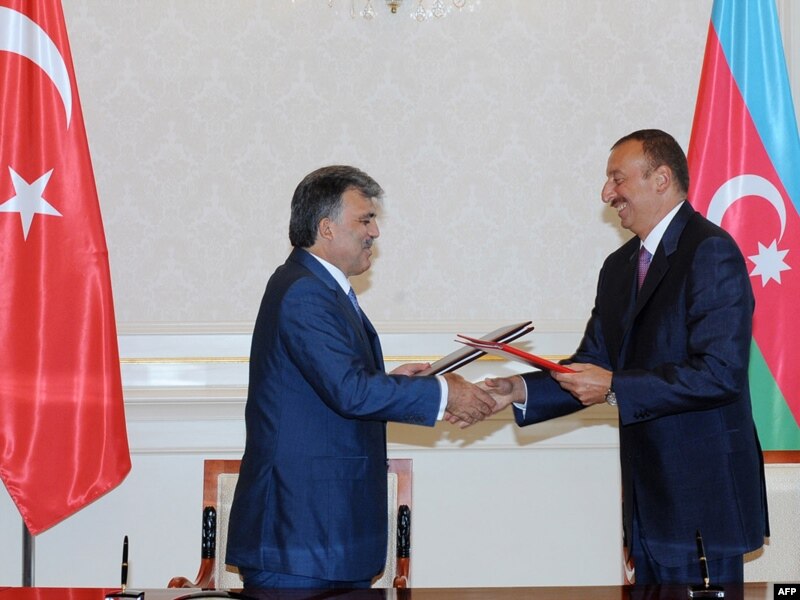
Azerbaijan -- Azerbaijan's President Ilham Aliyev (R) shakes hands with his Turkish counterpart Abdullah Gul (L) during a signing ceremony in Baku, 16Aug2010
16.08.2010
Turkish President Abdullah Gul reaffirmed his country’s unconditional support for Azerbaijan in the Nagorno-Karabakh conflict and criticized international mediators ahead of a state visit to Baku that began on Monday.
The unresolved dispute was reportedly on the agenda of his talks with Azerbaijani President Ilham Aliyev held later in the day. Reports from Baku said the two leaders signed a new Turkish-Azerbaijani agreement on “strategic partnership” and “mutual assistance.” Details of the agreement were not immediately made public. Gul stated both before and after the talks that the Karabakh conflict must be resolved rapidly and on the basis of Azerbaijan’s territorial integrity. In a weekend interview with the Azerbaijani APA news agency, he said Ankara “will do everything necessary” for a Karabakh settlement acceptable to Baku. “The world will not accept continued [Armenian] occupation of our fraternal country,” he said. The Turkish president also took a swipe at U.S., Russian and French mediators co-chairing the OSCE Minsk Group. “We want the Minsk Group to move close to the conflict’s resolution,” he told APA. “But as things stand now, people call visits to the region by Minsk Group representatives ‘tourist trips.’ Therefore, new steps need to be taken.”“In 2008, I came up with such an initiative. At first, I traveled to Yerevan, then honorable [President Serzh] Sarkisian visited Turkey. We informed honorable President Ilham Aliyev about this whole process,” Gul added, referring to the Turkish-Armenian rapprochement that eventually ended in failure. Armenian leaders have said all along that the Karabakh conflict was never on the agenda of Turkish-Armenian fence-mending negotiations. They say the process failed because Ankara subsequently reverted to linking the normalization of Turkish-Armenian with Karabakh peace. Gul appeared to single out Russia’s “important” role in the mediation process. But he also acknowledged, “Such difficult problems can not solved under pressure from of a single country.” Turkish Prime Minister Recep Tayyip Erdogan described Russia as “the most important actor” in the Karabakh peace process and urged it do more to broker an Armenian-Azerbaijani settlement when he visited Moscow in January.However, both President Dmitry Medvedev and Prime Minister Vladimir sidestepped the implicit Turkish calls for a stronger Russian pressure on Armenia during their subsequent visits to Turkey. “We don’t want anyone to think [after the conflict’s resolution] that we pressured one of the parties and achieved a solution to the problem that is unfair to somebody,” Putin said in Ankara in June. Putin also stressed earlier this year that the Turks should drop their Karabakh talks in their talks with
Azerbaijan -- Azerbaijan's President Ilham Aliyev (R) shakes hands with his Turkish counterpart Abdullah Gul (L) during a signing ceremony in Baku, 16Aug2010
16.08.2010
Turkish President Abdullah Gul reaffirmed his country’s unconditional support for Azerbaijan in the Nagorno-Karabakh conflict and criticized international mediators ahead of a state visit to Baku that began on Monday.
The unresolved dispute was reportedly on the agenda of his talks with Azerbaijani President Ilham Aliyev held later in the day. Reports from Baku said the two leaders signed a new Turkish-Azerbaijani agreement on “strategic partnership” and “mutual assistance.” Details of the agreement were not immediately made public. Gul stated both before and after the talks that the Karabakh conflict must be resolved rapidly and on the basis of Azerbaijan’s territorial integrity. In a weekend interview with the Azerbaijani APA news agency, he said Ankara “will do everything necessary” for a Karabakh settlement acceptable to Baku. “The world will not accept continued [Armenian] occupation of our fraternal country,” he said. The Turkish president also took a swipe at U.S., Russian and French mediators co-chairing the OSCE Minsk Group. “We want the Minsk Group to move close to the conflict’s resolution,” he told APA. “But as things stand now, people call visits to the region by Minsk Group representatives ‘tourist trips.’ Therefore, new steps need to be taken.”“In 2008, I came up with such an initiative. At first, I traveled to Yerevan, then honorable [President Serzh] Sarkisian visited Turkey. We informed honorable President Ilham Aliyev about this whole process,” Gul added, referring to the Turkish-Armenian rapprochement that eventually ended in failure. Armenian leaders have said all along that the Karabakh conflict was never on the agenda of Turkish-Armenian fence-mending negotiations. They say the process failed because Ankara subsequently reverted to linking the normalization of Turkish-Armenian with Karabakh peace. Gul appeared to single out Russia’s “important” role in the mediation process. But he also acknowledged, “Such difficult problems can not solved under pressure from of a single country.” Turkish Prime Minister Recep Tayyip Erdogan described Russia as “the most important actor” in the Karabakh peace process and urged it do more to broker an Armenian-Azerbaijani settlement when he visited Moscow in January.However, both President Dmitry Medvedev and Prime Minister Vladimir sidestepped the implicit Turkish calls for a stronger Russian pressure on Armenia during their subsequent visits to Turkey. “We don’t want anyone to think [after the conflict’s resolution] that we pressured one of the parties and achieved a solution to the problem that is unfair to somebody,” Putin said in Ankara in June. Putin also stressed earlier this year that the Turks should drop their Karabakh talks in their talks with
Thursday, August 12, 2010
Bryza has ties to intensifying autocracy in Azerbaijan: Washington Times
Bryza has ties to intensifying autocracy in Azerbaijan: Washington Times
16:10 • 12.08.10
Last month, Washington Times reporter James Morrison wrote an item in his Embassy Row column about the nomination of Matthew Bryza as US ambassador to Azerbaijan. As Mr. Morrison noted, several human rights groups had previously questioned Mr. Bryza's close ties to Azerbaijani leadership, and tough questions about his possible bias again surfaced during his recent confirmation hearing.During the hearings, Mr. Bryza stated: "If confirmed, I will continue to encourage the government of Azerbaijan to move forward on key issues such as media freedom, freedom of expression, political pluralism, rule of law and civic participation." Obviously, these are noble goals often repeated by US ambassadors who are stationed in authoritarian countries, but Mr. Bryza's past in Azerbaijan raises important doubts about his promises.In 2007, the editor of the opposition newspaper Azadlig, Ganimat Zahid, and correspondent Agil Khalil were sued over an article titled "Azerbaijanis Paid for Matthew Bryza's Wedding." The article states that Azeri Economic Development Minister Haydar Babayev paid for a significant portion of Mr. Bryza's wedding, which took place in Istanbul the same year. At the time, Mr. Bryza was the US co-chairman of the Organization for Security and Cooperation in Europe Minsk Group, the body tasked with mediating a peace deal for the Nagorno-Karabakh conflict between Azerbaijan and Armenia. Both countries claim sovereignty over the region, and although a cease-fire has been observed since 1994, no agreement has ever been signed between the two governments.In the year after the article was published, Azadlig correspondent Agil Khalil was the target of four murder attempts, and in July 2008 - no longer able to deal with the constant threats against him - he fled to France, where he remains to this day. Mr. Khalil cannot return to Azerbaijan because he fears for his life.There is no doubt that Mr. Bryza's experience in the region could be valuable for improving relations between the United States and Azerbaijan, but we think that because he has been involved in a complaint and suit against a newspaper, his credibility within Azerbaijani civil society and his stated commitment to press freedom can easily be questioned.Moreover, Mr. Bryza was very much criticized and questioned about his position on the Nagorno-Karabakh conflict, an extremely sensitive and taboo subject in Azerbaijan. Reporter and editor Eynulla Fatullayev remains in jail for writing about the subject in a way that displeased Azerbaijani officials. A respected journalist recognized as a political prisoner by the international community, Mr. Fatullayev was the editor of two newspapers that since have been closed down, the weekly Realny Azerbaijan and the daily Gundelik Azerbaijan. Arrested in 2007, he was convicted the following year on charges of "insulting the honor and dignity of the Azerbaijani people," refusing to pay taxes and making "terrorist threats." The last charge resulted from an article that accused the Azerbaijani armed forces of sharing responsibility with their Armenian counterparts for the deaths of hundreds of civilians during an attack by Armenian troops in 1992 on the village of Khojali in the Nagorno-Karabakh region.Re-elected in October 2008 with 89 percent of the vote, Azerbaijani President Ilham Aliyev reinforced his control of the country's destiny even more in 2009 by abolishing any limit on the number of terms he can serve. The latest development of note has been the adoption of amendments to the press law imposing additional curbs on journalists, including draconian limitations on the ability to take photos. The first sign a country is reforming its policy in a democratic way is to let journalists do their job properly, as a sign of transparency.As Mr. Aliyev continues to crack down on the press and freedom of speech, a nominee who can easily be identified as a strong supporter of the Azerbaijani government might indeed undermine the U.S. government's stated goal of improving democracy and human rights in the country.If Bryza's appointmentment is confirmed, let us be honest enough to say that it is not one of the priorities of President Obama's administration to improve media freedom or the right to freedom of expression in the country. Apparently, the administration prefers to focus on US energy investments. But without journalists properly doing their job, the United States will never know what their investments are used for.The Washington Times
Tert.am
16:10 • 12.08.10
Last month, Washington Times reporter James Morrison wrote an item in his Embassy Row column about the nomination of Matthew Bryza as US ambassador to Azerbaijan. As Mr. Morrison noted, several human rights groups had previously questioned Mr. Bryza's close ties to Azerbaijani leadership, and tough questions about his possible bias again surfaced during his recent confirmation hearing.During the hearings, Mr. Bryza stated: "If confirmed, I will continue to encourage the government of Azerbaijan to move forward on key issues such as media freedom, freedom of expression, political pluralism, rule of law and civic participation." Obviously, these are noble goals often repeated by US ambassadors who are stationed in authoritarian countries, but Mr. Bryza's past in Azerbaijan raises important doubts about his promises.In 2007, the editor of the opposition newspaper Azadlig, Ganimat Zahid, and correspondent Agil Khalil were sued over an article titled "Azerbaijanis Paid for Matthew Bryza's Wedding." The article states that Azeri Economic Development Minister Haydar Babayev paid for a significant portion of Mr. Bryza's wedding, which took place in Istanbul the same year. At the time, Mr. Bryza was the US co-chairman of the Organization for Security and Cooperation in Europe Minsk Group, the body tasked with mediating a peace deal for the Nagorno-Karabakh conflict between Azerbaijan and Armenia. Both countries claim sovereignty over the region, and although a cease-fire has been observed since 1994, no agreement has ever been signed between the two governments.In the year after the article was published, Azadlig correspondent Agil Khalil was the target of four murder attempts, and in July 2008 - no longer able to deal with the constant threats against him - he fled to France, where he remains to this day. Mr. Khalil cannot return to Azerbaijan because he fears for his life.There is no doubt that Mr. Bryza's experience in the region could be valuable for improving relations between the United States and Azerbaijan, but we think that because he has been involved in a complaint and suit against a newspaper, his credibility within Azerbaijani civil society and his stated commitment to press freedom can easily be questioned.Moreover, Mr. Bryza was very much criticized and questioned about his position on the Nagorno-Karabakh conflict, an extremely sensitive and taboo subject in Azerbaijan. Reporter and editor Eynulla Fatullayev remains in jail for writing about the subject in a way that displeased Azerbaijani officials. A respected journalist recognized as a political prisoner by the international community, Mr. Fatullayev was the editor of two newspapers that since have been closed down, the weekly Realny Azerbaijan and the daily Gundelik Azerbaijan. Arrested in 2007, he was convicted the following year on charges of "insulting the honor and dignity of the Azerbaijani people," refusing to pay taxes and making "terrorist threats." The last charge resulted from an article that accused the Azerbaijani armed forces of sharing responsibility with their Armenian counterparts for the deaths of hundreds of civilians during an attack by Armenian troops in 1992 on the village of Khojali in the Nagorno-Karabakh region.Re-elected in October 2008 with 89 percent of the vote, Azerbaijani President Ilham Aliyev reinforced his control of the country's destiny even more in 2009 by abolishing any limit on the number of terms he can serve. The latest development of note has been the adoption of amendments to the press law imposing additional curbs on journalists, including draconian limitations on the ability to take photos. The first sign a country is reforming its policy in a democratic way is to let journalists do their job properly, as a sign of transparency.As Mr. Aliyev continues to crack down on the press and freedom of speech, a nominee who can easily be identified as a strong supporter of the Azerbaijani government might indeed undermine the U.S. government's stated goal of improving democracy and human rights in the country.If Bryza's appointmentment is confirmed, let us be honest enough to say that it is not one of the priorities of President Obama's administration to improve media freedom or the right to freedom of expression in the country. Apparently, the administration prefers to focus on US energy investments. But without journalists properly doing their job, the United States will never know what their investments are used for.The Washington Times
Tert.am
Turkey trembles, Armenians triumph
Turkey trembles, Armenians triumphAugust 12, 2010 11:14
The lawsuit filed by two American-Armenians Garbis Davouyan and Hrayr Turabian against the Turkish government and two major Turkish banks caused serious concern in Turkey.
According to the Hurriyet daily, Turkey is getting ready to a trial with help of “three waves” program. They are discussing the issue from the viewpoint of international law, specifying whether Turkey has a possibility not to accept the lawsuit. The Turkish side is also studying what possibilities U.S. law provides in case compensation is demanded. The international agreements on the issue are being studied as well. For instance, under the Treaty of Kars signed in 1921, the sides (one of the sides was Soviet Armenia) agreed that they bear no animosity towards each other.
The Treaty of Lausanne enabled Armenians to return to Turkey within 2 years. In 1934-1937 Turkey agreed to pay U.S. $1.8 m for each Armenian – U.S. citizen.
In his turn, Mark Geragos, one of the lawyers, noted that he will submit new documents within 180 days. He did not specify the amount of compensation, adding that the point is billions of dollars.
The lawsuit filed by two American-Armenians Garbis Davouyan and Hrayr Turabian against the Turkish government and two major Turkish banks caused serious concern in Turkey.
According to the Hurriyet daily, Turkey is getting ready to a trial with help of “three waves” program. They are discussing the issue from the viewpoint of international law, specifying whether Turkey has a possibility not to accept the lawsuit. The Turkish side is also studying what possibilities U.S. law provides in case compensation is demanded. The international agreements on the issue are being studied as well. For instance, under the Treaty of Kars signed in 1921, the sides (one of the sides was Soviet Armenia) agreed that they bear no animosity towards each other.
The Treaty of Lausanne enabled Armenians to return to Turkey within 2 years. In 1934-1937 Turkey agreed to pay U.S. $1.8 m for each Armenian – U.S. citizen.
In his turn, Mark Geragos, one of the lawyers, noted that he will submit new documents within 180 days. He did not specify the amount of compensation, adding that the point is billions of dollars.
Wednesday, August 11, 2010
At 90, Sevres Treaty is Most Relevant Today
At 90, Sevres Treaty is Most Relevant Today
Signing of the Turkish Treaty with the Allies
On August 10, 1920, the Treaty of Sevres was signed between the Ottoman Empire and the Allied Powers after World War I. A significant provision of the document was the inclusion of the Wilsonian Mandate for Armenia, which envisioned a Republic of Armenia that included much of its historic territory.
The relevance of this internationally binding document became even more apparent during last year’s sloppy efforts by Armenia and Turkey to enter into a normalization process without regard for history. The reader is all too familiar with the outcome of the so-called protocols process, but the danger of reverting back to that failed approach still remains as neither party is willing to nullify the documents, which served as the basis for normalization.
Much of the discussion of the protocols debacle centered on Turkey’s preconditions for a quick resolution to the Karabakh conflict, in favor of Azerbaijan and the formation of a commission that would discuss the Armenian Genocide. But a more disturbing point of contention in the protocols documents was the absence of an acknowledgement of the Sevres Treaty, which, for all intents and purposes, laid a concise groundwork for that region of the world and provided comprehensive legal mandates for parties involved.
Due to political realities, the pursuit of the Armenian Cause has evolved into the vocal advocacy for the international recognition of the Armenian Genocide. In recent years that movement has achieved momentum due in great part to the perseverance and commitment of Armenians throughout the world who have pressured their respective governments for recognition.
However, the Armenian Cause is multi-faceted in nature and encompasses an equally critical component, which includes restitution and reparations for the crime of Genocide. The Sevres Treaty ensures not only provides a basis for the pursuit of the above elements, but also clearly draws a map, which makes Armenians’ territorial claims legally binding and valid in the eyes of the international community.
Many times inadvertently we fall into the position of justifying our demands, where historically no justification is needed since the facts speak for themselves. The Armenian Genocide is an indisputable fact, as is the need for reparations for that crime. World leaders at the time were more cognizant of that than those who followed them since history has shown that complicity in denial has proven to be more expedient politically and economically.
As we mark the 90th anniversary of this landmark document, all efforts should be directed to how effectively the Sevres Treaty can be implemented today from an international legal perspective and how each of the signatories can be pressured into accepting the mandates outlined within that document.
Futile arguments might ensue from naysayers who claim that subsequent efforts and treatises have shaped today’s reality and reversed the provision of the Sevres Treaty. It is time for national political forces to revitalize the relevance of the treaty. At the same time, the Armenian government must include the appropriate provisions of the Sevres Treaty within the context of any future talks with Turkey.
Signing of the Turkish Treaty with the Allies
On August 10, 1920, the Treaty of Sevres was signed between the Ottoman Empire and the Allied Powers after World War I. A significant provision of the document was the inclusion of the Wilsonian Mandate for Armenia, which envisioned a Republic of Armenia that included much of its historic territory.
The relevance of this internationally binding document became even more apparent during last year’s sloppy efforts by Armenia and Turkey to enter into a normalization process without regard for history. The reader is all too familiar with the outcome of the so-called protocols process, but the danger of reverting back to that failed approach still remains as neither party is willing to nullify the documents, which served as the basis for normalization.
Much of the discussion of the protocols debacle centered on Turkey’s preconditions for a quick resolution to the Karabakh conflict, in favor of Azerbaijan and the formation of a commission that would discuss the Armenian Genocide. But a more disturbing point of contention in the protocols documents was the absence of an acknowledgement of the Sevres Treaty, which, for all intents and purposes, laid a concise groundwork for that region of the world and provided comprehensive legal mandates for parties involved.
Due to political realities, the pursuit of the Armenian Cause has evolved into the vocal advocacy for the international recognition of the Armenian Genocide. In recent years that movement has achieved momentum due in great part to the perseverance and commitment of Armenians throughout the world who have pressured their respective governments for recognition.
However, the Armenian Cause is multi-faceted in nature and encompasses an equally critical component, which includes restitution and reparations for the crime of Genocide. The Sevres Treaty ensures not only provides a basis for the pursuit of the above elements, but also clearly draws a map, which makes Armenians’ territorial claims legally binding and valid in the eyes of the international community.
Many times inadvertently we fall into the position of justifying our demands, where historically no justification is needed since the facts speak for themselves. The Armenian Genocide is an indisputable fact, as is the need for reparations for that crime. World leaders at the time were more cognizant of that than those who followed them since history has shown that complicity in denial has proven to be more expedient politically and economically.
As we mark the 90th anniversary of this landmark document, all efforts should be directed to how effectively the Sevres Treaty can be implemented today from an international legal perspective and how each of the signatories can be pressured into accepting the mandates outlined within that document.
Futile arguments might ensue from naysayers who claim that subsequent efforts and treatises have shaped today’s reality and reversed the provision of the Sevres Treaty. It is time for national political forces to revitalize the relevance of the treaty. At the same time, the Armenian government must include the appropriate provisions of the Sevres Treaty within the context of any future talks with Turkey.
Subscribe to:
Posts (Atom)