Turkish leaders came up with a new ploy last week to impress world public opinion with fake magnanimity toward the country’s long-oppressed minorities.
Prime Minister Erdogan signed a decree last Saturday that supposedly will return hundreds of buildings that belonged to Christian and Jewish community foundations or charitable trusts. There are currently 162 such trusts (vakfs) registered in the Republic of Turkey.
Back in 1936, the Turkish government demanded that all non-Muslim foundations declare their property holdings. In 1974, Turkish courts illegally stripped these foundations from all properties acquired after 1936, and even some that belonged to them before that date. Last week’s decree requested the foundations to submit to the government within the next 12 months the list of properties confiscated from them — now worth billions of dollars — including schools, hospitals, orphanages, and cemeteries. If and when parliament adopts this decree, the Turkish government is pledging to either return the seized properties or pay compensation for those sold to third parties. It is important to note that this decree does not cover the hundreds of thousands of private properties that were confiscated by the Turkish authorities from Armenians and other minorities during and after World War I.
Before anyone starts thanking the Turkish leadership for its “kindness” or “fair mindedness” toward its non-Muslim citizens, one needs to scrutinize Ankara’s motives and anticipate its possible next steps.
Although Erdogan’s ruling party has more than sufficient votes in parliament to pass the proposed measure, no one should be surprised if this “generous” offer is considerably watered down in terms of the number and types of properties it covers and their current value, conveniently blaming these restrictions on the opposition parties. Erdogan’s previous promises to return confiscated properties to minority foundations were mired in bureaucratic red tape, causing lengthy delays and failure to honor almost all requests.
Most probably Turkish officials decided to issue this decree after losing several major property claims filed by Armenian and Greek foundations in the European Court of Human Rights. Clearly, Turkey can ill afford to lose hundreds of similar lawsuits. Adnan Ertem, head of Turkey’s administration of charitable trusts, told Sabah newspaper that by dealing internally with non-Muslim foundations, the government would be able to avoid paying much larger sums, including damages and court costs, should it lose the lawsuits filed in the European Court. Ertem claimed that there are 370 confiscated properties that should be returned to minority foundations.
More important than saving money, Turkey would spare itself the embarrassment of losing hundreds of court cases that would tarnish its reputation in the eyes of the world, particularly at a time when it is trying to join the European Union. In addition, Turkey has already scored a major propaganda coup by merely promising to return these properties. The international media has published glowing news reports of this “magnanimous” Turkish gesture, before a single piece of property has been returned to the minorities. No one should be surprised if Turkey uses this new decree as a propaganda tool to counter recent U.S. Congressional demands for the return of church properties to their rightful owners.
Likewise, no one should be surprised if Turkish leaders brazenly demand that the Armenian, Greek, and Israeli governments reciprocate with a gesture of their own toward Turkey. Turkish officials should be reminded that by returning the confiscated properties they are not doing a favor to the religious minorities. Such misplaced gratitude would be akin to a robbery victim thanking a thief who for selfish reasons decides to return a small portion of what he has stolen.
Even though the Turkish media has prematurely characterized the Erdogan decree as “historic” and “revolutionary,” in practice, it is less enforceable than the Turkish government’s obligations under the Treaty of Lausanne, which provides the country’s Armenian, Greek, and Jewish minorities much greater protection under international law. While domestic laws can be amended at any time, Turkey’s international treaty obligations cannot be restricted by governmental decree. Fearing for their own safety, none of the non-Muslim communities have dared to file a complaint with the United Nations or international courts, despite the fact that successive Turkish governments have violated the provisions of the Lausanne Treaty since its ratification in 1923.
My advice to Turkey’s minorities would be not to withdraw their lawsuits from the European Court of Human Rights until they recover their confiscated properties or receive appropriate financial restitution.
Thursday, September 1, 2011

Special Report: What is Turkey Returning to Armenians?
Special Report: What is Turkey Returning to Armenians?
Armenian Weekly)–The Turkish government recently announced that real estate assets confiscated by the State, which once belonged to Armenian, Greek, and Jewish charitable foundations, would be returned to the rightful owners, and that the government would pay compensation for any confiscated property that has since been sold to third parties. This is definitely a long overdue positive step in the right direction by the Turkish government, when compared with decades long injustice and discrimination of the past Turkish governments against its non-Muslim citizens. While this decree was hailed by the EU, Turkish media as well as the minority charitable foundations in Turkey, it was met by the Armenian Diaspora as an insufficient gesture at best, a cynical political trick at worst. Perhaps the following facts can help put the issue in context.
Selamet Han
In 1936, the Turkish government required the non-Muslim minority charitable foundations to submit a list of all their real estate assets to the state, which they did. In 1974, during the height of the Cyprus crisis and with inflamed hatred toward the Greeks, the Turkish government installed by the 1971 coup d’etat decreed that any assets not shown on the 1936 lists, that is, properties deeded to the charitable foundations after 1936, are illegally obtained and therefore, must be seized by the Turkish state. Some 1,410 properties willed or gifted to the non-Muslim charitable organizations from 1936 to 1974, were confiscated by the State, thus suddenly depriving the foundations from their beneficial uses and revenues. These assets included apartment, school and office buildings, houses, shops and vacant land, mostly in or near Istanbul, where most of the remaining non-Muslim minority citizens in Turkey lived. The present government decree pledges to return 162 of the 1,410 assets confiscated in 1974. Over the past several years, the charitable foundations had tried through Turkish legal channels to get back these assets but to no avail. They had recently applied to the European Court of Human Rights, which had already ruled against the Turkish state on a number of cases.
Below is a partial list of the Armenian charitable foundation assets to be returned by the government:
1. Gedikpasha Armenian Protestant primary school – the building is already demolished, at present used as a park
2. Gedikpasha Armenian Protestant Church – one apartment building in Kumkapi, a restaurant, a playground
3. Surp Harutyun Armenian Church – several flats in Beyoglu
4. Ferikoy Surp Vartanants Church – an apartment building and a vacant lot in Sisli
5. Kurucheshme Surp Khatch Yerevman Church – one building in Arnavutkoy
6. Kumkapi Surp Harutyun School – a store in Kumkapi and a store in Kadikoy
7. Kumkapi Mayr Asdvadzadzin Church – a flat in Eminonu
8. Yenikoy Surp Asdvadzadzin Church – a vacant lot in Istinye
9. Bomonti Mkhitaryan Armenian Catholic School – school buildings, two shops and a flat in Sisli
10. Yedikule Surp Prgitch (Holy Saviour) Armenian Hospital – a total of 19 properties, including one building lot, a house and four shared lots in Sariyer, a residential building in Moda, 2 residential buildings in Sisli, one flat in Beyoglu, one store in Kapalicarsi Covered Bazaar, a house in Uskudar, one apartment building, one flat and a warehouse in Kurtulus, a four storey hotel in Taksim, a retail and office commercial building in Beyoglu, a flat in Chamlica, a 47,500 sq. m. vacant lot in Beykoz, and a 44,000 sq. m. land adjacent to the Hospital, formerly the gardens of the Hospital, presently used as Zeytinburnu Soccer Stadium, a sports building, a parking lot and a tea garden, and last but not least, the valuable office building called Selamet Han in Eminonu, Istanbul.
It is noteworthy to emphasize the significance of the Selamet Han office building, which was donated in 1953 by well known businessman and oil magnate Caloust Gulbenkian. The impressive six storey art nouveau style building was built in early 20. century by Armenian architect Hovsep Aznavour, builder of many of the Istanbul landmarks in the Pera/Beyoglu district. The Selamet Han building, confiscated by the state in 1974, fell into disrepair and is now in a dilapidated condition. The Surp Prgitch Foundation has announced that as soon as the building is given back, it intends to restore it and put into use as a boutique hotel, to generate much needed revenues for the hospital operations.
The recent government decree at last and at least partially addresses the injustices of the 1974 confiscations, by pledging to return about ten percent of the 1,410 properties, mostly in Istanbul. However, there is a massive list of properties and assets belonging to the thousands of Armenian churches, monasteries and schools in Anatolia, lost after 1915. One example to illustrate the enormity of this issue is the case of the Surp Giragos Armenian Church in Diyarbakir, which by itself had owned more than 200 properties in central Diyarbakir prior to 1915. Another interesting example is the Sanasaryan High School in Erzurum. This school, which provided education of such high caliber that it even surpassed the Istanbul Armenian schools in the late 19. century, was closed down in 1915. It is still a little known fact in Turkey that Mustafa Kemal Ataturk, when drumming up support and organizing the resistance to the Allied occupation of Anatolia, convened the famous Erzurum Congress in this Armenian school in July-August 1919. The Sanasaryan School Foundation, had built and owned one of the largest office buildings in Istanbul in the late 19th Century, in order to support the Sanasaryan School in Erzurum. It is also a little known fact that the famous Sanasaryan Han Office Building in Istanbul was seized first by the Ottoman and then the Turkish Republic governments and converted into the General Security and Police Headquarters of Istanbul. This building became notorious for the imprisonment, torture and murder of hundreds of intelligentsia during the military government regimes in the 1970’s and 1980’s.
One last glaring example involves the lands belonging to the Surp Agop Armenian Cemetery, which were confiscated in the 1930s by the Istanbul municipal government. These lands were deeded in the 16. Century by the Ottoman Emperor Sultan Suleiman the Magnificent to the Armenian people for cemetery uses, as a reward to his personal cook Manuk Karaseferyan of Van, who saved the Sultan from a poisoning plot against him by the Germans and Hungarians after the campaign to take Budapest. The Armenian cemetery was in use for nearly four centuries from 1560s to 1930s. As these vast lands lie adjacent to the most popular road in the centre of the city, they were deemed most valuable by the Istanbul government and expropriated from the Armenian Surp Agop Foundation without any compensation, despite years of legal struggles. At present, these lands are occupied by the State Radio and Television Headquarters, The Turkish Armed Forces Istanbul Headquarters, the Military Museum, many fashionable hotels such as Hilton, Regency Hyatt, Divan, several apartment and office buildings, as well as the expansive Taksim Park, which has walkways made from marble of the Armenian tombstones.
The decree by the present government may seem insufficient or insignificant, but everything is relative, and this is an enormous first step of a long journey in the right direction when compared with past Turkish government policies. This journey requires mutual empathy, cooperation, encouragement and, above all, the uncovering of all hidden historic facts on the path to the creation of a common body of knowledge.
Armenian Weekly)–The Turkish government recently announced that real estate assets confiscated by the State, which once belonged to Armenian, Greek, and Jewish charitable foundations, would be returned to the rightful owners, and that the government would pay compensation for any confiscated property that has since been sold to third parties. This is definitely a long overdue positive step in the right direction by the Turkish government, when compared with decades long injustice and discrimination of the past Turkish governments against its non-Muslim citizens. While this decree was hailed by the EU, Turkish media as well as the minority charitable foundations in Turkey, it was met by the Armenian Diaspora as an insufficient gesture at best, a cynical political trick at worst. Perhaps the following facts can help put the issue in context.
Selamet Han
In 1936, the Turkish government required the non-Muslim minority charitable foundations to submit a list of all their real estate assets to the state, which they did. In 1974, during the height of the Cyprus crisis and with inflamed hatred toward the Greeks, the Turkish government installed by the 1971 coup d’etat decreed that any assets not shown on the 1936 lists, that is, properties deeded to the charitable foundations after 1936, are illegally obtained and therefore, must be seized by the Turkish state. Some 1,410 properties willed or gifted to the non-Muslim charitable organizations from 1936 to 1974, were confiscated by the State, thus suddenly depriving the foundations from their beneficial uses and revenues. These assets included apartment, school and office buildings, houses, shops and vacant land, mostly in or near Istanbul, where most of the remaining non-Muslim minority citizens in Turkey lived. The present government decree pledges to return 162 of the 1,410 assets confiscated in 1974. Over the past several years, the charitable foundations had tried through Turkish legal channels to get back these assets but to no avail. They had recently applied to the European Court of Human Rights, which had already ruled against the Turkish state on a number of cases.
Below is a partial list of the Armenian charitable foundation assets to be returned by the government:
1. Gedikpasha Armenian Protestant primary school – the building is already demolished, at present used as a park
2. Gedikpasha Armenian Protestant Church – one apartment building in Kumkapi, a restaurant, a playground
3. Surp Harutyun Armenian Church – several flats in Beyoglu
4. Ferikoy Surp Vartanants Church – an apartment building and a vacant lot in Sisli
5. Kurucheshme Surp Khatch Yerevman Church – one building in Arnavutkoy
6. Kumkapi Surp Harutyun School – a store in Kumkapi and a store in Kadikoy
7. Kumkapi Mayr Asdvadzadzin Church – a flat in Eminonu
8. Yenikoy Surp Asdvadzadzin Church – a vacant lot in Istinye
9. Bomonti Mkhitaryan Armenian Catholic School – school buildings, two shops and a flat in Sisli
10. Yedikule Surp Prgitch (Holy Saviour) Armenian Hospital – a total of 19 properties, including one building lot, a house and four shared lots in Sariyer, a residential building in Moda, 2 residential buildings in Sisli, one flat in Beyoglu, one store in Kapalicarsi Covered Bazaar, a house in Uskudar, one apartment building, one flat and a warehouse in Kurtulus, a four storey hotel in Taksim, a retail and office commercial building in Beyoglu, a flat in Chamlica, a 47,500 sq. m. vacant lot in Beykoz, and a 44,000 sq. m. land adjacent to the Hospital, formerly the gardens of the Hospital, presently used as Zeytinburnu Soccer Stadium, a sports building, a parking lot and a tea garden, and last but not least, the valuable office building called Selamet Han in Eminonu, Istanbul.
It is noteworthy to emphasize the significance of the Selamet Han office building, which was donated in 1953 by well known businessman and oil magnate Caloust Gulbenkian. The impressive six storey art nouveau style building was built in early 20. century by Armenian architect Hovsep Aznavour, builder of many of the Istanbul landmarks in the Pera/Beyoglu district. The Selamet Han building, confiscated by the state in 1974, fell into disrepair and is now in a dilapidated condition. The Surp Prgitch Foundation has announced that as soon as the building is given back, it intends to restore it and put into use as a boutique hotel, to generate much needed revenues for the hospital operations.
The recent government decree at last and at least partially addresses the injustices of the 1974 confiscations, by pledging to return about ten percent of the 1,410 properties, mostly in Istanbul. However, there is a massive list of properties and assets belonging to the thousands of Armenian churches, monasteries and schools in Anatolia, lost after 1915. One example to illustrate the enormity of this issue is the case of the Surp Giragos Armenian Church in Diyarbakir, which by itself had owned more than 200 properties in central Diyarbakir prior to 1915. Another interesting example is the Sanasaryan High School in Erzurum. This school, which provided education of such high caliber that it even surpassed the Istanbul Armenian schools in the late 19. century, was closed down in 1915. It is still a little known fact in Turkey that Mustafa Kemal Ataturk, when drumming up support and organizing the resistance to the Allied occupation of Anatolia, convened the famous Erzurum Congress in this Armenian school in July-August 1919. The Sanasaryan School Foundation, had built and owned one of the largest office buildings in Istanbul in the late 19th Century, in order to support the Sanasaryan School in Erzurum. It is also a little known fact that the famous Sanasaryan Han Office Building in Istanbul was seized first by the Ottoman and then the Turkish Republic governments and converted into the General Security and Police Headquarters of Istanbul. This building became notorious for the imprisonment, torture and murder of hundreds of intelligentsia during the military government regimes in the 1970’s and 1980’s.
One last glaring example involves the lands belonging to the Surp Agop Armenian Cemetery, which were confiscated in the 1930s by the Istanbul municipal government. These lands were deeded in the 16. Century by the Ottoman Emperor Sultan Suleiman the Magnificent to the Armenian people for cemetery uses, as a reward to his personal cook Manuk Karaseferyan of Van, who saved the Sultan from a poisoning plot against him by the Germans and Hungarians after the campaign to take Budapest. The Armenian cemetery was in use for nearly four centuries from 1560s to 1930s. As these vast lands lie adjacent to the most popular road in the centre of the city, they were deemed most valuable by the Istanbul government and expropriated from the Armenian Surp Agop Foundation without any compensation, despite years of legal struggles. At present, these lands are occupied by the State Radio and Television Headquarters, The Turkish Armed Forces Istanbul Headquarters, the Military Museum, many fashionable hotels such as Hilton, Regency Hyatt, Divan, several apartment and office buildings, as well as the expansive Taksim Park, which has walkways made from marble of the Armenian tombstones.
The decree by the present government may seem insufficient or insignificant, but everything is relative, and this is an enormous first step of a long journey in the right direction when compared with past Turkish government policies. This journey requires mutual empathy, cooperation, encouragement and, above all, the uncovering of all hidden historic facts on the path to the creation of a common body of knowledge.
Turkey to Return Properties Confiscated from Christian, Jewish Minorities
Turkey Decrees Partial Return of Confiscated Christian, Jewish Property (Update)
Hachikian: Erdogan’s decree would return less than one percent of the churches and church properties confiscated during the Armenian Genocide and the decades that followed it.
ANKARA, Turkey—Turkey’s government is returning hundreds of properties confiscated from the country’s Christian and Jewish minorities over the past 75 years in a gesture to religious groups over complaints of discrimination, and in a move likely to thwart possible court rulings against the country, reported the Associated Press (AP).
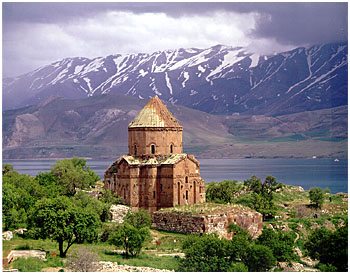
The Akhtamar Church
A government decree published on Aug. 27 returns assets that once belonged to Greek, Armenian, or Jewish trusts and makes provisions for the government to pay compensation for any confiscated property that has since been sold on.
Turkish Prime Minister Recep Tayyip Erdogan announced the decision formally on Aug. 28 when he hosted religious leaders and the heads of about 160 minority trusts, at a fast-breaking dinner for the holy Muslim month of Ramadan.
The properties include former hospital, orphanage or school buildings and cemeteries. Their return is a key European Union demand. A series of court cases has also been filed against primarily Muslim Turkey at the European Court of Human Rights. Last year, the court ordered Turkey to return an orphanage to the Greek Orthodox Patriarchate.
Some properties were seized when they fell into disuse over the years. Others were confiscated after 1974 when Turkey ruled that non-Muslim trusts could not own new property in addition to those that were already registered in their names in 1936. The 1974 decision came around the time of a Turkish invasion of Cyprus that followed a coup attempt by supporters of a union with Greece, when relations with that country were at an all time low.
Erdogan’s Islamic-rooted government, seeking to promote religious freedoms, has pledged to address the problems of the religious minorities. Over the past few years, it has amended laws to allow for the return of some of the properties, but restrictions remained and the issue of properties sold to third parties was left unsolved.
The decree overcomes those restrictions and helps scupper further court rulings.
“There was huge pressure from the European Court of Human Rights, which has already ruled against Turkey,” said Orhan Kemal Cengiz, a human rights activist and lawyer who specializes in minority issues. “It is nevertheless a very important development. With the return of properties and the compensations, the minority communities will be able to strengthen economically and their lives will be made easier.”
The country’s population of 74 million, mostly Muslim, includes an estimated 65,000 Armenian Orthodox Christians, 23,000 Jews, and fewer than 2,500 Greek Orthodox Christians.
Religious minorities have often complained of discrimination in Turkey, which had a history of conflict with Greece and with Armenians who accuse Turkish authorities of trying to exterminate them early in the last century. Turkey says the mass killings at that time were the result of the chaos of war, rather than a systematic campaign of genocide. Few minority members have been able to hold top positions in politics, the military, or the public service.
Turkey is also under intense pressure to reopen a seminary that trained generations of Greek Orthodox patriarchs. The Halki Theological School on Heybeliada Island, near Istanbul, was closed to new students in 1971 under a law that put religious and military training under state control. The school closed its doors in 1985, when the last five students graduated.
Pressure from the U.S.
As the Armenian Weekly has reported in recent months, there were more than 2,000 Armenian churches operating in what is today Turkey before the Armenian Genocide of 1915. Most of the churches were destroyed and their properties confiscated. The aforementioned decree does not include these church properties. It is only limited to properties confiscated over the past 75 years. Moreover, not only about ten percent properties confiscated after 1936 are being returned. (Read Armenian Weekly editorial on this issue here.)
“Erdogan’s decree, clearly prompted by increased Congressional scrutiny of Turkey’s repression of its Christian minority and successive losses at the European Court of Human Rights, would return less than one percent of the churches and church properties confiscated during the Armenian Genocide and the decades that followed it,” said ANCA Chairman Ken Hachikian. “Ninety-six years after the genocide perpetrated against the Armenians, Greeks, and Syriacs, this decree is a smokescreen to evade the much broader consequences of those brutal acts. The ANCA will expand its outreach to Congress and the [Obama] Administration to ensure that the Turkish government comes to terms with its brutal past, respects the religious freedom of surviving Christian communities, and returns the fruits of its crime.”
Last month, with a vote of 43-1, the House Foreign Affairs Committee adopted an amendment to the State Department Authorization bill, spearheaded by Ranking Democrat Howard Berman (D-Calif.) and Rep. David Cicilline (D-R.I.), calling for the return of Christian churches confiscated by the Turkish government and an end to Turkey’s discrimination against its Christian communities. ANCA Executive Director Aram Hamparian welcomed that decision, stating, “The Turkish government has destroyed or confiscated the vast majority of their holy sites and places of worship. The Foreign Affairs Committee today sent a powerful message to Turkey that it must come to terms with this brutal legacy, respect religious freedom of surviving Christian communities, and return the fruits of its crimes.” The passage of the resolution was also hailed by Greek and Syriac American organizations, including the American Hellenic Educational and Public Affairs Association (AHEPA), American Hellenic Institute (AHI), American Hellenic Council (AHC), and the Syriac Universal Alliance, among many others.
The amendment is similar to a resolution (H.Res.306), introduced in June by Representatives Ed Royce (R-Calif.) and Howard Berman (D-Calif.), which has over 35 co-sponsors.
Turkey’s treatment of its Christian minority has also emerged as an issue of contention in the Senate Foreign Relations Committee’s consideration of U.S. ambassador to Turkey nominee Francis Ricciardone. In response to questions submitted by Sen. Robert Menendez (D-N.J.), Ricciardone erroneously asserted that a majority of Christian churches functioning in 1915 continue to operate as churches today. A revised response recently submitted to the key Senate panel continued to misrepresent the number of functioning churches. In response, Armenian American church leaders issued powerfully worded spiritual messages. In an Aug. 15 statement, Archbishop Oshagan Choloyan, Prelate of the Armenian Apostolic Church of Eastern U.S., stressed that the ambassador’s initial assertion was “so blatantly false that it cannot remain unchallenged.” He went on to explain that “the facts are quite clear. From the massacres of Armenians in 1895-96 and the Armenian Genocide in 1915, to the decades following the establishment of the Turkish republic, Christian houses of worship were systematically destroyed or confiscated. My own church’s hierarchal see, the Armenian Catholicosate of Cilicia, was a victim of this process, and today is exiled in Lebanon. The archives of the Catholicosate contain hundreds of original deeds and other documentation of churches and church owned property that was confiscated.”
The Primate of the Armenian Apostolic Church of Eastern U.S., Archbishop Khajag Barsamian, stated that Ricciardone’s response had “deeply offended Armenian Americans,” explaining that “the loss of these many hundreds of churches, their neglect, and outright destruction, and the conversion of many of our sanctuaries into mosques, is a matter of intense pain to Armenians: an ongoing reminder of the loss of life and the destruction that we suffered as a result of the 1915 genocide.”
Hachikian: Erdogan’s decree would return less than one percent of the churches and church properties confiscated during the Armenian Genocide and the decades that followed it.
ANKARA, Turkey—Turkey’s government is returning hundreds of properties confiscated from the country’s Christian and Jewish minorities over the past 75 years in a gesture to religious groups over complaints of discrimination, and in a move likely to thwart possible court rulings against the country, reported the Associated Press (AP).
The Akhtamar Church
A government decree published on Aug. 27 returns assets that once belonged to Greek, Armenian, or Jewish trusts and makes provisions for the government to pay compensation for any confiscated property that has since been sold on.
Turkish Prime Minister Recep Tayyip Erdogan announced the decision formally on Aug. 28 when he hosted religious leaders and the heads of about 160 minority trusts, at a fast-breaking dinner for the holy Muslim month of Ramadan.
The properties include former hospital, orphanage or school buildings and cemeteries. Their return is a key European Union demand. A series of court cases has also been filed against primarily Muslim Turkey at the European Court of Human Rights. Last year, the court ordered Turkey to return an orphanage to the Greek Orthodox Patriarchate.
Some properties were seized when they fell into disuse over the years. Others were confiscated after 1974 when Turkey ruled that non-Muslim trusts could not own new property in addition to those that were already registered in their names in 1936. The 1974 decision came around the time of a Turkish invasion of Cyprus that followed a coup attempt by supporters of a union with Greece, when relations with that country were at an all time low.
Erdogan’s Islamic-rooted government, seeking to promote religious freedoms, has pledged to address the problems of the religious minorities. Over the past few years, it has amended laws to allow for the return of some of the properties, but restrictions remained and the issue of properties sold to third parties was left unsolved.
The decree overcomes those restrictions and helps scupper further court rulings.
“There was huge pressure from the European Court of Human Rights, which has already ruled against Turkey,” said Orhan Kemal Cengiz, a human rights activist and lawyer who specializes in minority issues. “It is nevertheless a very important development. With the return of properties and the compensations, the minority communities will be able to strengthen economically and their lives will be made easier.”
The country’s population of 74 million, mostly Muslim, includes an estimated 65,000 Armenian Orthodox Christians, 23,000 Jews, and fewer than 2,500 Greek Orthodox Christians.
Religious minorities have often complained of discrimination in Turkey, which had a history of conflict with Greece and with Armenians who accuse Turkish authorities of trying to exterminate them early in the last century. Turkey says the mass killings at that time were the result of the chaos of war, rather than a systematic campaign of genocide. Few minority members have been able to hold top positions in politics, the military, or the public service.
Turkey is also under intense pressure to reopen a seminary that trained generations of Greek Orthodox patriarchs. The Halki Theological School on Heybeliada Island, near Istanbul, was closed to new students in 1971 under a law that put religious and military training under state control. The school closed its doors in 1985, when the last five students graduated.
Pressure from the U.S.
As the Armenian Weekly has reported in recent months, there were more than 2,000 Armenian churches operating in what is today Turkey before the Armenian Genocide of 1915. Most of the churches were destroyed and their properties confiscated. The aforementioned decree does not include these church properties. It is only limited to properties confiscated over the past 75 years. Moreover, not only about ten percent properties confiscated after 1936 are being returned. (Read Armenian Weekly editorial on this issue here.)
“Erdogan’s decree, clearly prompted by increased Congressional scrutiny of Turkey’s repression of its Christian minority and successive losses at the European Court of Human Rights, would return less than one percent of the churches and church properties confiscated during the Armenian Genocide and the decades that followed it,” said ANCA Chairman Ken Hachikian. “Ninety-six years after the genocide perpetrated against the Armenians, Greeks, and Syriacs, this decree is a smokescreen to evade the much broader consequences of those brutal acts. The ANCA will expand its outreach to Congress and the [Obama] Administration to ensure that the Turkish government comes to terms with its brutal past, respects the religious freedom of surviving Christian communities, and returns the fruits of its crime.”
Last month, with a vote of 43-1, the House Foreign Affairs Committee adopted an amendment to the State Department Authorization bill, spearheaded by Ranking Democrat Howard Berman (D-Calif.) and Rep. David Cicilline (D-R.I.), calling for the return of Christian churches confiscated by the Turkish government and an end to Turkey’s discrimination against its Christian communities. ANCA Executive Director Aram Hamparian welcomed that decision, stating, “The Turkish government has destroyed or confiscated the vast majority of their holy sites and places of worship. The Foreign Affairs Committee today sent a powerful message to Turkey that it must come to terms with this brutal legacy, respect religious freedom of surviving Christian communities, and return the fruits of its crimes.” The passage of the resolution was also hailed by Greek and Syriac American organizations, including the American Hellenic Educational and Public Affairs Association (AHEPA), American Hellenic Institute (AHI), American Hellenic Council (AHC), and the Syriac Universal Alliance, among many others.
The amendment is similar to a resolution (H.Res.306), introduced in June by Representatives Ed Royce (R-Calif.) and Howard Berman (D-Calif.), which has over 35 co-sponsors.
Turkey’s treatment of its Christian minority has also emerged as an issue of contention in the Senate Foreign Relations Committee’s consideration of U.S. ambassador to Turkey nominee Francis Ricciardone. In response to questions submitted by Sen. Robert Menendez (D-N.J.), Ricciardone erroneously asserted that a majority of Christian churches functioning in 1915 continue to operate as churches today. A revised response recently submitted to the key Senate panel continued to misrepresent the number of functioning churches. In response, Armenian American church leaders issued powerfully worded spiritual messages. In an Aug. 15 statement, Archbishop Oshagan Choloyan, Prelate of the Armenian Apostolic Church of Eastern U.S., stressed that the ambassador’s initial assertion was “so blatantly false that it cannot remain unchallenged.” He went on to explain that “the facts are quite clear. From the massacres of Armenians in 1895-96 and the Armenian Genocide in 1915, to the decades following the establishment of the Turkish republic, Christian houses of worship were systematically destroyed or confiscated. My own church’s hierarchal see, the Armenian Catholicosate of Cilicia, was a victim of this process, and today is exiled in Lebanon. The archives of the Catholicosate contain hundreds of original deeds and other documentation of churches and church owned property that was confiscated.”
The Primate of the Armenian Apostolic Church of Eastern U.S., Archbishop Khajag Barsamian, stated that Ricciardone’s response had “deeply offended Armenian Americans,” explaining that “the loss of these many hundreds of churches, their neglect, and outright destruction, and the conversion of many of our sanctuaries into mosques, is a matter of intense pain to Armenians: an ongoing reminder of the loss of life and the destruction that we suffered as a result of the 1915 genocide.”
Saturday, August 27, 2011
Majority of Europeans are from Armenia - genetic conformation
THE BRITISH & SPANISH ARE RELATED TO US ARMENIAN.
Majority of Europeans are from Armenia - genetic conformation
August 27, 2011 03:07
A recent study of the origin of the first Europeans recently published in the British monthly Proceedings of the Royal Society reveals that the first men came to Western Europe nearly 40,000 years ago, reports Nouvelles d’Arménie.
These people lived by hunting, fishing and gathering. These early Europeans were oppressed with the arrival of people from Anatolia (Armenian plateau), who were sedentary living people with very different lifestyle from economic and social respects. According to recent studies, characteristic features of these people from Anatolia were present in the chromosomes of 100 million Europeans, particularly those living in Spain, Ireland and Wales.
The researchers also found that the presence of these chromosomes were even stronger in populations of Eastern Europe, close to Anatolia. Thus there would be little difference in the genetic characteristics of populations in Eastern Europe and Middle East. Only downside to the study of British researchers is that they cannot say the precise date for the arrival of these chromosomes from Anatolia (the Armenian plateau) to Europe.
=
Saturday, August 20, 2011
Archbishop Barsamian Responds to Ricciardone’s ‘Deeply Offensive’ Statement
Primate Khajag Barsamian sent a letter to Secretary of State Hillary Clinton responding to assertions made by Ambassador Francis Ricciardone, President Barack Obama’s recess appointment to serve as U.S. Ambassador to Turkey.
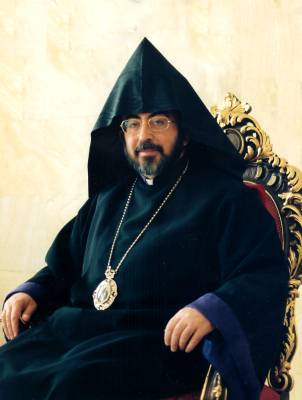
Primate Khajag Barsamian
Answering a question from New Jersey Senator Robert Menendez, Amb. Ricciardone had said, “Most of the Christian churches functioning prior to 1915 are still operating as churches. Some churches of significance operate as museums. The remaining have fallen into disrepair or were converted to mosques for lack of use.”
Barsamian said, “Ambassador Ricciardone deeply offended Armenian-Americans with his remarks, opening sensitive wounds and potentially setting back the gradual process of healing.” He added, “In all charity, perhaps the Ambassador is simply unaware of certain facts. But mastery of the history of a country, its dark as well as bright chapters, is essential to serving the United States effectively and diplomatically in this important and complex region.”
The full text of Archbishop Barsamian’s letter to Clinton appears below.
Dear Madame Secretary:
My kind greetings and blessings you, as you continue your service to our nation.
As Primate of the Eastern Diocese of the Armenian Church of America, I write regarding the statements made by Ambassador Francis Ricciardone, President Obama’s appointment as U.S. Ambassador to the Republic of Turkey, during his confirmation hearing.
Please know that we have been generally supportive of the efforts of the U.S. government to promote a more normal relationship between the republics of Turkey and Armenia. Likewise, we greatly respect and appreciate the productive role you personally have played in such initiatives.
With those efforts in mind, it is difficult to understand Ambassador Ricciardone’s assertions about the status of historic Armenian churches, and other Christian churches, in Turkey. The loss of these many hundreds of churches, their neglect and outright destruction, and the conversion of many of our sanctuaries into mosques, is a matter of intense pain to Armenians: an ongoing reminder of the loss of life and the destruction that we suffered as a result of the 1915 Genocide.
Ambassador Ricciardone deeply offended Armenian-Americans with his remarks, opening sensitive wounds and potentially setting back the gradual process of healing. In all charity, perhaps the Ambassador is simply unaware of certain facts. But mastery of the history of a country, its dark as well as bright chapters, is essential to serving the United States effectively and diplomatically in this important and complex region.
Again, it is our general support for your efforts, Madame Secretary, as well as our desire to see genuine progress made to benefit the entire region, that prompts this letter to you. I am confident that you will give these thoughts all due consideration, as you make decisions about the vital role America plays in Turkey, in Armenia, and throughout the world.
Madame Secretary, you have our great respect and support in all your undertakings. May our Lord strengthen and guide you in your service to our beloved country.
With prayers,Archbishop Khajag BarsamianPrimate
Primate Khajag Barsamian
Answering a question from New Jersey Senator Robert Menendez, Amb. Ricciardone had said, “Most of the Christian churches functioning prior to 1915 are still operating as churches. Some churches of significance operate as museums. The remaining have fallen into disrepair or were converted to mosques for lack of use.”
Barsamian said, “Ambassador Ricciardone deeply offended Armenian-Americans with his remarks, opening sensitive wounds and potentially setting back the gradual process of healing.” He added, “In all charity, perhaps the Ambassador is simply unaware of certain facts. But mastery of the history of a country, its dark as well as bright chapters, is essential to serving the United States effectively and diplomatically in this important and complex region.”
The full text of Archbishop Barsamian’s letter to Clinton appears below.
Dear Madame Secretary:
My kind greetings and blessings you, as you continue your service to our nation.
As Primate of the Eastern Diocese of the Armenian Church of America, I write regarding the statements made by Ambassador Francis Ricciardone, President Obama’s appointment as U.S. Ambassador to the Republic of Turkey, during his confirmation hearing.
Please know that we have been generally supportive of the efforts of the U.S. government to promote a more normal relationship between the republics of Turkey and Armenia. Likewise, we greatly respect and appreciate the productive role you personally have played in such initiatives.
With those efforts in mind, it is difficult to understand Ambassador Ricciardone’s assertions about the status of historic Armenian churches, and other Christian churches, in Turkey. The loss of these many hundreds of churches, their neglect and outright destruction, and the conversion of many of our sanctuaries into mosques, is a matter of intense pain to Armenians: an ongoing reminder of the loss of life and the destruction that we suffered as a result of the 1915 Genocide.
Ambassador Ricciardone deeply offended Armenian-Americans with his remarks, opening sensitive wounds and potentially setting back the gradual process of healing. In all charity, perhaps the Ambassador is simply unaware of certain facts. But mastery of the history of a country, its dark as well as bright chapters, is essential to serving the United States effectively and diplomatically in this important and complex region.
Again, it is our general support for your efforts, Madame Secretary, as well as our desire to see genuine progress made to benefit the entire region, that prompts this letter to you. I am confident that you will give these thoughts all due consideration, as you make decisions about the vital role America plays in Turkey, in Armenia, and throughout the world.
Madame Secretary, you have our great respect and support in all your undertakings. May our Lord strengthen and guide you in your service to our beloved country.
With prayers,Archbishop Khajag BarsamianPrimate
Thursday, August 18, 2011
American Magic Jack views Karabakh as part of Armenia
American Magic Jack Internet based telephone service company put Armenia and Nagorno-Karabakh in one section, report Nouvelles dArménie.
This provoked the rage of Azerbaijani community in the U.S., whose members have expressed their anger in a letter to Magic Jack, asking “to correct their mistake as soon as possible.”
Earlier Google also drew wrath of the Azerbaijanis when a few weeks ago presented Nagorno-Karabakh as part of Armenia in its Google Voice service.
Nagorno-Karabakh Republic, although not recognized by the international community, is a part of Armenia in its daily functions and committed relationship. Politicians in Baku have not yet grasped this fact. Private companies, on the other hand, went beyond political barriers and are not guided by politics.
This provoked the rage of Azerbaijani community in the U.S., whose members have expressed their anger in a letter to Magic Jack, asking “to correct their mistake as soon as possible.”
Earlier Google also drew wrath of the Azerbaijanis when a few weeks ago presented Nagorno-Karabakh as part of Armenia in its Google Voice service.
Nagorno-Karabakh Republic, although not recognized by the international community, is a part of Armenia in its daily functions and committed relationship. Politicians in Baku have not yet grasped this fact. Private companies, on the other hand, went beyond political barriers and are not guided by politics.
Monday, August 15, 2011
Why aren’t you satisfied with your own lands? 13-year-old girl from Karabakh wrote letter to President of Azerbaijan
STEPANAKERT. - Today Nagorno-Karabakh is inhabited either by participants of the Karabakh war, the elder generation, or by their descendants, who have inherited the same fervent blood that brought the nation to the victory twenty years ago. On August 8, 2011 a 13-year-old girl from Nagorno-Karabakh Republic (NKR) Adeline Avakimyan wrote a letter to the President of Azerbaijan Ilham Aliyev.
The letter was also sent to Azerbaijani mass media but none of them dared to publish it.
Armenian News-NEWS.am presents unofficial translation of the full text of the letter.
“Mr. President,
My name is Adeline Avakimyan, I am a schoolgirl from Karabakh. I did not tell anybody about my intention to write to you. I have been thinking, should I write or should I not? Eventually I decided to write.
I was born and currently live in Stepanakert. I love my country because Karabakh is my homeland, I was born and I live here, my father and mother were born here, so were my grandfathers and grandmothers. Their grandmothers and grandfathers were also born here (perhaps you know that in the past, when our country was one of the provinces of Armenia, it was called Artsakh). I have a lot of friends and they also love our country… But that is not actually the point of my letter.
Just like many others, I also have problems, which I try to solve to the best of my abilities. When I have free time, I think about many things: about human life, about happiness, about my relatives living far away from me, about their country, which is different from ours. At nights I gaze upon the stars and think, whether there are people living on those far away planets. My grandpa says that in his childhood he also used to look on the starry sky and think about same things. Sometimes I think about people surrounding me, of those who have seen more grief than happiness. I really want everybody to live happily and never have any problems.
Mr. President, every time I watch TV, I read or listen to the stories of elders I get surprised: all the time you speak about Karabakh and war as if you have nothing else to think of. It seems you do not have any other problems or goals and no other issue actually troubles you.
I never saw an Azerbaijani. I do not think about you, about your country and neither do my parents. I do not really understand what you want from our country. I know that you have never been to Artsakh, you have never seen our Gandzasar, Dadivank, Amaras but you always think about capturing our country. Why can’t you be satisfied with your own lands? Why do you want Karabakh? Grandpa told me that before the war, even 50 or 100 years ago, when Azerbaijanis still lived here, they did not bury their deceased here, they took them to Azerbaijan, because people knew that this is not their motherland. That is why we have so few Azerbaijani cemeteries.
My father is a veteran of Karabakh war. I have not seen the war, but I learned from the stories of elders that it is something bad and terrible and I would never like to see it. I am sure that not a single Azerbaijani child would like to see war either. But adults always say that in case of war they will defend their country again. One of my peer friends said that if they do not allow him take arms, he will help the adults to protect our country like French Gavroche did. I will also help my parents as much as I can…
I have heard many stories of how it all happened. Our people went to a peaceful meeting and said that they want Artsakh to join Mother-Armenia, because Azerbaijan is not our country and 70 years ago a chief called Stalin gave our country to Azerbaijan on purpose. In response, your countrymen started killing Armenians in Sumgait, Kirovabad, Baku and other cities, driving them out of their homes. However that did not satisfy your father and he went to war against Artsakh but lost it, although he had much more soldiers and tanks.
I asked my parents, how come he lost being so strong and they said that we were defending our land, whereas Azerbaijanis attacked to capture it, take away our lives and liberty…
If you start new war, whole Armenian nation will rise to defend our land. But tell me, will your children, your relatives participate in this war? You will send ordinary Azerbaijani youth against us. I know that in case of war many of us might die, including women and children, many children might become orphans but many Azerbaijani youngsters will die as well and their children will also be orphans. Do you want this? Is this the reason why you think about war and Karabakh every day?
Why do you always buy guns? You could have used that money to build an easy and happy life for your people (especially those who became refugees after your father started the war). Isn’t it better than sending people to war?
I really want that you respond to my letter and tell me why you want to take my homeland, which does not belong to you. Why aren’t you satisfied with your own lands?
Adeline Avakimyan,
NKR, Stepanakert.
10.08.11
The letter was also sent to Azerbaijani mass media but none of them dared to publish it.
Armenian News-NEWS.am presents unofficial translation of the full text of the letter.
“Mr. President,
My name is Adeline Avakimyan, I am a schoolgirl from Karabakh. I did not tell anybody about my intention to write to you. I have been thinking, should I write or should I not? Eventually I decided to write.
I was born and currently live in Stepanakert. I love my country because Karabakh is my homeland, I was born and I live here, my father and mother were born here, so were my grandfathers and grandmothers. Their grandmothers and grandfathers were also born here (perhaps you know that in the past, when our country was one of the provinces of Armenia, it was called Artsakh). I have a lot of friends and they also love our country… But that is not actually the point of my letter.
Just like many others, I also have problems, which I try to solve to the best of my abilities. When I have free time, I think about many things: about human life, about happiness, about my relatives living far away from me, about their country, which is different from ours. At nights I gaze upon the stars and think, whether there are people living on those far away planets. My grandpa says that in his childhood he also used to look on the starry sky and think about same things. Sometimes I think about people surrounding me, of those who have seen more grief than happiness. I really want everybody to live happily and never have any problems.
Mr. President, every time I watch TV, I read or listen to the stories of elders I get surprised: all the time you speak about Karabakh and war as if you have nothing else to think of. It seems you do not have any other problems or goals and no other issue actually troubles you.
I never saw an Azerbaijani. I do not think about you, about your country and neither do my parents. I do not really understand what you want from our country. I know that you have never been to Artsakh, you have never seen our Gandzasar, Dadivank, Amaras but you always think about capturing our country. Why can’t you be satisfied with your own lands? Why do you want Karabakh? Grandpa told me that before the war, even 50 or 100 years ago, when Azerbaijanis still lived here, they did not bury their deceased here, they took them to Azerbaijan, because people knew that this is not their motherland. That is why we have so few Azerbaijani cemeteries.
My father is a veteran of Karabakh war. I have not seen the war, but I learned from the stories of elders that it is something bad and terrible and I would never like to see it. I am sure that not a single Azerbaijani child would like to see war either. But adults always say that in case of war they will defend their country again. One of my peer friends said that if they do not allow him take arms, he will help the adults to protect our country like French Gavroche did. I will also help my parents as much as I can…
I have heard many stories of how it all happened. Our people went to a peaceful meeting and said that they want Artsakh to join Mother-Armenia, because Azerbaijan is not our country and 70 years ago a chief called Stalin gave our country to Azerbaijan on purpose. In response, your countrymen started killing Armenians in Sumgait, Kirovabad, Baku and other cities, driving them out of their homes. However that did not satisfy your father and he went to war against Artsakh but lost it, although he had much more soldiers and tanks.
I asked my parents, how come he lost being so strong and they said that we were defending our land, whereas Azerbaijanis attacked to capture it, take away our lives and liberty…
If you start new war, whole Armenian nation will rise to defend our land. But tell me, will your children, your relatives participate in this war? You will send ordinary Azerbaijani youth against us. I know that in case of war many of us might die, including women and children, many children might become orphans but many Azerbaijani youngsters will die as well and their children will also be orphans. Do you want this? Is this the reason why you think about war and Karabakh every day?
Why do you always buy guns? You could have used that money to build an easy and happy life for your people (especially those who became refugees after your father started the war). Isn’t it better than sending people to war?
I really want that you respond to my letter and tell me why you want to take my homeland, which does not belong to you. Why aren’t you satisfied with your own lands?
Adeline Avakimyan,
NKR, Stepanakert.
10.08.11
Subscribe to:
Posts (Atom)