Wednesday, March 16, 2016

The Empire the World Forgot--Turkish lies and denial continue


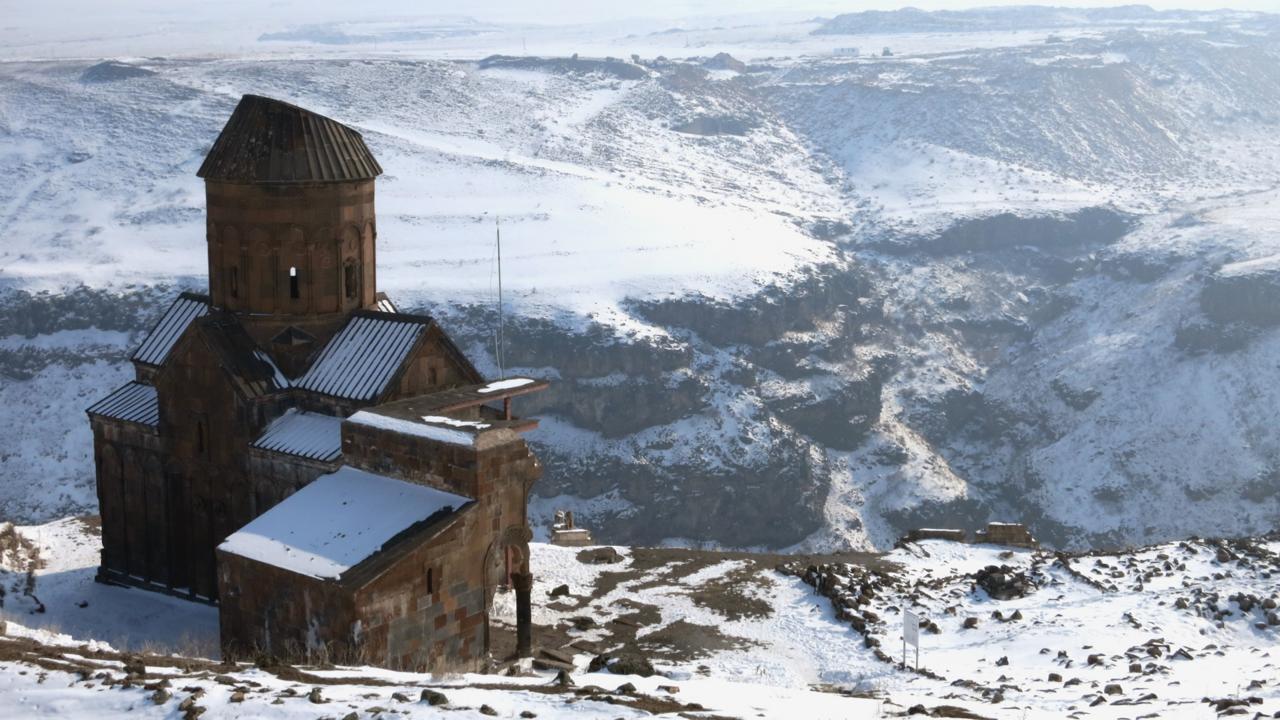
Church of St Gregory of Tigran Honents
(Credit: Joseph Flaherty)
An abandoned city of ghostsRuled by a dizzying array of kingdoms and empires over the centuries – from the Byzantines to the Ottomans – the city of Ani once housed many thousands of people, becoming a cultural hub and regional power under the medieval Bagratid Armenian dynasty. Today, it’s an eerie, abandoned city of ghosts that stands alone on a plateau in the remote highlands of northeast Turkey, 45km away from the Turkish border city of Kars. As you walk among the many ruins, left to deteriorate for over 90 years, the only sound is the wind howling through a ravine that marks the border between Turkey and Armenia.
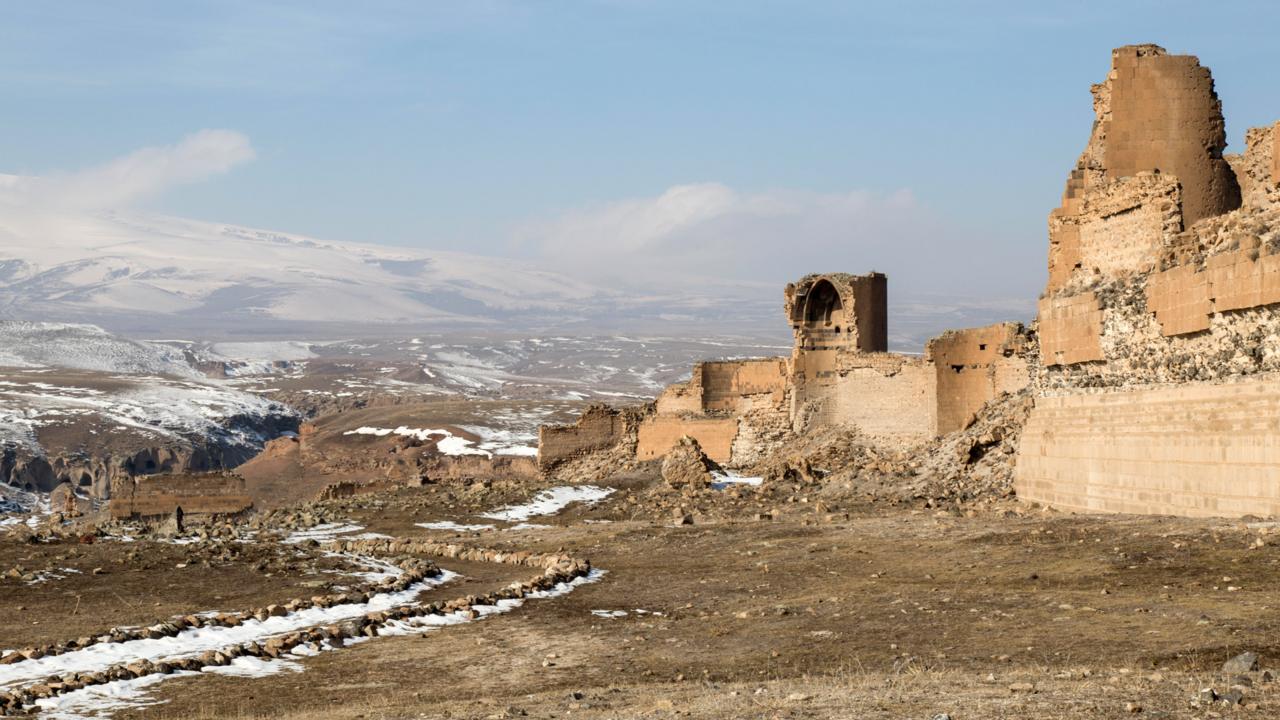
Ani’s city walls
(Credit: Linda Caldwell/Alamy)
The toll of many rulersVisitors who pass through Ani’s city walls are greeted with a panoramic view of ruins that span three centuries and five empires – including the Bagratid Armenians, Byzantines, Seljuk Turks, Georgians and Ottomans. The Ani plateau was ceded to Russia once the Ottoman Empire was defeated in the 1877-78 Russo-Turkish War. After the outbreak of World War I, the Ottomans fought to take back northeast Anatolia, and although they recaptured Ani and the surrounding area, the region was given to the newly formed Republic of Armenia. The site changed hands for the last time after the nascent Turkish Republic captured it during the 1920 eastern offensive in the Turkish War of Independence.
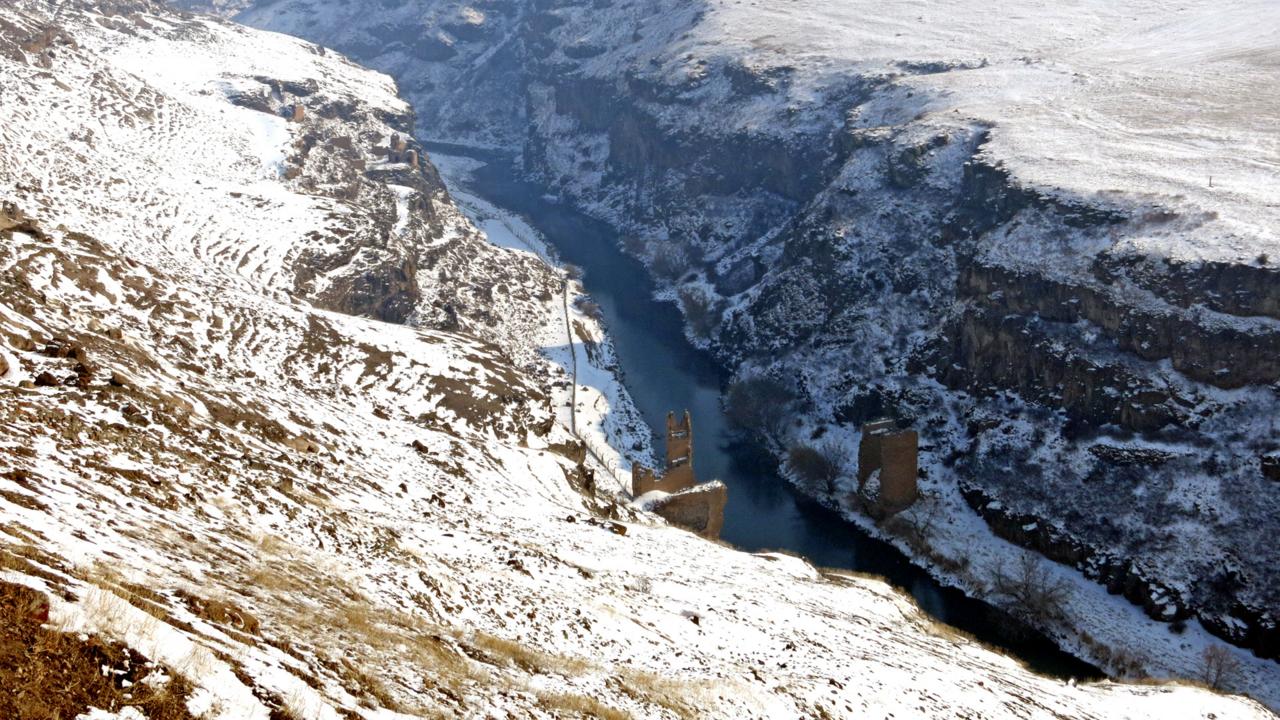
Ancient bridge over the Akhurian River
(Credit: Joseph Flaherty)
A hotly contested territoryThe ruins of an ancient bridge over the Akhurian River, which winds its way at the bottom of the ravine to create a natural border, are fitting given the vexed state of Turkish-Armenian relations. The two countries have long disagreed over the mass killings of Armenians that took place under the Ottoman Empire during World War I, and Turkey officially closed its land border with Armenia in 1993 in response to a territorial conflict between Armenia and Turkey’s ally Azerbaijan.
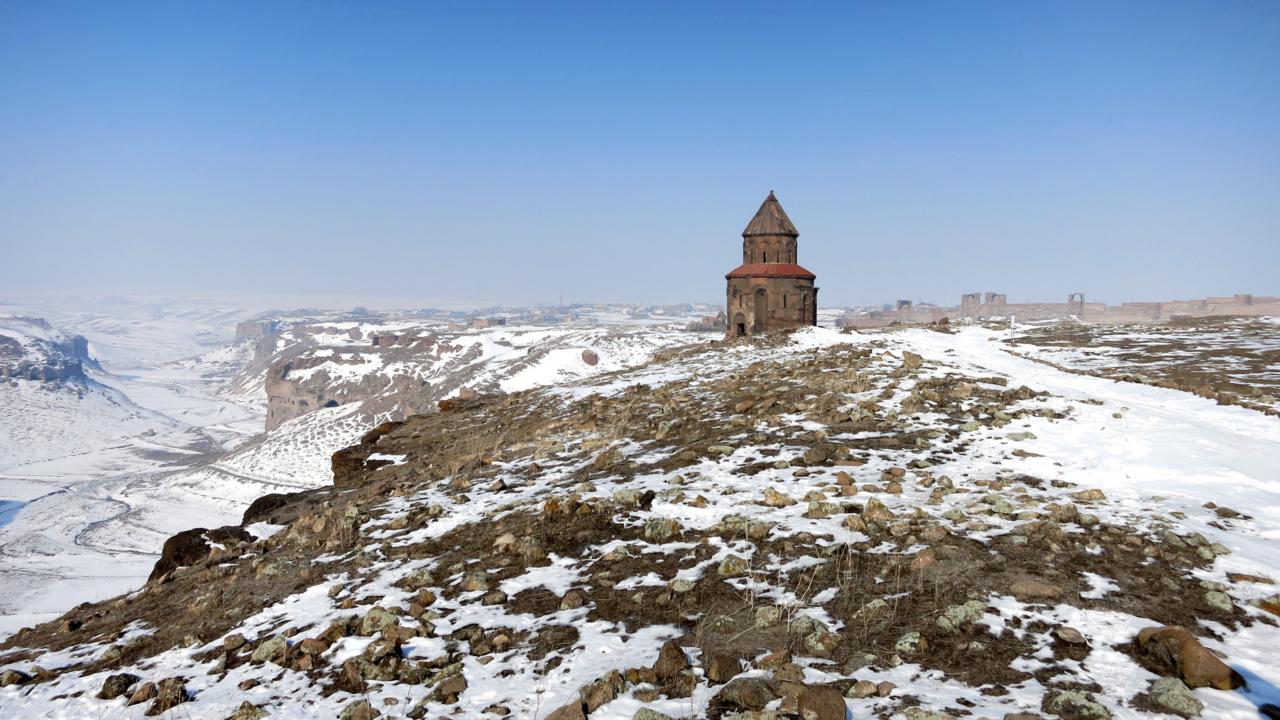
Ruins of Ani
(Credit: Joseph Flaherty)
A bid to save the ruins
Although the focus on Turkish-Armenian tension preoccupies most discussion of Ani, there’s an ongoing effort by archaeologists and activists to save the ruins, which have been abandoned in favour of more accessible and less historically contested sites from classical antiquity. Historians have long argued for Ani’s importance as a forgotten medieval nexus, and as a result, Ani is now on a tentative list for recognition as a Unesco World Heritage Site. With some luck and careful restoration work, which has begun in 2011, they may be able to forestall the hands of time.
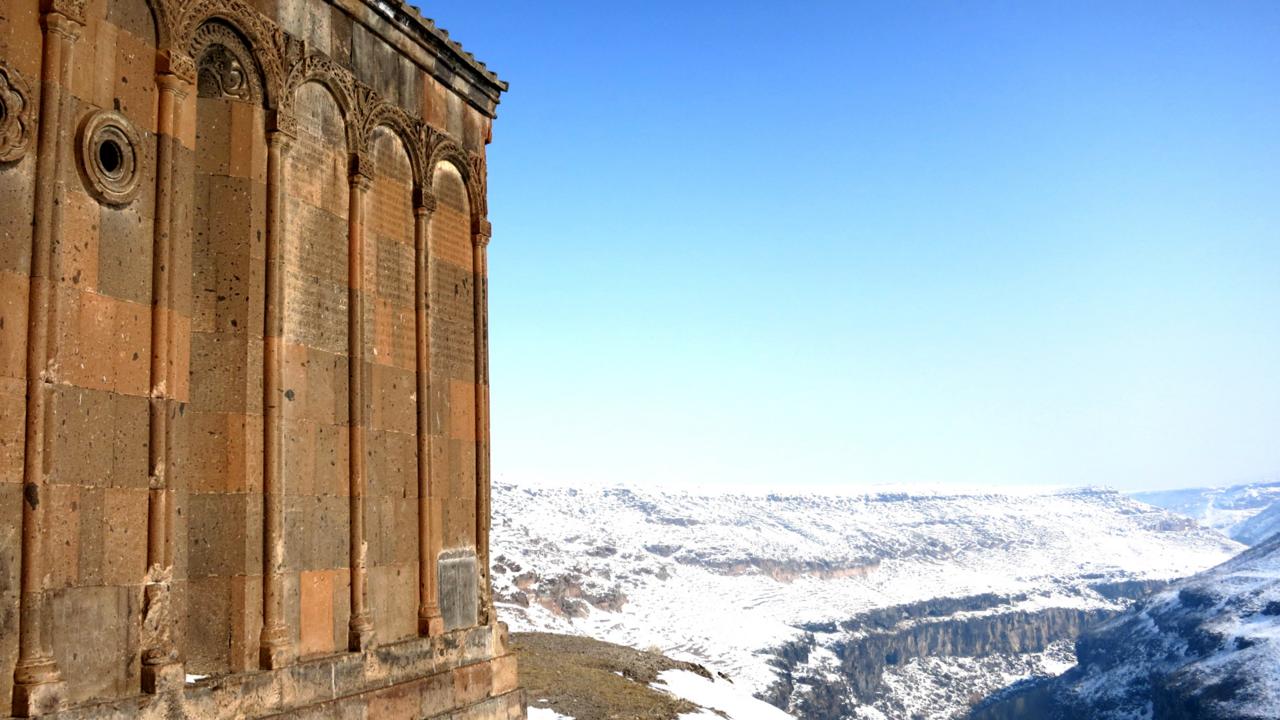
Exterior wall of The Church of St Gregory of Tigran Honents
(Credit: Joseph Flaherty)
‘The City of 1,001 Churches’At its height during the 11th Century, scholars estimate that Ani’s population reached as high as 100,000 people. Artistic renderings based on the site’s archaeological findings show a bustling medieval centre crowded with myriad homes, artisanal workshops and impressive churches scattered throughout.
Known as “The City of 1,001 Churches”, Ani’s Armenian rulers and city merchants funded an extraordinary number of places of worship, all designed by the greatest architectural and artistic minds in their milieu. Although the nickname was hyperbole, archaeologists have discovered evidence of at least 40 churches, chapels and mausoleums to date.
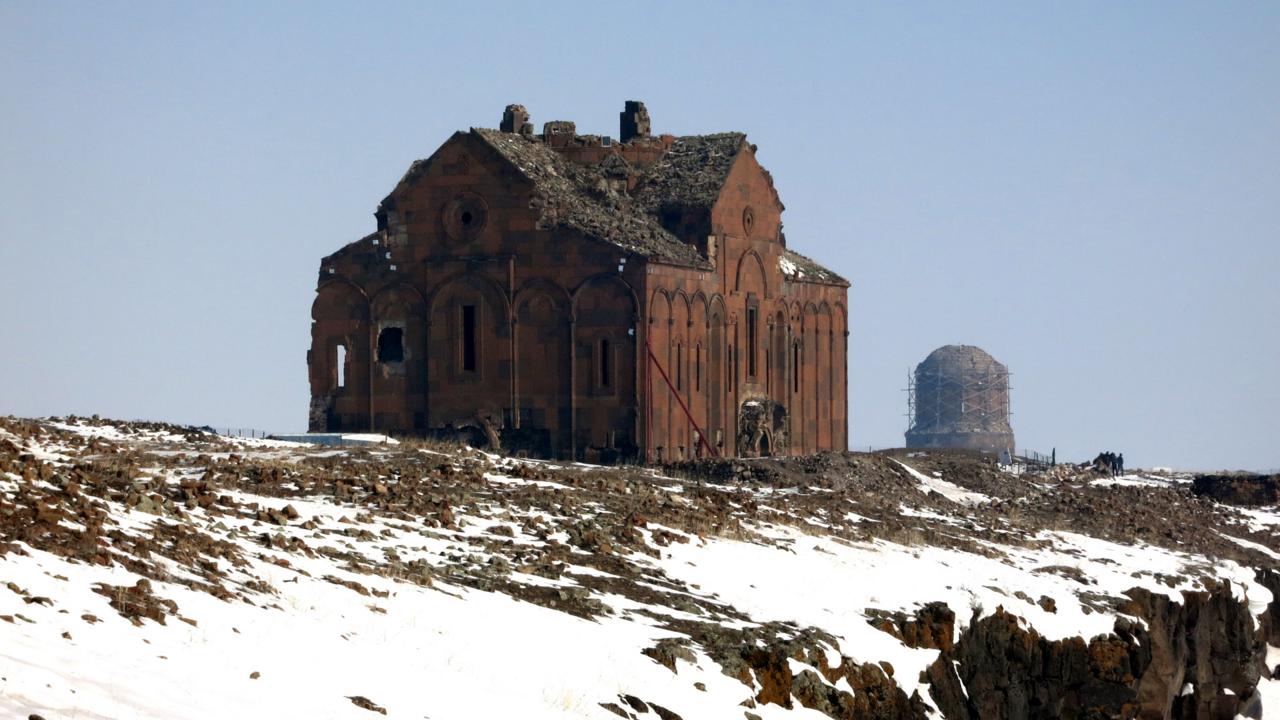
Cathedral of Ani
(Credit: Joseph Flaherty)
An imposing cathedralA rust-coloured brick redoubt, the Cathedral of Ani looms over the now-abandoned city. Although its dome collapsed in an earthquake in 1319 – and, centuries later, another earthquake destroyed its northwest corner – it is still imposing in scale. It was completed in 1001 under the reign of Armenian King Gagik I, when the wealth and population of Ani was at its peak. Trdat, the renowned Armenian architect who designed it, also served the Byzantines by helping them repair the dome of the Hagia Sophia.
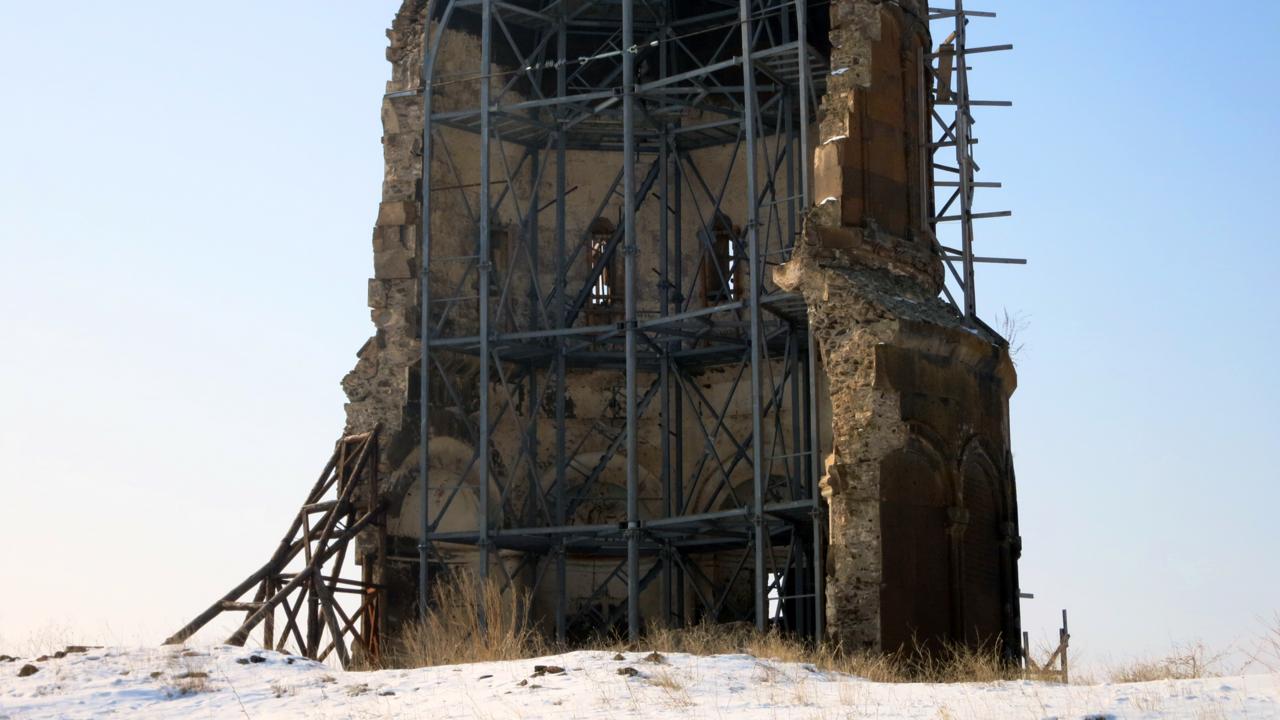
Ani's Church of the Redeemer
(Credit: Joseph Flaherty)
Half of a churchOnly one half of the Church of the Redeemer remains – a monument to both the artistic prowess of the Armenian Bagratid Dynasty and the inevitability of time. Propped up by extensive scaffolding now, the church was an impressive architectural feat when it was built. It featured 19 archways and a dome, all made from local reddish-brown volcanic basalt.
The church also housed a fragment of the True Cross, upon which Jesus was crucified. The church’s patron, Prince Ablgharib Pahlavid, reportedly obtained the relic during a visit to the Byzantine court at Constantinople.
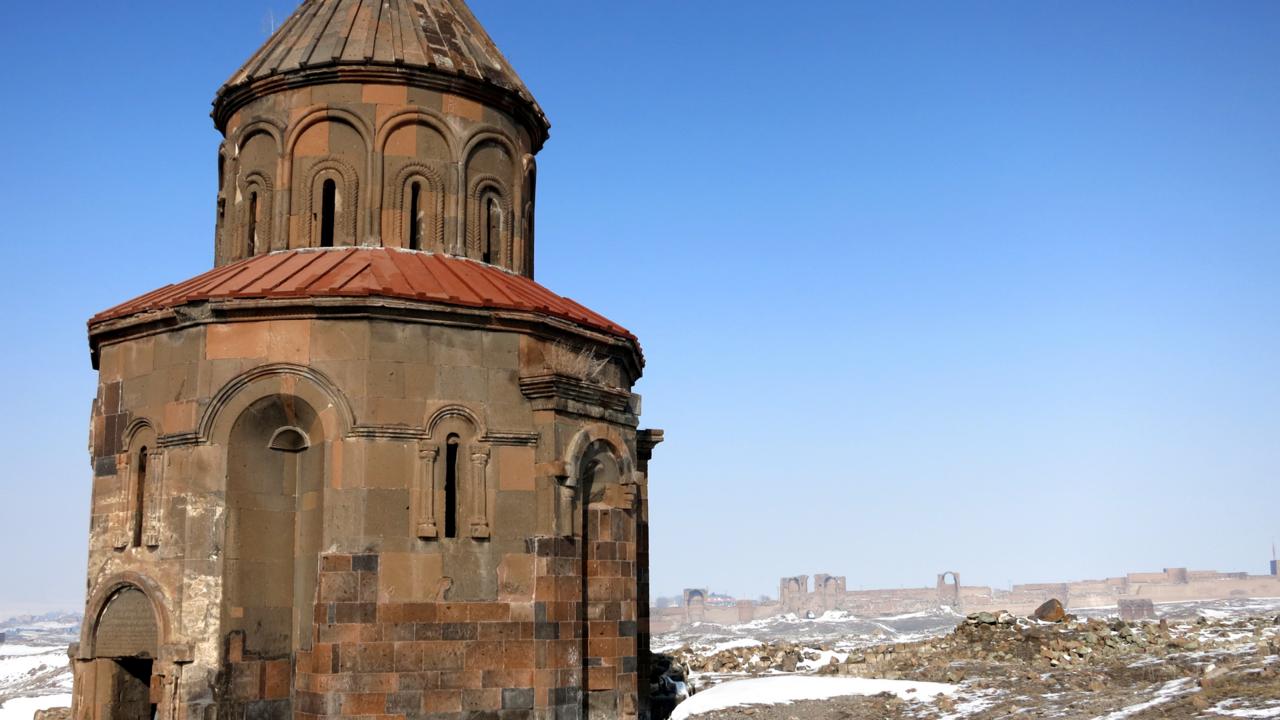
Church of St Gregory of the Abughamrents
(Credit: Joseph Flaherty)
A church fit for a princeBuilt sometime in the late 10th Century, the Church of St Gregory of the Abughamrentsis a stoic-looking, 12-sided chapel that has a dome carved with blind arcades: arches that are purely for embellishment instead of leading to a portal. In the early 1900s, a mausoleum was discovered buried under the church’s north side, likely containing the remains of the church’s patron, Prince Grigor Pahlavuni of the Bagratid Armenians, and his kin. Unfortunately, like many of the sites at Ani, the prince’s sepulchre was looted in the 1990s.
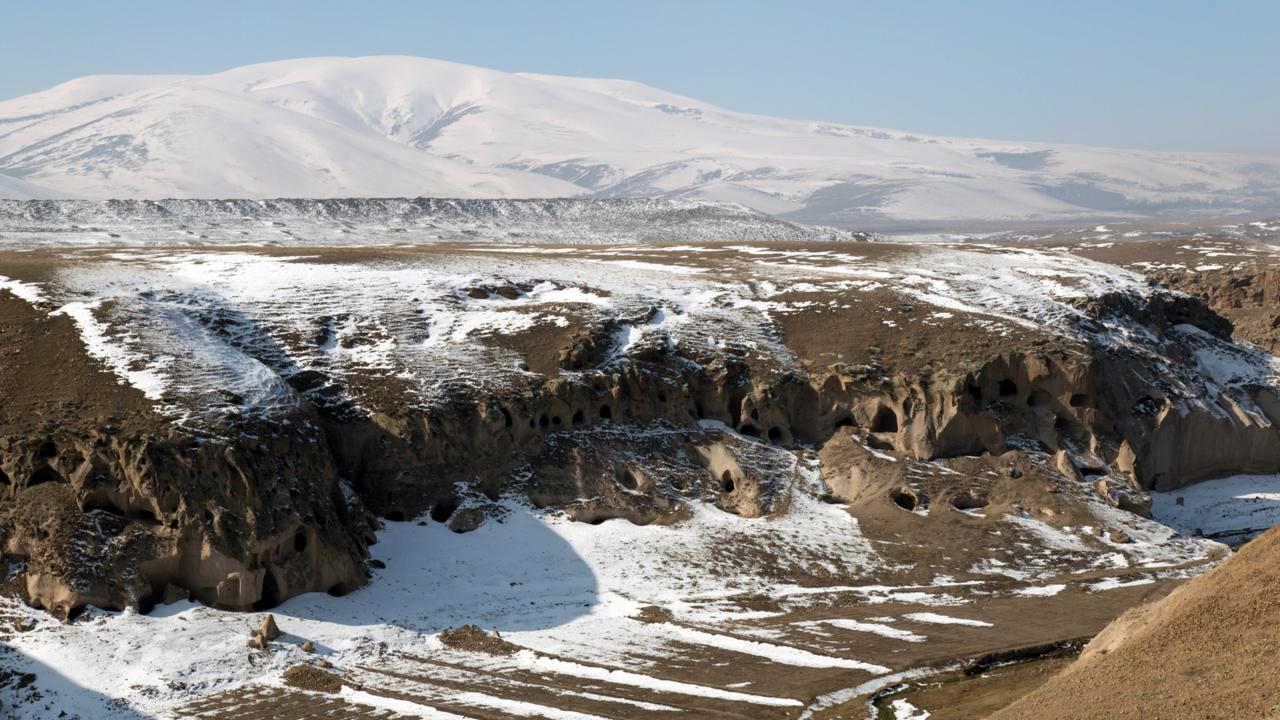
Ani’s “underground city” of caves
(Credit: Linda Caldwell/Alamy)
The remnants of an underground cityOpposite the Church of St Gregory of the Abughamrentsare a series of caves dug out of the rock, which some historians speculate may predate Ani. The caves are sometimes described as Ani’s “underground city” and signs point to their use as tombs and churches. In the early 20th Century, some of these caves were still used as dwellings.
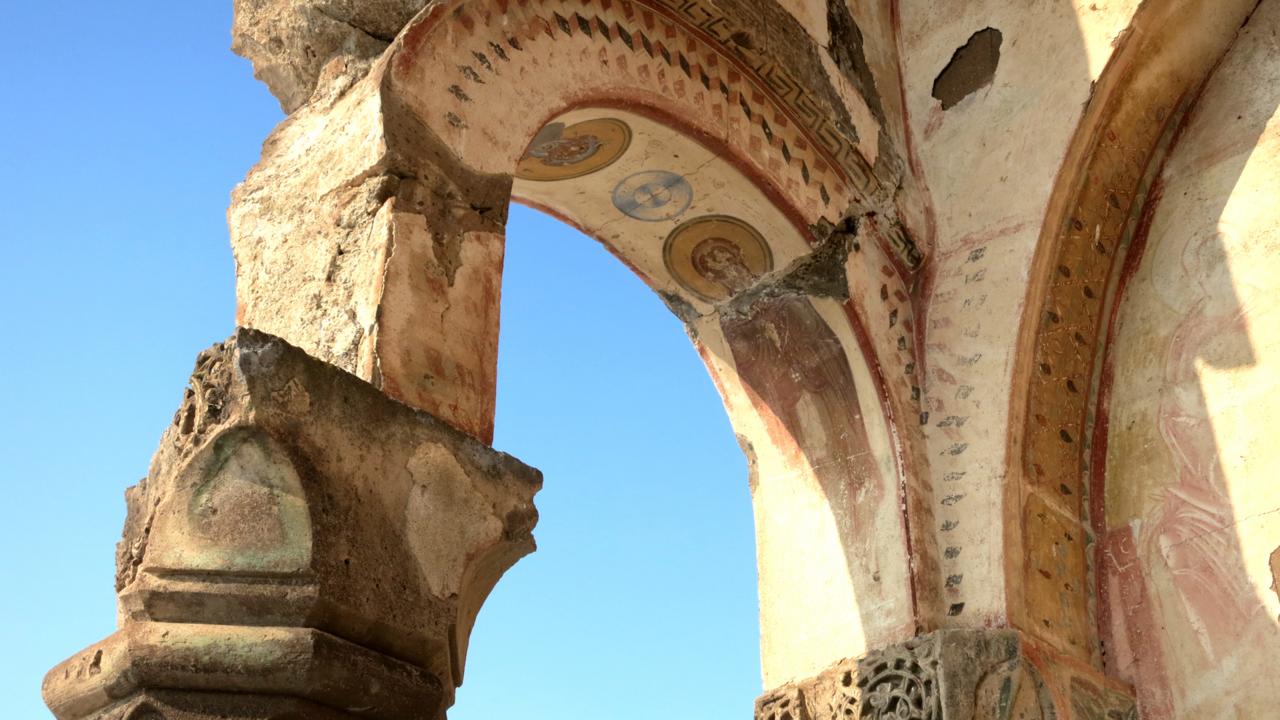
Church of St Gregory of Tigran Honents arch
(Credit: Joseph Flaherty)
A church that keeps watchThe Church of St Gregory of Tigran Honents stands vigilant over the ravine that separates Turkey and Armenia. Commissioned by a wealthy merchant and built in 1215, it was constructed when the then-controlling Kingdom of Georgia granted Ani as a fiefdom to a bloodline of Armenian rulers, the Zakarians. During the winter, the lonely church makes for a striking sight against the endless, snow-covered Armenian steppe in the distance.
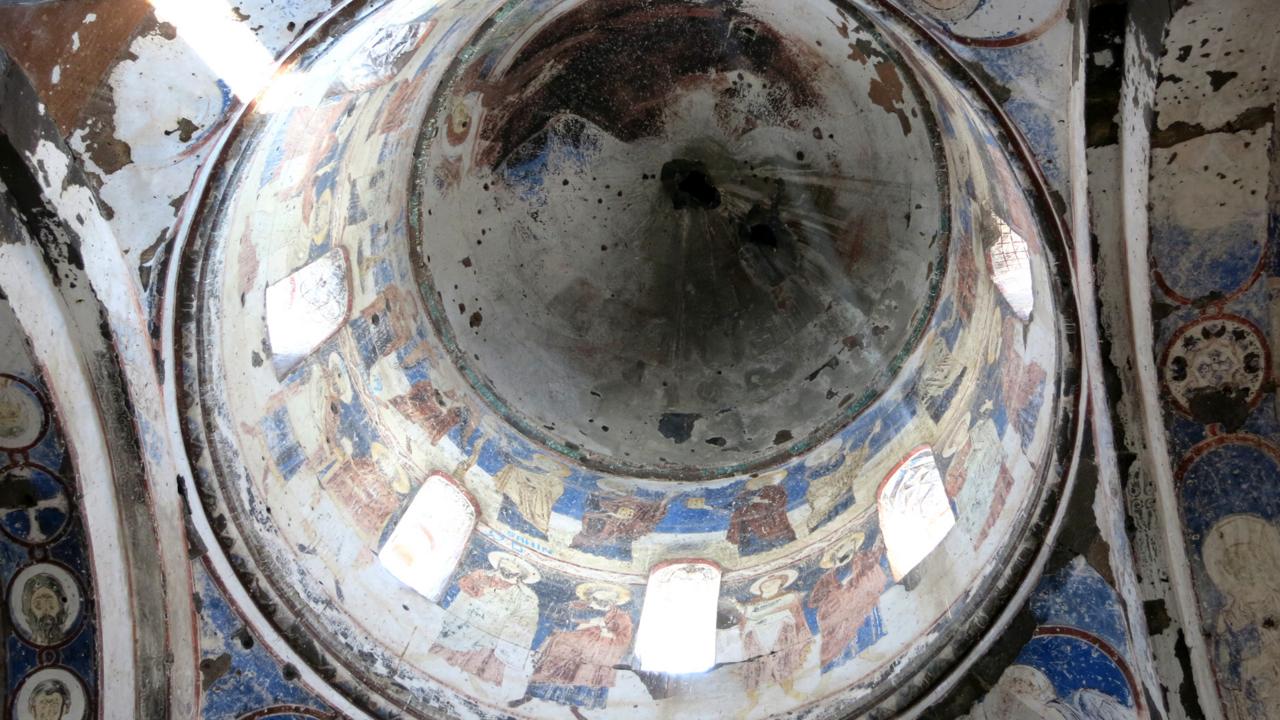
Frescoes in the Church of St Gregory of Tigran Honents
(Credit: Joseph Flaherty)
Frescoes cover the wallsThe Church of St Gregory of Tigran Honents is one of Ani’s best preserved buildings, adorned with remnants of paintings depicting scenes from the life of Christ and St Gregory the Illuminator. Detailed fresco cycles did not ordinarily appear in Armenian art of the era, leading scholars to believe the artists were most likely Georgian.
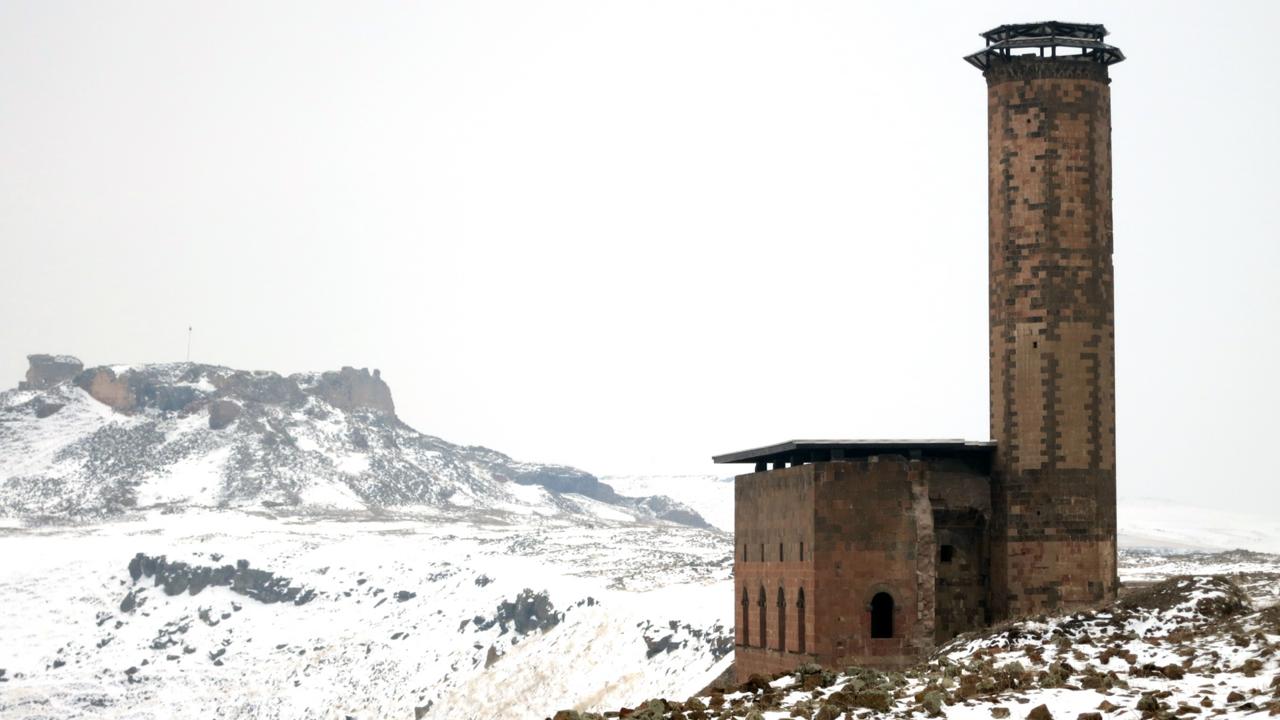
Ani's mosque of Manuchihr
(Credit: Joseph Flaherty)
An Islamic minaret still standsThe Seljuk Empire – a Turkish state in Anatolia that drove out the Byzantines and eventually gave way to the Ottoman Empire – controlled the greater area of what is today northeast Turkey and Armenia beginning in the mid-1000s. However, in 1072, the Seljuks granted control of Ani to an Islamic dynasty of Kurdish origin, the Shaddadids. The Shaddadids, in turn, left their mark on Ani with buildings like the mosque of Manuchihr, which is perched precariously on the edge of the cliff. Its minaret is still standing from when the mosque was constructed in the late 1000s; the rest of the mosque is most likely an addition from the 12th or 13th Centuries.
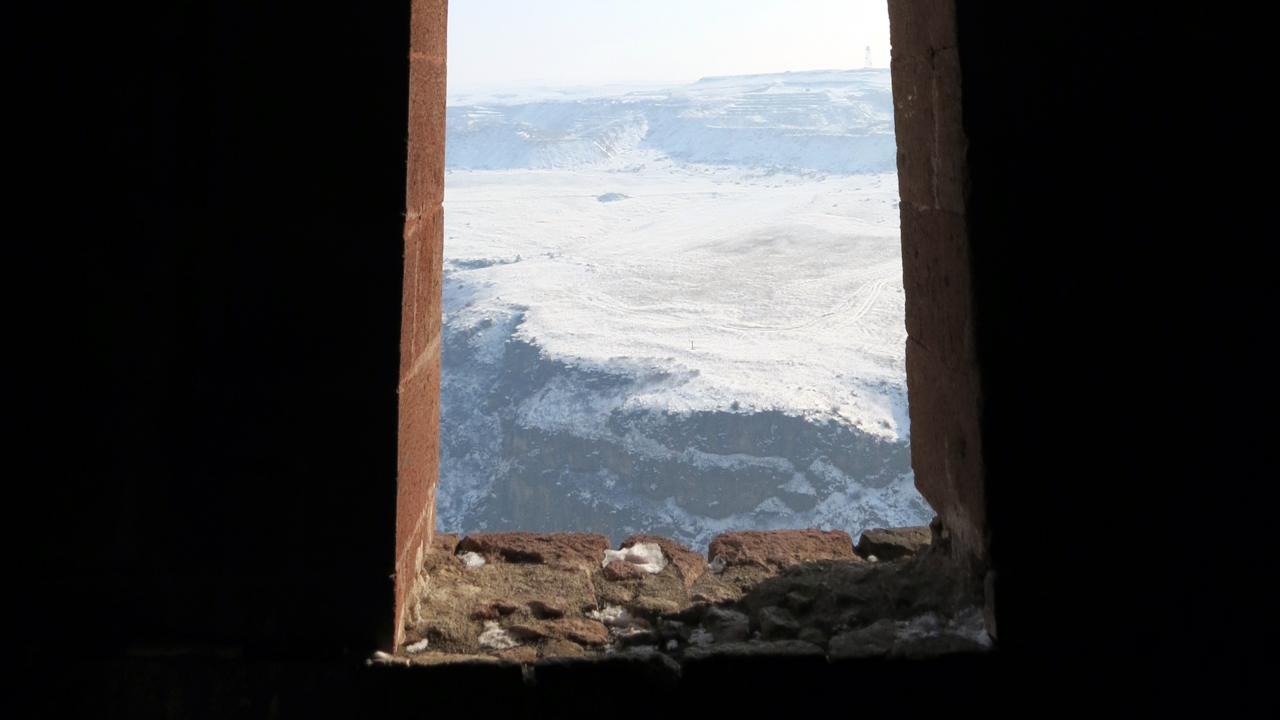
View from Ani's mosque of Manuchihr
(Credit: Joseph Flaherty)
Origins up for debateThe original purpose of the mosque of Manuchihr is debated on both the Turkish and Armenian sides. Some contend that the building once served as a palace for the Armenian Bagratid dynasty and was only later converted into a mosque. Others argue that the structure was built as a mosque from the ground up, and thus was the first Turkish mosque in Anatolia. From 1906 to 1918, the mosque served as a museum of findings from Ani’s excavation by the Russian archaeologist Nicholas Marr. Regardless of the building’s origins, the mosque’s four elegant windows display spectacular views of the river and the other side of the gorge.
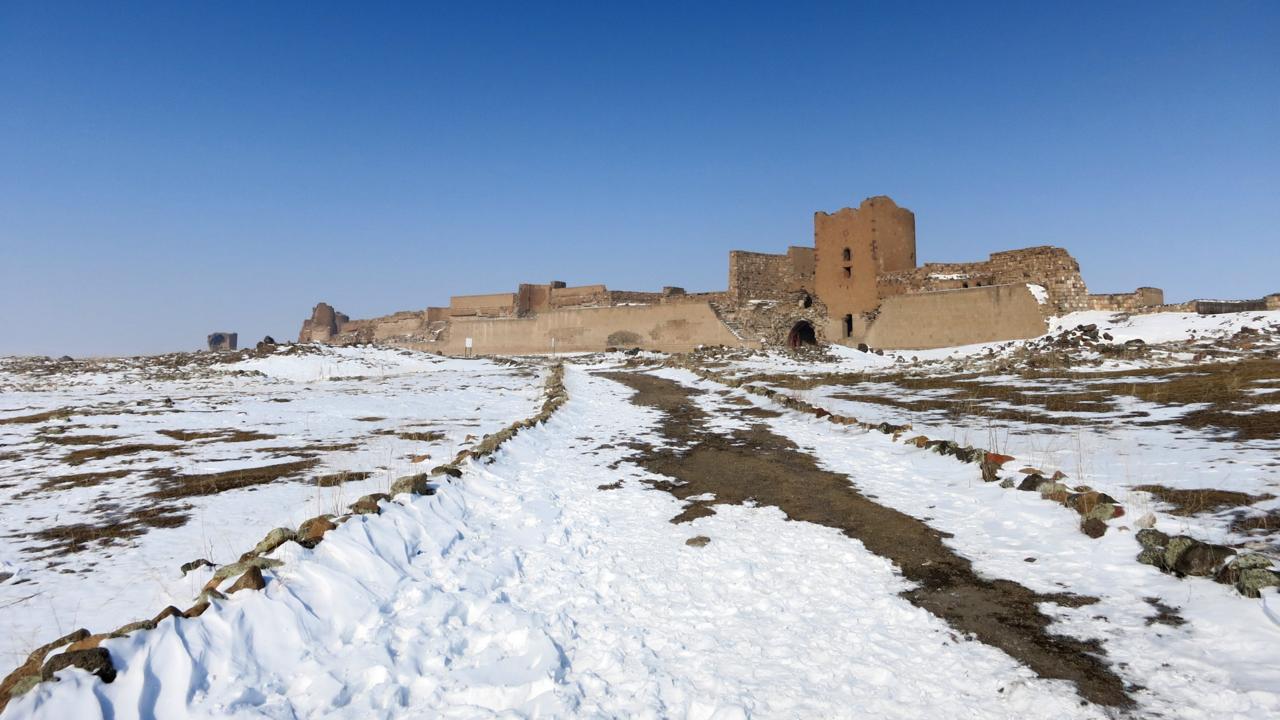
Ani's once formidable city walls
(Credit: Joseph Flaherty)
Once formidable city wallsAni’s city walls may seem ready to crumble, but when they were constructed in the 10th Century, they made for a formidable defence. The Bagratid family of kings built them in order to fortify their new capital and, over the centuries, they protected the city’s occupants against siege after siege by various armies. These ramparts, along with Ani’s inhabitants, witnessed bloody conflicts between the Bagratids and the Byzantines, and the Byzantines and the Seljuks.
Despite Ani’s history as a field of warfare, the ruins also represent many periods throughout history where the city saw a remarkable interchange of cultures, religions and artistic motifs.
If you liked this story, sign up for the weekly bbc.com features newsletter, called “If You Only Read 6 Things This Week”. A handpicked selection of stories from BBC Future, Earth, Culture, Capital, Travel and Autos, delivered to your inbox every Friday.

Friday, March 11, 2016

Learn About Holy Week in the Armenian church--I recommend it--Rafi Topalian

Learn About Holy Week

A helpful resource in the preparation for Holy Week is Avak Shapat: A Guide to the Holy Week Services of the Armenian Church. Authored by the Very Rev. Fr. Daniel Findikyan, director of the Diocese’s Krikor and Clara Zohrab Information Center, and released last year, the book is intended to assist clergy, seminarians, deacons, and choir members in conducting the Holy Week services. It contains detailed explanations of prayers, hymns, Scripture readings, and rituals associated with each Holy Week service, as well liturgical glossaries in Armenian and English.

Click on the following links to read morehear Fr. Findikyan’s presentation about the book, and to purchase the publication at the St. Vartan Bookstore.

Confidential Document Targeting Hrant Dink Exposed

Confidential document that was revealed during Dink's case. (Source: Armenpress)
Confidential document that was revealed during Dink’s case. (Source: Armenpress)
YEREVAN(Armenpress) — A document in the appendix of the indictment prepared for Hrant Dink case revealed that Turkey’s intelligence agency, known as MİT was monitoring Armenians, Greeks and other non-Muslim communities under the title of “Ethnic Separatist Activities.” According to the document, Dink had become a target of the intelligence agency.
One of the documents that was found revealed why Drink was not given a passport for many years, according to Agos Newspaper.
For nearly 25 years Drink applied to the Regional Security Office in Istanbul to receive a passport, but his applications were always sent back. In the sidelines of the investigation of the journalist’s murder, a document dating 1997 was revealed, which is labeled “confidential.” In addition to Dink’s name, the names of the then vicar of the Armenian Patriarchate of Constantinople and the current Patriarch Mesrob Mutafyan were also mentioned.
“An individual named Firat Dink is among our targets due to his pro-Armenian activities. He is the editor-in-chief of Agos periodical, published by Armenians, and is in close ties with the vicar of the Armenian Patriarchate Mesrob Archbishop Mutafyan, famous for his Armenian nationalist inclinations,”reads the document.
The court demanded this document within the framework of investigating the complicity of former officials in Dink’s case.
Another document exposes that the state had been interested in the ethnic belonging of the murderer of Hrant Dink Ogun Samast and the murderer’s accomplice Yasin Hayal. In a justification sent by the Intelligence Department of General Directorate of Security that Yasin Hayal’s background has been explored. The observation showed that there are no non-Muslims or apostasy cases among the members of his family. The same has been revealed for Ogun Samast.

Museum of Lost Objects: The Armenian church in Deir al-Zour

Museum of Lost Objects: The Armenian church in Deir al-Zour

  • 10 March 2016
  •  
  • From the sectionMagazine
Courtyard of the church of the Armenia Martyr in SyriaImage copyrightAlamy
Twenty-five years ago a new church was consecrated in the town of Deir al-Zour in eastern Syria, dedicated to the Armenians killed en masse in 1915. Ironically the building erected in memory of the victims of violence has now been destroyed by bombs.
In the basement of the Armenian Martyrs' Memorial Church in Deir al-Zour lay a shrine - a sunken area filled with sand, and laid on top, a pile of human remains.
"I was so shocked. I just stood and looked at the bones," says British-Armenian writer Nouritza Matossian, who visited the church in 2001.
"Everybody was hushed, it was silent in there. We were all lost in our thoughts. It was really quite an isolated moment. It wasn't pulling at you to cry or weep. It was just very simple and dignified and noble."
Inside the shrineImage copyrightFurther To Fly Photography USA
A stone pillar rose up through the ceiling, into the church and up to the roof.
"I looked at this beautiful shrine and I thought, 'What an amazing idea to have taken this column which was like a tree, rooted in the ground, and take it right up through the body of the church, right up into the cupola and up into the sky,'" she says.
It was not an old building - the Syrian government had approved its construction in the 1980s and it was consecrated in 1991 in memory of Armenians who died in 1915.
Matossian's ancestors were among those caught up in the events a century ago. As the Ottoman Empire crumbled, hundreds of thousands of Armenians, mainly from eastern Anatolia, were rounded up and sent hundreds of miles away across the Syrian Desert.
Some were forced to walk, while others were taken in trains and caravans to the city of Deir al-Zour.
Matossian's grandfather, Hovhannes, on the day Nouritza's mother and father got marriedImage copyrightNouritza Matossian
Image captionMatossian's grandfather, Hovhannes (right), on the day Nouritza's mother and father got married
Matossian's grandfather, Hovhannes, had already left Antep - now Gaziantep in Turkey - after an outbreak of violence in 1910. Although he had moved to Cyprus, the rest of his family stayed behind and were eventually deported.
They were "driven across these deserts starving, without water, stripped naked, their clothes were torn off their backs everything was taken from them," says Matossian.
"Deir al- Zour was the end of the road, it was the last Ottoman outpost into the desert in the eastern part of Syria," says Heghnar Watenpaugh, a Lebanese-Armenian historian at the University of California, Davis. "Beyond that there's really nothing, no settlements.
"Very few people made it there, and once they made it they were killed outright, or just succumbed to disease and starvation."

Find out more
Human bones in a pit within the churchImage copyrightNouritza Matossian

Armenians say 1.5 million people were systematically killed. Turkey maintains the number is closer to 300,000, and denies accusations of genocide, saying that many ethnic Turks also died during World War One.
In the years that followed, Deir al-Zour became "a major pilgrimage site for Armenians," says Watenpaugh, and a shrine was finally built. But the Armenian Martyrs' Memorial Church stood for less than a quarter of a century before it was destroyed.
In 2014, it was blown up during fighting between the so-called Islamic State group and the al-Qaeda-affiliated al-Nusra Front. The central church of the complex was almost completely demolished.
"It's a very dark moment in our life, in our history. I never thought this could be repeated," says Matossian.
The Armenian Martyrs Cathedral Church in AleppoImage copyrightAlamy
Image captionThe Armenian Martyrs' Cathedral Church in Aleppo
Before the Syrian civil war, there were an estimated 100,000 ethnic Armenians in Syria - most of them descendants of those who survived the deportations. There were small communities in cities across the country but the majority, more than 60,000, settled in Aleppo.
For many of them Aleppo "is like a sacred word, a magical incantation," says Watenpaugh. "All of our families went through Aleppo at some point during the deportations. For some, it was a place where salvation was possible, where you could bribe your way out of the deportation or find some way to escape."
She says Armenian women were often taken by Bedouin families, sometimes willingly and sometimes by force.
"They became part of extended Bedouin households and the concubines or wives of various Bedouin men.
"Today, when Bedouin come to Aleppo on business and go to a store run by an Armenian they will often call the Armenians of Aleppo khalo - brother of my mother. That's because there is this very strong connection between the Bedouin who know that their mothers or grandmothers were Armenians."
Nouritza Matossian's great-aunt was one of the Armenian women picked up by local Bedouin. Years later, she was spotted in Aleppo.
A Bedouin woman from Syria with her face tattooedImage copyrightGetty Images
Image captionA Bedouin woman from Syria with her face tattooed
"Our relations saw her in the bazaar, and they recognised her, they called out her name - Berjouhi," says Matossian.
"She recognised them but there were children with her, and she swept up her children and disappeared into the crowd. She was married or she was living with these people and she didn't want to leave her children behind.
"Her face was covered in tattoos. In order to assimilate them, the Bedouin made them change their religion, and they tattooed their women - it was a sort of tribal thing."
Deir al-Zour made a deep impression on Matossian and she returned to the city in 2007.
At the shrine, she bought a small box as a memento. Inside is a tiny cross made of olive wood, two ears of wheat, two little candles, incense, and a tube of soil.
"The priest told me that that is the earth of Deir al-Zour. Some people take earth from where they're born and they spread it on their grave when they die. This soil has that significance," she says.
"I always keep this box within eyesight, on my desk. I never expected that one day I would be looking at this box and that church would be gone, destroyed. It's very hard to accept."
Box containing cross and earth from Deir al-Zour
The Museum of Lost Objects traces the stories of 10 antiquities or ancient sites that have been destroyed or looted in Iraq and Syria.
Subscribe to the BBC News Magazine's email newsletter to get articles sent to your inbox.