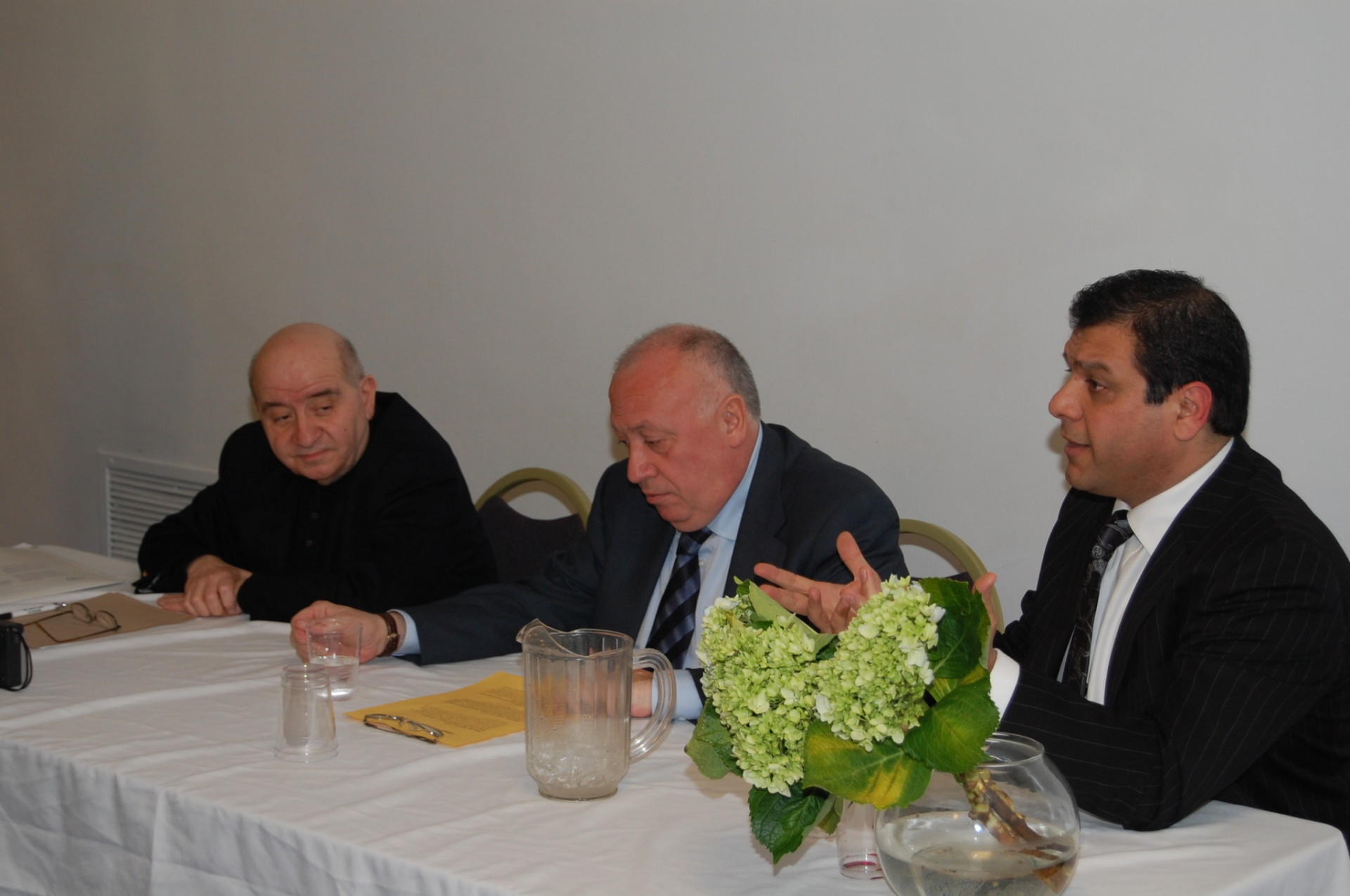
Three prominent Armenian jewelers spoke about their trade and the jewelry industry on Wed., March 10 at the Armenian Diocese in New York. Hosted by the Zohrab Center and the Armenian Network of New York, this unique event allowed participants to get an inside look into the jewelry industry and how it pertains to Armenians, who are leading forces in the field.
In the jewelry business since the age of 10, Hirant Gulian, who has a degree in accounting from Queens College, said Armenian jewelers have been active in the industry in many different ways.
“We have talent, knowledge, and creativity, and this is why we have survived,” said Gulian, who immigrated to the U.S. from Turkey when he was 18. He also noted that the owner of the largest jewelry manufacturer in the world is an Armenian from Moscow by the name of Gagik Gevorkyan, the president of Estet Jewelry. Gevorkyan, who employs 1,000, close to half of which are Armenian, donated a pure gold croisier (pastoral staff) to His Holiness Karekin II, Catholicos of All Armenians, which is worth $1.5 million.
Gulian also said that jewelers have to expand on their knowledge of the industry. “You have to learn what’s around you and what the market is. It’s important to educate yourself within the industry so you can use your talent and advance.”
Born and raised in Damascus, Syria, Hagop Baghdadlian moved to the U.S. in 1977 and started his own business as a diamond dealer. He was president of Cora International, which specializes in diamond manufacturing, from 2003-09. For the past seven years Baghdadlian has served as an executive board member of the International Armenian Jewelers Association and executive member in the Armenian Jewelers Association for the East Coast.
Baghdadlian talked about the four C’s of diamond quality: clarity, cut, color, and carat. He said that diamonds are a $140 billion industry and also discussed the origin of the rough diamond—a diamond which has not yet been cut—which comes mainly from Africa, Brazil, and Australia. In 2005, Baghdadlian and his partner Ara Arslanian purchased a 570 carat diamond and manufactured it, selling it for $36 million to Dr. Stanley Ho, who named it the “Star of Macau Diamond.” According to the Gemological Institute of America (GIA), the 218 carat, “internally flawless” diamond is the largest of its kind in the world.
Berge Abajian, the founder, CEO, and designer for Bergio International, was born in Lebanon and immigrated to the U.S. in 1976. An aspiring entrepreneur, he attended Fairleigh Dickinson University as a business administration major, receiving his bachelor of science degree in 1982. Imbued with the spirit of adventure, he traveled to Brazil, where he became fascinated with the unusual stones that would ultimately become his specialty—yellow and pink colored (“fancy”) diamonds. He started his own company in 1995.
Abajian talked about his experiences in the jewelry industry. “I was always looking outside of the box and wanted to be in the business of jewelry.” In November 2009, he became the first Armenian jeweler to go public, when Bergio International became a publicly traded company under the symbol BRGO.
“I want Armenians in the jewelry business to get involved in the financial aspect of the jewelry industry,” said Abajian, who has served as president of the Armenian Jewelers Association. “My dream is to get Armenians to think out of the box and get off the bench because we are leaders in this industry.”
A question and answer session followed in which the topics of the future of Armenian jewelers was discussed. Paul Minoyan, the current president of the Armenian Jewelers Association, said it’s important to bring Armenian jewelers together on both a regional and international level. “The idea of the Armenian Jewelers Association is to help jewelers. We can be stronger and more powerful together,” said Minoyan, who is a pearl wholesaler.
A wine and cheese reception followed the event, during which attendants had the opportunity to talk to the speakers.
“It was inspiring to see such successful Armenian jewelers and how they have left their mark on the jewelry industry in the U.S. and also around the world,” said Levon Vrtanesyan, a student at NYU’s Stern School of Business.
Another attendee, Karen Minasian, said, “The speakers’ inspiring stories really epitomized the tireless efforts, determined spirit, and resourcefulness which contributed to their rise and success as Armenian immigrants, and their encouraging words to the audience to strive for the same levels of accomplishment were particularly meaningful.”
WEBSITE QGOLD.COM
ACCT # 23547 USER ID: guest PASSWORD: top
RAFI TOPALIAN ,OWNER............"THE SINGING JEWELER"
TOP CUSTOM JEWELERS INC.
"YOUR TOP DIAMOND AND GOLD SOURCE"
HILLTOP PLAZA #4
143 TROY-SCHENECTADY ROAD
WATERVLIET NEWYORK 12189
WORK: 518-272-2000
CELL : 518-810-5018
Tuesday, June 28, 2011

Thursday, June 23, 2011
Rhode Island Governor signs a law on genocide education
Rhode Island Governor signs a law on genocide education
Rhode Island Governor Lincoln Chafee signed a new law encouraging state department on education to help local schools to teach students about genocide, which is supposed to be a part of civil education, “wpri.com” website writes.
The legislation, signed into law Wednesday by Chafee, directs state education officials to create online curricular materials dealing with past genocides.
“Stamfordadvocate.com” writes the material will be designed to help local middle and high schools create lesson plans on the Holocaust and genocides in Armenia, Cambodia, Iraq, Rwanda and Darfur.
The bill was sponsored by state Rep. Anastasia Williams, a Providence Democrat, and state Sen. Joshua Miller, a Cranston Democrat.
Source: Panorama.am
Rhode Island Governor Lincoln Chafee signed a new law encouraging state department on education to help local schools to teach students about genocide, which is supposed to be a part of civil education, “wpri.com” website writes.
The legislation, signed into law Wednesday by Chafee, directs state education officials to create online curricular materials dealing with past genocides.
“Stamfordadvocate.com” writes the material will be designed to help local middle and high schools create lesson plans on the Holocaust and genocides in Armenia, Cambodia, Iraq, Rwanda and Darfur.
The bill was sponsored by state Rep. Anastasia Williams, a Providence Democrat, and state Sen. Joshua Miller, a Cranston Democrat.
Source: Panorama.am
Wednesday, June 22, 2011
Armenian Church Slams Georgian Patriarch
IN ENGLISH
Armenian Church Slams Georgian Patriarch
Armenia - High-level representatives of the Armenian Apostolic Church hold a news conference in Echmiadzin, 21Jun2011.
21.06.2011
Karine Simonian
The Armenian Apostolic Church hit out at Georgia’s Catholicos-Patriarch Ilia II on Tuesday for making what it called “inappropriate” references to its supreme head, Catholicos Garegin II, just days after his visit to Georgia.
Speaking in Tbilisi’s St. Trinity Cathedral on Sunday, Ilia attributed the failure of the two pontiffs to settle disputes between their churches to Garegin’s perceived young age.
“Garegin is young and apparently lacks experience,” the 78-year-old head of the Georgian Orthodox Church was reported to say. “He is intelligent but wants to do things quickly, which will not work. I told him that I have a 30-year experience and that staying calm is the best thing.”
Senior clerics at the Armenian Church’s Mother See in Echmiadzin, a town 20 kilometers south of Yerevan, denounced these remarks.
“Considering the logic of the ethics of relations between church heads, it is inappropriate to make such statements,” said Bishop Arshak Khachatrian, the Mother See chancellor. “I will refrain from making further comments.”
Georgia -- Catholicos of All Armenians Garegin II (R) and Catholicos-Patriarch of All Georgia Ilia II meet in Tbilisi, 11Jun2011
The bitter exchange highlights lingering tensions between the two churches that center on ownership of Christian worship sites located in Georgia and Armenia. Garegin, who has headed the Armenian Church 1999 and will turn 60 in August, hoped to ease those tensions when he began a weeklong visit to Georgia on June 10. But he and Ilia failed to reach any concrete agreements.
Ilia insisted last week that the Armenian Church should gain official recognition in Georgia only if the Georgian Church is granted the same status in Armenia. He also effectively dismissed Armenian demands for the unconditional return of six mostly derelict churches in and outside Tbilisi that used to belong to Echmiadzin. He said they should be repaired only “in case of the restoration of Georgian churches in Armenia.”
The Georgian patriarch referred to several medieval and mostly abandoned churches located in Armenia’s northern Lori province. The Armenian Church disputes Georgian claims to these churches, saying that they were built and always used by Armenian adherents of the Greek Orthodox denomination.
Archbishop Yeznik Petrosian, another senior Echmiadzin cleric, claimed that the Georgian side is exploiting the uncertain status of the Lori churches as a bargaining chip in the long-running negotiations on Armenian religious heritage in Georgia. “This is an artificially created situation,” he said at a joint news conference with Bishop Khachatrian.
“My impression is that there is too much intolerance and manifestations of extremism in the Georgian Church,” Khachatrian charged for his part. “I cannot explain the reasons for that.”
Armenian Church Slams Georgian Patriarch
Armenia - High-level representatives of the Armenian Apostolic Church hold a news conference in Echmiadzin, 21Jun2011.
21.06.2011
Karine Simonian
The Armenian Apostolic Church hit out at Georgia’s Catholicos-Patriarch Ilia II on Tuesday for making what it called “inappropriate” references to its supreme head, Catholicos Garegin II, just days after his visit to Georgia.
Speaking in Tbilisi’s St. Trinity Cathedral on Sunday, Ilia attributed the failure of the two pontiffs to settle disputes between their churches to Garegin’s perceived young age.
“Garegin is young and apparently lacks experience,” the 78-year-old head of the Georgian Orthodox Church was reported to say. “He is intelligent but wants to do things quickly, which will not work. I told him that I have a 30-year experience and that staying calm is the best thing.”
Senior clerics at the Armenian Church’s Mother See in Echmiadzin, a town 20 kilometers south of Yerevan, denounced these remarks.
“Considering the logic of the ethics of relations between church heads, it is inappropriate to make such statements,” said Bishop Arshak Khachatrian, the Mother See chancellor. “I will refrain from making further comments.”
Georgia -- Catholicos of All Armenians Garegin II (R) and Catholicos-Patriarch of All Georgia Ilia II meet in Tbilisi, 11Jun2011
The bitter exchange highlights lingering tensions between the two churches that center on ownership of Christian worship sites located in Georgia and Armenia. Garegin, who has headed the Armenian Church 1999 and will turn 60 in August, hoped to ease those tensions when he began a weeklong visit to Georgia on June 10. But he and Ilia failed to reach any concrete agreements.
Ilia insisted last week that the Armenian Church should gain official recognition in Georgia only if the Georgian Church is granted the same status in Armenia. He also effectively dismissed Armenian demands for the unconditional return of six mostly derelict churches in and outside Tbilisi that used to belong to Echmiadzin. He said they should be repaired only “in case of the restoration of Georgian churches in Armenia.”
The Georgian patriarch referred to several medieval and mostly abandoned churches located in Armenia’s northern Lori province. The Armenian Church disputes Georgian claims to these churches, saying that they were built and always used by Armenian adherents of the Greek Orthodox denomination.
Archbishop Yeznik Petrosian, another senior Echmiadzin cleric, claimed that the Georgian side is exploiting the uncertain status of the Lori churches as a bargaining chip in the long-running negotiations on Armenian religious heritage in Georgia. “This is an artificially created situation,” he said at a joint news conference with Bishop Khachatrian.
“My impression is that there is too much intolerance and manifestations of extremism in the Georgian Church,” Khachatrian charged for his part. “I cannot explain the reasons for that.”
Tuesday, June 14, 2011
Resolutions Demanding Return of Confiscated Churches, Genocide Recognition to be Introduced
By: Weekly Staff
WASHINGTON—A bipartisan group of U.S. legislators are set to introduce two resolutions in support of a truthful and just resolution of the Armenian Genocide, including a new measure specifically pressing Turkey to fully respect the rights of Christians to practice their faith in freedom, including through the rightful return of confiscated churches to Armenians, Greeks, Assyrians, Pontians, Syriacs and other Christians communities, reported the Armenian National Committee of America (ANCA).
The Return of Churches resolution, spearheaded by senior House Foreign Affairs Committee member Ed Royce (R-Calif.) and the panel’s Ranking Democrat Howard Berman (D-Calif.), calls upon the government of Turkey to honor its international obligations to end all forms of religious persecution and to protect the rights and religious freedoms of Christians. The measure specifically calls upon Turkey to return confiscated Christian church properties.
The Armenian Genocide Resolution, introduced by Congressmen Robert Dold (R-Ill.) and Adam Schiff (D-Calif.), calls upon the President to recognize the Armenian Genocide and encourages the U.S. government to apply the lessons of this tragedy to prevent future crimes against humanity. This measure, identical to H.Res.252 during the previous session of Congress, has been adopted by the Foreign Affairs Committee four times over the past eleven years, but has yet to reach the floor for an up-or-down vote of the full U.S. House of Representatives.
“We want to thank Congressmen Royce, Berman, Dold, and Schiff for their leadership in working toward a truthful and just resolution of the Armenian Genocide,” said ANCA chairman Ken Hachikian.
Commenting specifically on the measure safeguarding Christian heritage introduced by Reps. Royce and Berman, Hachikian noted: “The respect for Christian rights legislation reflects and reaffirms the long and proud history of principled leadership by the U.S. Congress in protecting religious freedom abroad—for Christians and for peoples of all faiths. In calling upon Turkey to end restrictions on freedom of worship and restore the rights of Christians to their stolen places of worship, the Congress will, with the full moral authority of the American people, add its voice to the international effort to morally defend and materially protect the rights and religious freedoms of Christians inside Turkey’s present-day borders.”
This religious freedom measure represents an effort to highlight, confront, and eventually reverse decades of official Turkish policy of destroying Christian church properties, desecrating holy sites, discriminating against Christian communities, and denying of the right of Armenians, Greeks, Assyrians, Chaldeans, Pontians, Arameans (Syriacs), and others to practice their faith in freedom. The measure is consistent with many other resolutions adopted by the U.S. House over the past several decades defending religious freedom and protecting sacred sites and places of worship, as well as with the International Religious Freedom Act of 1998 and America’s longstanding leadership in supporting the Universal Declaration of Human Rights.
Reps. Royce and Berman Speak out on Turkey’s Confiscation of Churches; Crackdown on Religious Freedom
Return of Churches resolution lead sponsors Reps. Ed Royce and Howard Berman speak out on the importance of immediate action to address Turkey’s repression of its religious minorities and the confiscation of churches.
Source on Capitol Hill report that both resolution are supported by a broad bi-partisan group of original cosponsors.
“Conditions in Turkey have deteriorated with violent hate crimes increasingly linked to religion,” explained Rep. Royce. “My resolution urges Turkey to protect its vulnerable religious minorities. They should be able to freely practice, worship and study their faith without fear of discrimination or violence. We expect Turkey to make good on its obligation to provide this protection.”
Rep. Berman concurred, noting, “By expropriating church properties, harassing worshippers, and refusing to grant full legal status to some Christian groups, Turkey has failed to fulfill its obligation as a signatory to the Universal Declaration of Human Rights, which requires ‘freedom of thought, conscience, and religion.’ Turkey must end its deeply disturbing practice of religious discrimination, cease all restrictions on gatherings for religious prayer and education, and return stolen church property.”
The territory of present-day Turkey, home to many of the most important centers of early Christianity—most notably Nicaea, Ephesus, Chalcedon, and Constantinople—contains, to this day, a rich legacy of Christian heritage, including thousands of religious sites and properties. Source on Capitol Hill report that both measures are supported by a broad bi-partisan group of original cosponsors.
To learn more about the Return of Christian Churches Resolution and to ask your U.S. Representatives to cosponsor this measure, visit: www.anca.org/return
To learn more about the Armenian Genocide Resolution and to ask your U.S. Representatives to cosponsor this genocide prevention measure, visit: www.anca.org/endthegagrule
WASHINGTON—A bipartisan group of U.S. legislators are set to introduce two resolutions in support of a truthful and just resolution of the Armenian Genocide, including a new measure specifically pressing Turkey to fully respect the rights of Christians to practice their faith in freedom, including through the rightful return of confiscated churches to Armenians, Greeks, Assyrians, Pontians, Syriacs and other Christians communities, reported the Armenian National Committee of America (ANCA).
The Return of Churches resolution, spearheaded by senior House Foreign Affairs Committee member Ed Royce (R-Calif.) and the panel’s Ranking Democrat Howard Berman (D-Calif.), calls upon the government of Turkey to honor its international obligations to end all forms of religious persecution and to protect the rights and religious freedoms of Christians. The measure specifically calls upon Turkey to return confiscated Christian church properties.
The Armenian Genocide Resolution, introduced by Congressmen Robert Dold (R-Ill.) and Adam Schiff (D-Calif.), calls upon the President to recognize the Armenian Genocide and encourages the U.S. government to apply the lessons of this tragedy to prevent future crimes against humanity. This measure, identical to H.Res.252 during the previous session of Congress, has been adopted by the Foreign Affairs Committee four times over the past eleven years, but has yet to reach the floor for an up-or-down vote of the full U.S. House of Representatives.
“We want to thank Congressmen Royce, Berman, Dold, and Schiff for their leadership in working toward a truthful and just resolution of the Armenian Genocide,” said ANCA chairman Ken Hachikian.
Commenting specifically on the measure safeguarding Christian heritage introduced by Reps. Royce and Berman, Hachikian noted: “The respect for Christian rights legislation reflects and reaffirms the long and proud history of principled leadership by the U.S. Congress in protecting religious freedom abroad—for Christians and for peoples of all faiths. In calling upon Turkey to end restrictions on freedom of worship and restore the rights of Christians to their stolen places of worship, the Congress will, with the full moral authority of the American people, add its voice to the international effort to morally defend and materially protect the rights and religious freedoms of Christians inside Turkey’s present-day borders.”
This religious freedom measure represents an effort to highlight, confront, and eventually reverse decades of official Turkish policy of destroying Christian church properties, desecrating holy sites, discriminating against Christian communities, and denying of the right of Armenians, Greeks, Assyrians, Chaldeans, Pontians, Arameans (Syriacs), and others to practice their faith in freedom. The measure is consistent with many other resolutions adopted by the U.S. House over the past several decades defending religious freedom and protecting sacred sites and places of worship, as well as with the International Religious Freedom Act of 1998 and America’s longstanding leadership in supporting the Universal Declaration of Human Rights.
Reps. Royce and Berman Speak out on Turkey’s Confiscation of Churches; Crackdown on Religious Freedom
Return of Churches resolution lead sponsors Reps. Ed Royce and Howard Berman speak out on the importance of immediate action to address Turkey’s repression of its religious minorities and the confiscation of churches.
Source on Capitol Hill report that both resolution are supported by a broad bi-partisan group of original cosponsors.
“Conditions in Turkey have deteriorated with violent hate crimes increasingly linked to religion,” explained Rep. Royce. “My resolution urges Turkey to protect its vulnerable religious minorities. They should be able to freely practice, worship and study their faith without fear of discrimination or violence. We expect Turkey to make good on its obligation to provide this protection.”
Rep. Berman concurred, noting, “By expropriating church properties, harassing worshippers, and refusing to grant full legal status to some Christian groups, Turkey has failed to fulfill its obligation as a signatory to the Universal Declaration of Human Rights, which requires ‘freedom of thought, conscience, and religion.’ Turkey must end its deeply disturbing practice of religious discrimination, cease all restrictions on gatherings for religious prayer and education, and return stolen church property.”
The territory of present-day Turkey, home to many of the most important centers of early Christianity—most notably Nicaea, Ephesus, Chalcedon, and Constantinople—contains, to this day, a rich legacy of Christian heritage, including thousands of religious sites and properties. Source on Capitol Hill report that both measures are supported by a broad bi-partisan group of original cosponsors.
To learn more about the Return of Christian Churches Resolution and to ask your U.S. Representatives to cosponsor this measure, visit: www.anca.org/return
To learn more about the Armenian Genocide Resolution and to ask your U.S. Representatives to cosponsor this genocide prevention measure, visit: www.anca.org/endthegagrule
Saturday, May 28, 2011
Until recently, Israel chose to ignore the genocide in the Ottoman empire.
Armenians, the Jews and Israel
By S. H. ROLEF The Jerusalem Post
Until recently, Israel chose to ignore the genocide in the Ottoman empire.
In 1915-16, during World War I, the Turks were responsible for the massacre of as many as 1.5 million Armenian inhabitants of the Ottoman Empire. Among the first to warn about the nature and scope of the atrocity was Aaron Aaronsohn – the renowned agronomist from Zichron Ya’acov who established the Nili spy ring, which in the course of the war collected information about Ottoman military movements and other strategic issues and passed it on to the British authorities.
Several of Aaronsohn’s relatives and colleagues actually witnessed the bloody manifestations of the massacre. In November 1916, Aaronsohn sent the British authorities a memorandum entitled “Pro Armenia,” in which he described the atrocities.
The previous month, he had sent a long letter to Judge Julian Mack – a leading American Zionist – in which he tried to convince him to adopt a pro-British position, inter alia describing the massacre of the Armenians and claiming that the Ottoman policy against both the Armenians and the Jews (who he feared might suffer a similar plight) had “made in Germany” written all over it. The Ottoman Empire, it may be recalled, was an ally of Germany in the war, and at the time Aaronsohn was writing, many Jews held pro-German or neutral positions. The Jewish yishuv in Palestine, the Zionist Organization and the State of Israel since 1948 could not claim ignorance of what happened to the Armenians.
And yet until recently, Israel has chosen to ignore the event, with numerous excuses, each of which is shameful in its own right.
The first is that since Turkey denies that a systematic massacre of Armenians ever took place, as well as minimizing the numbers involved (a number that justifies the term genocide), and since for years Israel regarded Turkey as a strategic ally – one of the few Muslim states it could regard as such – Israel would do well not to “let sleeping dogs lie.”
The fact that other states, including the US, adopted a similar policy seemed to justify Israel’s position.
The second excuse was that referring to the massacre of the Armenians as genocide might belittle the enormity of the Holocaust – an Israeli attitude that applies to other cases of genocide as well (and is, in my opinion, not just unjustified, but disgraceful). The Jewish Holocaust – in terms of both its circumstances and its manifestations – is without doubt unique. Nevertheless, this does not justify our belittling or ignoring the horrors that have occurred to other peoples.
The third excuse is that since we do not like others criticizing our treatment of the Palestinians, we should avoid criticizing other states for the way they treat their minorities. This excuse is simply foolish, and may easily boomerang, because no matter how problematic our record of treating our Arab citizens (and the Palestinians in general) might be, it bears no resemblance to the sorts of acts we are talking about. On the contrary, given the nature of the Arab-Israeli conflict, our record – though certainly not free of blemish – cannot be described as involving massacres or acts of genocide at all, as some, including the Turks, can. The Turks are the first who should be confronted with the difference, and it is a shame that only now, when Israel’s relations with Turkey have deteriorated to unprecedented levels due to unbridled Turkish attacks, Israel has finally decided to have its public say on the Armenian genocide.
For years, various MKs from Meretz have tried to get the Knesset to hold a public debate on the subject. Until last week, the only sort of debate to which the Foreign Ministry, speaking in the name of the government, would consent was one in the Knesset Foreign Affairs and Defense Committee, whose proceedings are confidential and whose minutes are not published.
On May 18, the plenum finally decided, following a motion brought forth by MK Zehava Gal-On, to hold an open debate on the subject in the Education, Culture and Sports Committee – the proceedings of which are public, with full minutes published on the Knesset website.
No one opposed the subject’s being referred to the committee, and all the speakers, from Right and Left, religious and secular, spoke in its favor. All one can say is: “better late than never,” but what a shame it took so long.
The writer is a former Knesset employee.=
Postal Stamp for Genocide Cenntenial
With the 100th anniversary of the Armenian Genocide coming up in the year 2015, I thought it would be appropriate for all Armenian organizations and church groups to unite in getting the US Postal Service to issue a US commemorative stamp on the Armenian Genocide of 1915-1923.
The US Postal Service usually requires at least two to three years notice to issue a commemorative stamp.
The United Nations Postal System should also be notified and possibly do a joint issue with the Republic of Armenia. An appropriate design should be forwarded with possibly a picture of Mt. Ararat in the background with the inscription: “The First Genocide of the 20th Century—1915 Genocide of the Armenian Nation.”
It also could be suggested to have it in a form of a souvenir sheet instead of a stamp.
Stephen T. DulgarianChelmsford, Mass.
The US Postal Service usually requires at least two to three years notice to issue a commemorative stamp.
The United Nations Postal System should also be notified and possibly do a joint issue with the Republic of Armenia. An appropriate design should be forwarded with possibly a picture of Mt. Ararat in the background with the inscription: “The First Genocide of the 20th Century—1915 Genocide of the Armenian Nation.”
It also could be suggested to have it in a form of a souvenir sheet instead of a stamp.
Stephen T. DulgarianChelmsford, Mass.
Friday, May 27, 2011
Woodrow Wilson’s Complete Arbitral Award to be Released Monday
YEREVAN—President Woodrow Wilson’s Arbitral Award, which defined the borders between Armenia and Turkey, has been published in full and will be released on Monday, announced Ara Papian, the director of the Modus Vivendi Center, which has been compiling the more than 240-page document.
“On November 22, 1920, Woodrow Wilson signed the Arbitral Award, which defined the border between Armenia and Turkey. However, that important document was kept secret for a long time,” added Papian during a press conference to announce the unveiling.
Papian has managed to restore the 245-page document and the attached maps, which clearly depict that not only Nagorno Karabakh, but also Lower Karabakh belongs to Armenia as delineated by President Wilson.
The never-before-published compilation will appear in two volumes. An Armenian translation is already in the works and will be available in two years.
Papian said that this comprehensive compilation will allow for the document to be presented to international legal experts and its conclusion be applied the International Court for a ruling on the matter.
On April 23, Papian was the keynote speaker at an Armenian Genocide commemoration vigil at the Montebello Martyrs’ Monument, organized by the San Gabriel Valley Armenian National Committee chapter.
“Armenian territorial rights are based upon several international instruments. The most important of them is the Arbitral Award by the United States President Woodrow Wilson, done on November 22, 1920, which by a binding decision and conclusively defined the boundary between Armenia and Turkey,” Papian said in his presentation.
“The main basis for the lawful solution of long-standing Armenian- Turkish problem are not the infamous Armenian-Turkish protocols, but the Arbitral Award, done over 90 years ago in the capital city of this country by the 28th President of the United States of America Woodrow Thomas Wilson,” added Papian.
“On November 22, 1920, Woodrow Wilson signed the Arbitral Award, which defined the border between Armenia and Turkey. However, that important document was kept secret for a long time,” added Papian during a press conference to announce the unveiling.
Papian has managed to restore the 245-page document and the attached maps, which clearly depict that not only Nagorno Karabakh, but also Lower Karabakh belongs to Armenia as delineated by President Wilson.
The never-before-published compilation will appear in two volumes. An Armenian translation is already in the works and will be available in two years.
Papian said that this comprehensive compilation will allow for the document to be presented to international legal experts and its conclusion be applied the International Court for a ruling on the matter.
On April 23, Papian was the keynote speaker at an Armenian Genocide commemoration vigil at the Montebello Martyrs’ Monument, organized by the San Gabriel Valley Armenian National Committee chapter.
“Armenian territorial rights are based upon several international instruments. The most important of them is the Arbitral Award by the United States President Woodrow Wilson, done on November 22, 1920, which by a binding decision and conclusively defined the boundary between Armenia and Turkey,” Papian said in his presentation.
“The main basis for the lawful solution of long-standing Armenian- Turkish problem are not the infamous Armenian-Turkish protocols, but the Arbitral Award, done over 90 years ago in the capital city of this country by the 28th President of the United States of America Woodrow Thomas Wilson,” added Papian.
Subscribe to:
Posts (Atom)