President Serge Sarkisian’s comments on Feb. 5 generated much
controversy when he reportedly stated at a campaign stop in Yerevan that
“tseghasbanoutyoun” (genocide) and “yeghern” (atrocity)
are synonymous. He asserted that President Barack Obama, without
uttering the word “genocide,” had said “everything.” The Armenian head
of state was referring to Obama’s use of the term “Medz Yeghern” (Great Atrocity) rather than “Armenian Genocide” in his annual April 24 commemorative statements.
The words yeghern and Medz Yeghern were used by
Armenians mostly before Raphael Lemkin coined the term “genocide” in
1943 to describe the organized mass killings of Armenians during the
1915-23 period. Before 1943, Armenians used various expressions to refer
to those killings, such as chart (massacre), medz vojir (great crime), aghed (disaster), deghahanoutyoun (deportation), and aksor (exile). However, none of these words have the legal connotation of tseghasbanoutyoun or genocide under international law.
Since 1943, Armenians have spent much time and effort convincing the
world that they were the victims of genocide, and are now seeking
justice from Turkey under international law. This is the fundamental
reason why Armenians demand genocide recognition, not massacres, atrocities, or deportations.
The only reason Obama has used the term Medz Yeghern in his annual statements is to avoid the words Armenian Genocide, in acquiescence to Turkish pressure. If Medz Yeghern and genocide have the same meaning, why doesn’t Obama use the term genocide instead of Medz Yeghern?
After all, then-presidential candidate Obama did not promise
Armenian-American voters that, if elected, he would recognize the Medz Yeghern; he pledged to recognize the Armenian Genocide.
Thus, all who allege that Medz Yeghern and genocide are
synonymous are simply giving Obama a free pass and allowing him not to
keep his solemn pledge. They are also undermining several decades of
extensive lobbying efforts for the recognition of the Armenian Genocide!
Those who claim equivalence between Medz Yeghern and genocide
do it not out of ignorance of Armenian terminology. They know full well
that the two words don’t have the same meaning. Their real reason is to
declare victory by making people believe that the president of the
United States did after all acknowledge the validity of the Armenian
Genocide.
There are a couple of fallacies in this approach. First, regardless of what Medz Yeghern means to Armenians, it is a meaningless term to all those who do not speak Armenian. Second, equating Medz Yeghern
and genocide to claim success on genocide recognition is a futile
exercise. It is really unnecessary to twist the meaning of Obama’s
words. The United States recognized the Armenian Genocide as far back as
1951, when the government submitted an official document to the
International Court of Justice (World Court) acknowledging the Jewish
Holocaust and the Armenian Genocide as examples of genocide. Another
U.S. president, Ronald Reagan, issued a Presidential Proclamation on
April 22, 1981, in which he mentioned the Armenian Genocide. Moreover,
the House of Representatives acknowledged the Armenian Genocide by
adopting two resolutions in 1975 and 1984.
Consequently, there is no longer a pressing need to pursue further
acknowledgment of the Armenian Genocide by passing repeated
congressional resolutions or demanding that Obama utter the words
Armenian Genocide. Nor is there a need to reinterpret Obama’s
statements, claiming that by using the term Medz Yeghern he has
automatically acknowledged the Armenian Genocide. The only reason Obama
should recognize the genocide is to be a man of his word.
It is imperative for Armenians and their supporters to concentrate
their efforts on the eve of the centennial of the genocide not on
gaining further recognition—an already accomplished fact—but on securing
justice for the massive crimes committed against their ancestors a
hundred years ago.
Rather than demanding that the U.S. or even Turkey acknowledge the
genocide, which would not result in any concrete benefit, Armenians
should focus their energies on more meaningful steps, such as filing
lawsuits against the Turkish government in national and international
courts.
Once Armenians regain their territories and properties from Turkey
through legal action or as a result of unexpected geopolitical
developments, the Turkish government can go on denying the genocide as
long as it wants!
Tuesday, February 12, 2013
Wednesday, February 6, 2013
Behind the Police Lines: The Attacks Against Armenians in Samatya
Special for the Armenian Weekly.
Historian Taner Akçam recently told me, “Living in Turkey as an Armenian is an art–the art of survival.” He was right.

And within a couple of days, I was in Samatya trying to understand what’s happening there.
Samatya is one of the oldest districts in Istanbul. After the establishment of the Turkish Republic they renamed it Kocamustafa Paşa. But many people still use the old name.
Since November 2012, we have been reading reports of attacks against elderly Armenians in the neighborhood. In December, Marissa Kuchuk was killed during one of these attacks. Several followed.
Even the Armenian community doesn’t know the exact number of the attacks, because Armenians are frightened to even say that they were attacked. If there is no considerable harm, they don’t want to talk about it. This silence confuses the public and allows the police and others to argue that the attacks are not hate crimes.
Now let’s dig deeper, reminding ourselves that as of Jan. 31, the police haven’t yet made a single arrest.
The Armenian NGO Nor Zartonk has been following these attacks. Its representative, Sayat Tekir, told me on our TV show (IMC-GAMURC) that they had predicted a rise in hate crimes against Armenians in their report dated November 2012.
Around the same time, Göksel Gülbey, the president of ASIMDER (The Association for fighting against Armenian Claims), was sharing the names and addresses of Armenian schools in Istanbul on his Twitter and Facebook accounts, without providing additional commentary. He was essentially making these schools targets of attacks.
Soon thereafter, a Turkish teacher at the Aramyan Unciyan Armenian School was murdered in his house not far from the school. Yet no one investigated the president of ASIMDER. He soon claimed that he was being threatened by Armenians and asked for protection from the government.
Now let’s return to the attacks in Samatya.
The Aksaray Police Department, which has jurisdiction over Samatya, told Human Rights Association-Istanbul branch representatives on Jan. 23 that the attacks weren’t hate crimes. The police also pointed to the increased police presence in the neighborhood.
Commenting on the most recent attack, which took place on Jan. 23, the police argued that it took place when the policemen in the area were on a lunch break. Let’s assume this statement is true; doesn’t it mean that the assailants knew about the police department’s shifts, and that these attacks were certainly well organized?
In turn, Istanbul’s mayor announced during a Jan. 25 press conference that the city would broaden the investigation to include two other attacks that occurred in the Sisli and Fatih neighborhoods. But, “fortunately,” those two attacks were against two Turkish old women. Essentially, the mayor had figured out a way to argue that the attacks were not racially motivated.
So why are the police and the mayor insisting that these attacks are random and are not hate crimes against Armenians?
Because if the attacks are organized and are targeting Armenians, it means that nationalism continues to be on the rise in this country. It means that the ruling Justice and Development Party (AKP) has failed to address this problem.
It also means that while the AKP was busy with the “deep state” organization Ergenekon, it didn’t give enough importance to the KAFES operation, which was a part of Ergenekon, and targeted Turkey’s Armenians specifically.
The names of many who worked for the Turkish-Armenian weekly newspaper Agos were on KAFES’s murder list. The group also sent threatening letters to Armenian schools in Istanbul.
It would have been much more effective if the mayor had made a statement in support of the Armenian community. This simple gesture would have calmed the community in Samatya a bit.
Armenians in Istanbul want to believe that these attacks were not targeting them specifically. But they also remember what happened in 1915, 1942, and 1955…
And it seems that such attacks or threats are going to continue until 2015, the centennial of the genocide. The upcoming elections won’t help either, because it’s possible that the government will look the other way to win nationalist votes.
Historian Taner Akçam recently told me, “Living in Turkey as an Armenian is an art–the art of survival.” He was right.
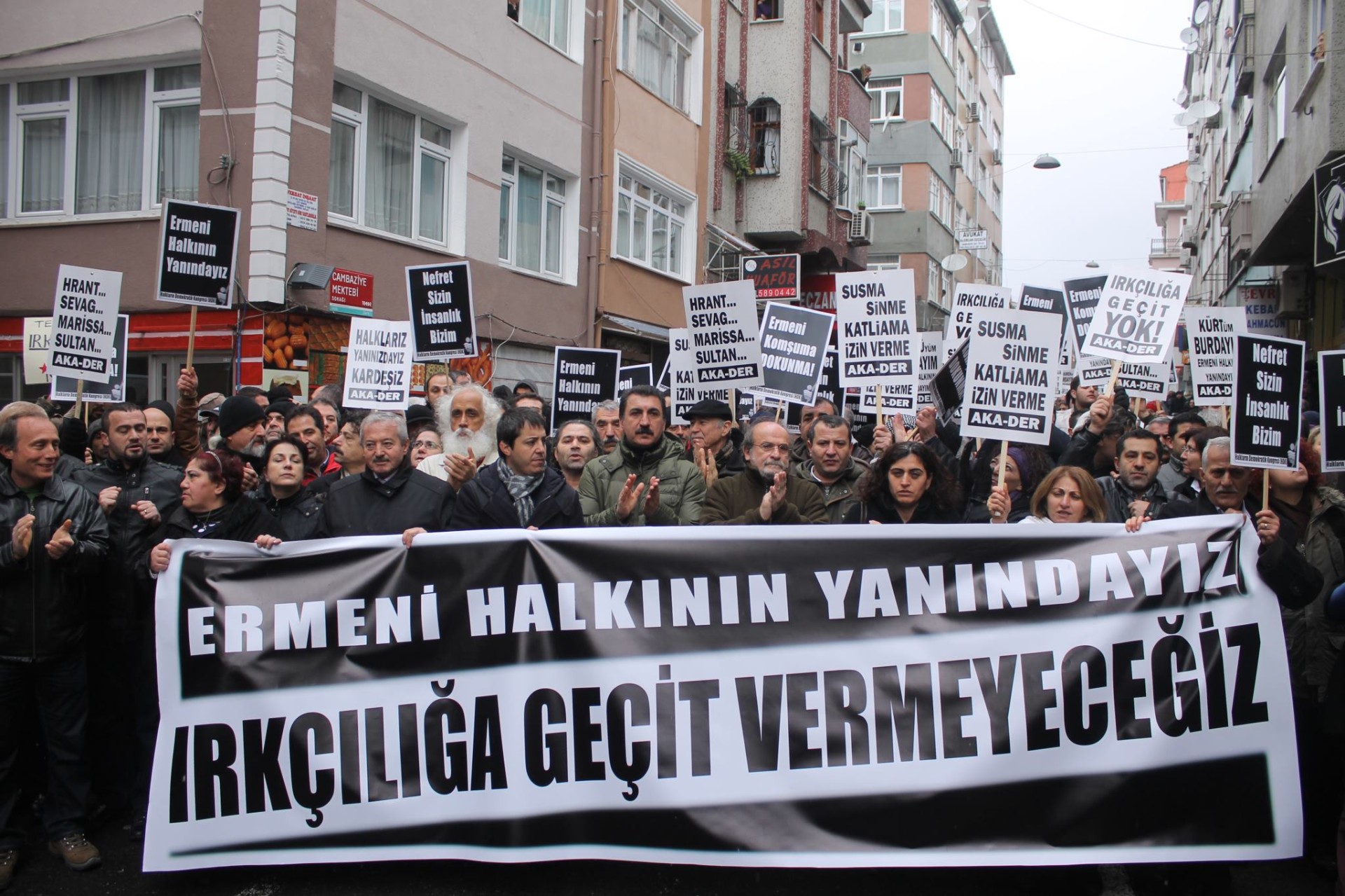
Protest against anti-Armenian crimes in
Samatya, Istanbul: ‘We stand together with Armenians, we won’t give way
to racism.’ (Photo shared on Facebook by Halkların Demokratik Kongresi
[HDK])
Samatya is one of the oldest districts in Istanbul. After the establishment of the Turkish Republic they renamed it Kocamustafa Paşa. But many people still use the old name.
Since November 2012, we have been reading reports of attacks against elderly Armenians in the neighborhood. In December, Marissa Kuchuk was killed during one of these attacks. Several followed.
Even the Armenian community doesn’t know the exact number of the attacks, because Armenians are frightened to even say that they were attacked. If there is no considerable harm, they don’t want to talk about it. This silence confuses the public and allows the police and others to argue that the attacks are not hate crimes.
Now let’s dig deeper, reminding ourselves that as of Jan. 31, the police haven’t yet made a single arrest.
The Armenian NGO Nor Zartonk has been following these attacks. Its representative, Sayat Tekir, told me on our TV show (IMC-GAMURC) that they had predicted a rise in hate crimes against Armenians in their report dated November 2012.
Around the same time, Göksel Gülbey, the president of ASIMDER (The Association for fighting against Armenian Claims), was sharing the names and addresses of Armenian schools in Istanbul on his Twitter and Facebook accounts, without providing additional commentary. He was essentially making these schools targets of attacks.
Soon thereafter, a Turkish teacher at the Aramyan Unciyan Armenian School was murdered in his house not far from the school. Yet no one investigated the president of ASIMDER. He soon claimed that he was being threatened by Armenians and asked for protection from the government.
Now let’s return to the attacks in Samatya.
The Aksaray Police Department, which has jurisdiction over Samatya, told Human Rights Association-Istanbul branch representatives on Jan. 23 that the attacks weren’t hate crimes. The police also pointed to the increased police presence in the neighborhood.
Commenting on the most recent attack, which took place on Jan. 23, the police argued that it took place when the policemen in the area were on a lunch break. Let’s assume this statement is true; doesn’t it mean that the assailants knew about the police department’s shifts, and that these attacks were certainly well organized?
In turn, Istanbul’s mayor announced during a Jan. 25 press conference that the city would broaden the investigation to include two other attacks that occurred in the Sisli and Fatih neighborhoods. But, “fortunately,” those two attacks were against two Turkish old women. Essentially, the mayor had figured out a way to argue that the attacks were not racially motivated.
So why are the police and the mayor insisting that these attacks are random and are not hate crimes against Armenians?
Because if the attacks are organized and are targeting Armenians, it means that nationalism continues to be on the rise in this country. It means that the ruling Justice and Development Party (AKP) has failed to address this problem.
It also means that while the AKP was busy with the “deep state” organization Ergenekon, it didn’t give enough importance to the KAFES operation, which was a part of Ergenekon, and targeted Turkey’s Armenians specifically.
The names of many who worked for the Turkish-Armenian weekly newspaper Agos were on KAFES’s murder list. The group also sent threatening letters to Armenian schools in Istanbul.
It would have been much more effective if the mayor had made a statement in support of the Armenian community. This simple gesture would have calmed the community in Samatya a bit.
Armenians in Istanbul want to believe that these attacks were not targeting them specifically. But they also remember what happened in 1915, 1942, and 1955…
And it seems that such attacks or threats are going to continue until 2015, the centennial of the genocide. The upcoming elections won’t help either, because it’s possible that the government will look the other way to win nationalist votes.
A Link to the Past: The ‘Armenian DNA Project’
Technological and medical advances in the last decade have opened
many doors to research and development. It seems that the more answers
we find, the more complex and layered our questions become. DNA testing
is one of the advances that have become more readily available to the
public. DNA is a self-replicating material present in all living things
as the main constituent of chromosomes. A human normally has 23 pairs of
chromosomes and inherits the 2 sets of chromosomes from his/her
parents. Two of the chromosomes are the sex chromosomes: If you have an
XY chromosome, you are a male, and if you have an XX chromosome, you are
a female. DNA testing allows a person to determine changes in genes
that may indicate a specific disorder, and the test results can reveal a
large amount of family history.

But what if you wanted a genetic map of your ancestry? What if you
wanted to know if all families that shared your last name were related
to you genetically? This is particularly important to Armenians,
considering the variability of Armenian last names and the destruction
of genealogical records of Ottoman-Armenians during the genocide. A
group of scientists decided to find answers to these questions, and
began the Armenian DNA Project.
The Armenian DNA Project was launched in September 2009 by Hovann Simonian, Peter Hrechdakian, and Mark Arslan to help researchers from common or related families work together to find their shared heritage, to identify and confirm genetic Lineages of ancestral families, and to ultimately catalogue pedigrees and genetic connections of all known project families. The Armenian DNA Project works in close cooperation with Levon Yepiskoposyan, a professor at the Institute of Molecular Biology. Yepiskoposyan began his ambitious experiment in January 2010, aiming to reconstruct the genetic history of Armenia and provide a precise interpretation of Armenians’ genetic DNA makeup. In 2010, he administered a blood test to 500 male Armenians, free of charge. In human genetic genealogy, use of the information contained in the Y chromosome is of particular interest since, unlike other chromosomes, the Y chromosome is passed on exclusively from father to son. Testing the Y chromosome can provide insight into the recent and ancient genetic ancestry, as a human male should largely share the same Y chromosome as his father, give or take a few mutations. Similar genetic sequences on the Y chromosome can reveal that two males are related. Although Yepiskoposyan focuses only on males, the same test can be conducted on females by studying their mitochondrial DNA, as the mitochondria is passed from mother to child.
The founders of the Armenian DNA Project aim to find genetic traces of both the ancient peoples whose descendants make up the current Armenian population, and the ancient invaders who conquered or passed through Armenian lands. The project is open to individuals with direct paternal or maternal ancestors of Armenian ancestry. To learn more about the project, visit www.familytreedna.com and search for the “Armenia DNA Project.”
For readers who have studied DNA in biology, you’ll recall that chromosomes are very stringy, so what better recipe to share with you than spun sugar? All I ask from you is that you follow this recipe carefully and do not burn yourself!
Spun sugar recipe
Ingredients:
1 cup sugar
1 tablespoon glucose syrup (or corn syrup)
1/4 cup water
Bring the ingredients to a boil in a saucepan. Wash down the sides of the pan with a pastry brush dipped in water until there are no splashes of sugar on the sides. Boil without stirring until you see a golden tinge in the syrup. Remove from the heat immediately and stir.
The next steps require you to be very cautious!
To use your sugar syrup as a decoration for dessert, choose one of the following methods:
1. Using a fork or spoon drizzle the hot sugar syrup onto baking paper or use the back of a lightly oiled ladle to make domes.
2. Allow it to cool slightly and, using two forks, pull sugar into strands.
To learn more about the project, visit www.familytreedna.com and search for the “Armenia DNA Project.”
The Armenian DNA Project was launched in September 2009 by Hovann Simonian, Peter Hrechdakian, and Mark Arslan to help researchers from common or related families work together to find their shared heritage, to identify and confirm genetic Lineages of ancestral families, and to ultimately catalogue pedigrees and genetic connections of all known project families. The Armenian DNA Project works in close cooperation with Levon Yepiskoposyan, a professor at the Institute of Molecular Biology. Yepiskoposyan began his ambitious experiment in January 2010, aiming to reconstruct the genetic history of Armenia and provide a precise interpretation of Armenians’ genetic DNA makeup. In 2010, he administered a blood test to 500 male Armenians, free of charge. In human genetic genealogy, use of the information contained in the Y chromosome is of particular interest since, unlike other chromosomes, the Y chromosome is passed on exclusively from father to son. Testing the Y chromosome can provide insight into the recent and ancient genetic ancestry, as a human male should largely share the same Y chromosome as his father, give or take a few mutations. Similar genetic sequences on the Y chromosome can reveal that two males are related. Although Yepiskoposyan focuses only on males, the same test can be conducted on females by studying their mitochondrial DNA, as the mitochondria is passed from mother to child.
The founders of the Armenian DNA Project aim to find genetic traces of both the ancient peoples whose descendants make up the current Armenian population, and the ancient invaders who conquered or passed through Armenian lands. The project is open to individuals with direct paternal or maternal ancestors of Armenian ancestry. To learn more about the project, visit www.familytreedna.com and search for the “Armenia DNA Project.”
For readers who have studied DNA in biology, you’ll recall that chromosomes are very stringy, so what better recipe to share with you than spun sugar? All I ask from you is that you follow this recipe carefully and do not burn yourself!
Spun sugar recipe
Ingredients:
1 cup sugar
1 tablespoon glucose syrup (or corn syrup)
1/4 cup water
Bring the ingredients to a boil in a saucepan. Wash down the sides of the pan with a pastry brush dipped in water until there are no splashes of sugar on the sides. Boil without stirring until you see a golden tinge in the syrup. Remove from the heat immediately and stir.
The next steps require you to be very cautious!
To use your sugar syrup as a decoration for dessert, choose one of the following methods:
1. Using a fork or spoon drizzle the hot sugar syrup onto baking paper or use the back of a lightly oiled ladle to make domes.
2. Allow it to cool slightly and, using two forks, pull sugar into strands.
Youth Urge Congress to Speak Out Against Anti-Armenian Hate Crimes in Turkey
Capitol Hill Silent Protest Part of National “Stain of
Denial” Campus Campaign Raising Awareness about the Armenian Genocide
and Legacy of Intolerance
WASHINGTON—Armenian Student Association (ASA) members from the across the U.S. have teamed up with the Washington, DC Armenian Youth Federation (AYF) Ani chapter and local youth in organizing a silent protest on Capitol Hill this week to urge Congress to condemn a series of vicious hate crimes perpetrated against elderly Armenian women in Istanbul, Turkey and to call on U.S. leaders to end Turkey’s gag rule on proper U.S. affirmation of the Armenian Genocide.

The protest will be held in front of the Senate Dirksen Office
Building, on Constitution Ave., from 1 p.m. to 2 p.m. on Jan. 31,
coinciding with the nationwide “Stain of Denial” campus protests
organized by the All-ASA and supported by the AYF and ARF Shant Student
organizations.
“The growing number of hate crimes against Armenians, and particularly women, in Turkey is extremely disturbing. In only the past two months more than four Armenians were attacked and killed in Istanbul, once again bringing to light the strain of deeply rooted hatred and intolerance in Turkish society that is encouraged by the government and its continued policy of genocide denial,” explained Knarik Gasparyan, Public Relations Director of the UCLA Armenian Students Association, in Washington DC for a semester-long internship.
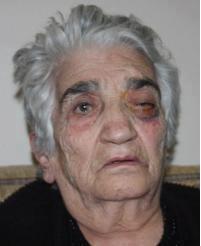
Gasparyan is referring to four widely publicized attacks against elderly Armenian women, one fatal, which have taken place over the past two months, in the historically Armenian-inhabited neighborhood of Samatya, in central Istanbul. On Dec. 28, an 85-year-old Armenian woman was repeatedly stabbed and killed in her home, with assailants carving a cross on her chest. Other attacks include the Nov. 2012 beating of an 87-year-old Armenian woman, and a failed attempt to abduct an elderly Armenian woman on Jan. 6. According to Turkish news outlet, Bianet, the latest incident took place on Jan. 22, when 83-year-old Sultan Aykar was attacked and repeatedly kicked until neighbors heard her screams and rushed to assist her. Aykar lost sight in one eye because of the brutal beating.
The beatings sparked a sharp response from Amnesty International earlier this week, which called on “Turkish authorities to carry out a prompt, thorough and impartial investigation into the series of attacks on elderly Armenian women in Istanbul.” The January 28th statement stressed that “Hate crimes constitute a serious form of discrimination… It is regrettable that Turkish legislation does not foresee any legislative and policy measures ensuring that hate motives are systematically and thoroughly investigated and duly taken into account in the prosecution and sentencing.”
Questions regarding a government cover-up of the attacks abound, as Turkish authorities attempt to downplay the crimes. “The incident was inspired by robbery, there were no racial motives. Be sure we will find the perpetrators. Good night,” tweeted Istanbul Governor Huseyin Avni Mutlu to his 100,000 followers. This and similar statements prompted Amnesty International to express “concern at public statements made by the authorities discounting the possibility of a racist motivation to the attacks.” Meanwhile, the Turkish Human Rights Association stated categorically that “the attacks were carried out with racist motives,” according to a January 28th Economist article, “Turkey’s Armenians: The Ghosts of 1915,” referencing the legacy of the Armenian Genocide and its denial.
“The recent brutal murders and attacks on elderly Armenian women in Istanbul once again showed the level of xenophobia and intolerance within the Turkish society,” explained Bloomfield College student Armen Sahakyan. “The events also serve as a sober reminder for us that the Armenian Genocide issue is not yet resolved and we should work ever harder to stand up to Turkey’s denial of that crime and secure the return of what rightfully belongs to the Armenian nation.”
WASHINGTON—Armenian Student Association (ASA) members from the across the U.S. have teamed up with the Washington, DC Armenian Youth Federation (AYF) Ani chapter and local youth in organizing a silent protest on Capitol Hill this week to urge Congress to condemn a series of vicious hate crimes perpetrated against elderly Armenian women in Istanbul, Turkey and to call on U.S. leaders to end Turkey’s gag rule on proper U.S. affirmation of the Armenian Genocide.
The protest will be held in front of the Senate Dirksen Office Building, on Constitution Ave., from 1 p.m. to 2 p.m. on Jan. 31
“The growing number of hate crimes against Armenians, and particularly women, in Turkey is extremely disturbing. In only the past two months more than four Armenians were attacked and killed in Istanbul, once again bringing to light the strain of deeply rooted hatred and intolerance in Turkish society that is encouraged by the government and its continued policy of genocide denial,” explained Knarik Gasparyan, Public Relations Director of the UCLA Armenian Students Association, in Washington DC for a semester-long internship.
Gasparyan is referring to four widely publicized attacks against elderly Armenian women, one fatal, which have taken place over the past two months, in the historically Armenian-inhabited neighborhood of Samatya, in central Istanbul. On Dec. 28, an 85-year-old Armenian woman was repeatedly stabbed and killed in her home, with assailants carving a cross on her chest. Other attacks include the Nov. 2012 beating of an 87-year-old Armenian woman, and a failed attempt to abduct an elderly Armenian woman on Jan. 6. According to Turkish news outlet, Bianet, the latest incident took place on Jan. 22, when 83-year-old Sultan Aykar was attacked and repeatedly kicked until neighbors heard her screams and rushed to assist her. Aykar lost sight in one eye because of the brutal beating.
The beatings sparked a sharp response from Amnesty International earlier this week, which called on “Turkish authorities to carry out a prompt, thorough and impartial investigation into the series of attacks on elderly Armenian women in Istanbul.” The January 28th statement stressed that “Hate crimes constitute a serious form of discrimination… It is regrettable that Turkish legislation does not foresee any legislative and policy measures ensuring that hate motives are systematically and thoroughly investigated and duly taken into account in the prosecution and sentencing.”
Questions regarding a government cover-up of the attacks abound, as Turkish authorities attempt to downplay the crimes. “The incident was inspired by robbery, there were no racial motives. Be sure we will find the perpetrators. Good night,” tweeted Istanbul Governor Huseyin Avni Mutlu to his 100,000 followers. This and similar statements prompted Amnesty International to express “concern at public statements made by the authorities discounting the possibility of a racist motivation to the attacks.” Meanwhile, the Turkish Human Rights Association stated categorically that “the attacks were carried out with racist motives,” according to a January 28th Economist article, “Turkey’s Armenians: The Ghosts of 1915,” referencing the legacy of the Armenian Genocide and its denial.
“The recent brutal murders and attacks on elderly Armenian women in Istanbul once again showed the level of xenophobia and intolerance within the Turkish society,” explained Bloomfield College student Armen Sahakyan. “The events also serve as a sober reminder for us that the Armenian Genocide issue is not yet resolved and we should work ever harder to stand up to Turkey’s denial of that crime and secure the return of what rightfully belongs to the Armenian nation.”
Friday, January 25, 2013
Bedrosyan: Hrant’s Message and the Way Forward
On the sixth anniversary of his assassination and more significantly,
on the sixth anniversary of the Turkish state’s inability or
unwillingness to find his real killers, Hrant Dink was remembered by
tens of thousands of people in many countries as well as in Turkey,
including Istanbul, Ankara, Izmir, Diyarbakir, Malatya, and Bodrum.
Throughout the world, Turkish and Armenian speakers repeated his vision
and message of direct dialogue between Turks and Armenians. Year by
year, instead of gradually diminishing in numbers toward oblivion, as is
the case for other assassinated journalists in Turkey, there is a
snowballing increase in the number and intensity of people attending the
Hrant Dink commemorations, protesting and demanding justice, as well as
adopting Hrant’s message with more determination. It is not the tiny
Armenian community in Turkey, but Turks (and Kurds) from all walks of
life who have embraced Hrant as a tragic hero. The momentum is building
to declare Hrant a martyr—the first shared martyr by the historically
opposing nations of Armenians and Turks.

But what exactly was Hrant’s message? He would define Armenians and
Turks as two sick people, clinical cases—Armenians suffering from trauma
(obsessed with 1915) and Turks suffering from paranoia (fear of
consequences of acknowledging 1915). He would advocate Armenians and
Turks to be each other’s doctors, with dialogue as the only
prescription. And he would clap his large hands vigorously, exclaiming,
“There is no other medicine, no other doctor, no, no, no.” He knew
dialogue would be useless if one couldn’t discuss the painful year of
1915, but only pleasant subjects such as Turks’ and Armenians’ shared
values, shared culture, shared foods like dolma and kebab. He knew that
dialogue would also be useless if one was unable to really “listen and
hear,” in addition to talk. And most importantly, he knew that dialogue
would be useless if one didn’t know the real historical facts of 1915.
After being systematically brainwashed by the state with ever-changing
official versions of history, people in Turkey have now finally started
to learn the true historic facts, reasons, and consequences of 1915, not
just the Turkish version versus Armenian version. So, if and when there
is willingness to talk and listen, both sides can and should engage in
direct dialogue, without the need to convince third parties to pressure
the other side.
Hrant had studied zoology, and he would explain that if you remove any living organism from its natural environment, you would cause its extinction. He would then say, “If you remove an entire people from its land where it has lived continuously for 3,000 years, even if you transport them with great care in ‘golden airplanes,’ this would still be similar to taking an axe to the roots of an ancient tree.” He didn’t need to explain 1915 with long words; in a corner of the Agos newspaper, every week, he would place some facts about a village or town in Anatolia—could be in west, east, north, south, or central Anatolia—giving the Armenian and total population numbers, the names and numbers of churches and schools there, before 1915. He would have photos of these active Armenian churches and schools in that village or town before 1915, and photos of these non-existent churches or schools today, totaling more than 4,000 buildings. That would be enough for anyone to understand the reality of 1915.
But he wouldn’t only talk about the Armenians gone or dead in 1915. He was much more interested in talking about the Armenians who remained, who stayed in Anatolia, who stayed and survived, but no longer as Armenians. These were the Armenians who survived by converting to Islam, by assuming Turkish, Kurdish, or Alawi identities. These were the Armenian girls and boys captured or sold, kept hidden, protected or married to Turks and Kurds. And entire Armenian villages that converted to Islam, or stayed protected by friendly Kurdish and Alawi leaders. Hrant was obsessed with this subject. What happened to these people? Did they secretly keep their Armenian identity? Did they pass it on to the next generations? Where are they now? How many are there? If there are “hidden Armenians,” what would be the trigger for them to “come out of hiding”?
Genocide is not a single event but a continuous process. It is not only denial of a genocide that continues it, but also assimilation and conversion that continue it. Scholars have recently started defining genocide not only as the destruction of an oppressed nation, but also the construction of the oppressor nation—using assimilation and conversion processes. For Armenians, these processes continued on all fronts.
Hrant didn’t or couldn’t write much about this sensitive subject, but he was preoccupied by it, gathering stories, anecdotal evidence, always encouraging others to find out more. Clearly, this was not a subject that could be researched openly and scientifically, but whenever a new revelation came out about hidden Armenians in Anatolia, he would be greatly excited. His lawyer Fethiye Cetin’s book My Grandmother was only an example of the fate of the hidden Armenians. In an interview with London filmmaker Nouritsa Matossian for the documentary “Hrant Dink: A Heart Of Two Nations,” Matossian asked him, “Do you see Armenian faces in Anatolia?” Hrant: “Yes, often.” Nouritsa: “Apparitions [meaning, ghosts]?” Hrant: “Apparitions and real ones.” One could tell that Hrant, the emotional Hrant with the biggest heart, was like a child who had a secret he could hardly keep.
The answer to the question that kept him wondering—What would be the trigger for the hidden Armenians to come out?—came four years too late for Hrant to witness, unfortunately. The trigger was the reconstruction of the Diyarbakir Surp Giragos Church in 2011. Thousands of Anatolians, young and old, Turkish and Kurdish, in appearance and identity, returned to their Armenian roots with the reopening of this church. Some got baptized in the church, some changed their Turkish names to the Armenian original, some changed their identity to Armenian but remained Muslim (a new phenomenon of Muslim-Armenians), some started learning the Armenian language. Hrant would have danced with joy to see an 11-year-old Kurdish girl not only learning Armenian but also singing Armenian songs at the first Armenian concert in the Diyarbakir Surp Giragos Church in 2012. Hrant would have danced on the table after seeing a thousand people from Adiyaman, Amasya, Arapkir, Dersim, Diyarbakir, Elazig, Harput, Hemshin, Istanbul, Kastamonu, Kayseri, Malatya, Musadagh, Sason, Sinop, Sivas, Tokat, Van, and Yozgat organize activities together and celebrate the Surp Hagop Day in December 2012, singing Armenian songs, even though no one knew how to speak Armenian.
Hrant was an Anatolian Armenian and wished to have the same democratic rights as all other citizens of the state, without being excluded, without being discriminated against, without being pressured to lose his identity. Armenians wished to have exactly the same things 100 years ago—no more, no less. The state felt threatened, and when fear got combined with opportunity it wiped out the Armenian identity in Anatolia to build a Turkish identity that excluded all others, including Greeks, Assyrians, and Kurds. The enormous transfer of wealth and assets from Armenians to Turks has added to the fear and paranoia of the state in facing its past. A new Turkish identity, which does not fear diversity or minority identities, needs to be created in Turkey in order to face both the past and the future. The state has finally started this process with the Kurds, but not the Armenians. The Kurds have started this process with the Armenians, openly acknowledging their role in 1915, and starting to make amends. It is hoped that Turks will see the light and follow them.
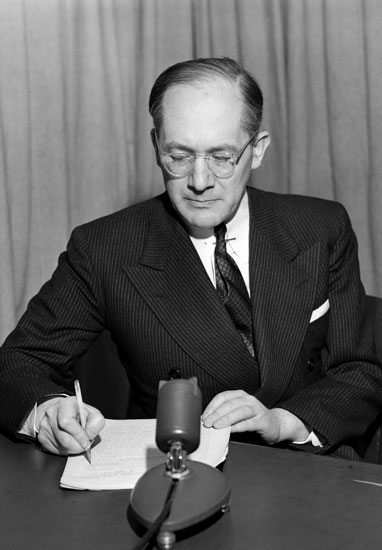
After being systematically brainwashed by
the state with ever-changing official versions of history, people in
Turkey have now finally started to learn the true historic facts,
reasons, and consequences of 1915, not just the Turkish version versus
Armenian version.
Hrant had studied zoology, and he would explain that if you remove any living organism from its natural environment, you would cause its extinction. He would then say, “If you remove an entire people from its land where it has lived continuously for 3,000 years, even if you transport them with great care in ‘golden airplanes,’ this would still be similar to taking an axe to the roots of an ancient tree.” He didn’t need to explain 1915 with long words; in a corner of the Agos newspaper, every week, he would place some facts about a village or town in Anatolia—could be in west, east, north, south, or central Anatolia—giving the Armenian and total population numbers, the names and numbers of churches and schools there, before 1915. He would have photos of these active Armenian churches and schools in that village or town before 1915, and photos of these non-existent churches or schools today, totaling more than 4,000 buildings. That would be enough for anyone to understand the reality of 1915.
But he wouldn’t only talk about the Armenians gone or dead in 1915. He was much more interested in talking about the Armenians who remained, who stayed in Anatolia, who stayed and survived, but no longer as Armenians. These were the Armenians who survived by converting to Islam, by assuming Turkish, Kurdish, or Alawi identities. These were the Armenian girls and boys captured or sold, kept hidden, protected or married to Turks and Kurds. And entire Armenian villages that converted to Islam, or stayed protected by friendly Kurdish and Alawi leaders. Hrant was obsessed with this subject. What happened to these people? Did they secretly keep their Armenian identity? Did they pass it on to the next generations? Where are they now? How many are there? If there are “hidden Armenians,” what would be the trigger for them to “come out of hiding”?
Genocide is not a single event but a continuous process. It is not only denial of a genocide that continues it, but also assimilation and conversion that continue it. Scholars have recently started defining genocide not only as the destruction of an oppressed nation, but also the construction of the oppressor nation—using assimilation and conversion processes. For Armenians, these processes continued on all fronts.
Hrant didn’t or couldn’t write much about this sensitive subject, but he was preoccupied by it, gathering stories, anecdotal evidence, always encouraging others to find out more. Clearly, this was not a subject that could be researched openly and scientifically, but whenever a new revelation came out about hidden Armenians in Anatolia, he would be greatly excited. His lawyer Fethiye Cetin’s book My Grandmother was only an example of the fate of the hidden Armenians. In an interview with London filmmaker Nouritsa Matossian for the documentary “Hrant Dink: A Heart Of Two Nations,” Matossian asked him, “Do you see Armenian faces in Anatolia?” Hrant: “Yes, often.” Nouritsa: “Apparitions [meaning, ghosts]?” Hrant: “Apparitions and real ones.” One could tell that Hrant, the emotional Hrant with the biggest heart, was like a child who had a secret he could hardly keep.
The answer to the question that kept him wondering—What would be the trigger for the hidden Armenians to come out?—came four years too late for Hrant to witness, unfortunately. The trigger was the reconstruction of the Diyarbakir Surp Giragos Church in 2011. Thousands of Anatolians, young and old, Turkish and Kurdish, in appearance and identity, returned to their Armenian roots with the reopening of this church. Some got baptized in the church, some changed their Turkish names to the Armenian original, some changed their identity to Armenian but remained Muslim (a new phenomenon of Muslim-Armenians), some started learning the Armenian language. Hrant would have danced with joy to see an 11-year-old Kurdish girl not only learning Armenian but also singing Armenian songs at the first Armenian concert in the Diyarbakir Surp Giragos Church in 2012. Hrant would have danced on the table after seeing a thousand people from Adiyaman, Amasya, Arapkir, Dersim, Diyarbakir, Elazig, Harput, Hemshin, Istanbul, Kastamonu, Kayseri, Malatya, Musadagh, Sason, Sinop, Sivas, Tokat, Van, and Yozgat organize activities together and celebrate the Surp Hagop Day in December 2012, singing Armenian songs, even though no one knew how to speak Armenian.
Hrant was an Anatolian Armenian and wished to have the same democratic rights as all other citizens of the state, without being excluded, without being discriminated against, without being pressured to lose his identity. Armenians wished to have exactly the same things 100 years ago—no more, no less. The state felt threatened, and when fear got combined with opportunity it wiped out the Armenian identity in Anatolia to build a Turkish identity that excluded all others, including Greeks, Assyrians, and Kurds. The enormous transfer of wealth and assets from Armenians to Turks has added to the fear and paranoia of the state in facing its past. A new Turkish identity, which does not fear diversity or minority identities, needs to be created in Turkey in order to face both the past and the future. The state has finally started this process with the Kurds, but not the Armenians. The Kurds have started this process with the Armenians, openly acknowledging their role in 1915, and starting to make amends. It is hoped that Turks will see the light and follow them.
Two Armenian Women Attacked in Istanbul in Past 24 Hours
Second attack not confirmed independently
ISTANBUL, Turkey—Two elderly Armenian women were attacked in Istanbul’s Samatya district on Jan 22 and 23, less than a month after an 84-year-old Armenian woman was brutally murdered in Istanbul, raising the number of violent attacks against elderly Armenian women to at least four in recent months.
The Jan. 22 attack happened around 5 p.m. when the victim, 83-year-old Sultan Aykar was about to enter her ground-floor apartment. She then saw the intruder and, frightened, she fell. The attacker proceeded to kick her. Hearing her screams, neighbors came down, scaring off the masked man, reported Bianet. The neighbors described the attacker as a male between the ages of 35 and 40, with gray hair, and dressed in black. During the attack, Aykar suffered damage to her eye. She has now lost sight in that eye, despite surgery on Jan. 23. The victim’s daughter, Menzar Etik, said her mother did not have any enemies, as she was a quiet woman. Etik did not believe the attacker’s intention was robbery, as the attacker did not attempt to steal her purse, and there was nothing more than a broken TV in her apartment.
Today (Jan. 23), another attack was reported on yet another elderly Armenian woman. The attack happened on the street, near the Samatya High School, sources reported. The two assailants ran away. The victim was covered with blood. Shortly thereafter, she disappeared. Community members and plainclothes policemen have been unable to find or identify the woman.
The Armenian Weekly could not independently confirm the report on today’s attack.
In turn, Agos editor Rober Koptas told the Weekly, “We spoke to churchmen, taghagans, shopkeepers, police, and lots of people but none of them confirmed it.”
The Samatya area is home to many Armenians. The community is weary of these attacks, and calls for caution have been made.
In recent years, there have been several attacks against Armenians in Turkey. In early December another Armenian woman was attacked and robbed; while months earlier an Armenian woman was attacked by a taxi driver and called an infidel.
On Jan. 6, three assailants tried to kidnap an elderly Armenian woman, according to Turkish sources. The attempt failed.
According to human rights activists, the common thread that runs through all of these crimes is not just their being motivated by hate or being committed in an environment that breeds intolerance against Armenians, but also the efforts of the authorities to play them down and cover them up.
The Armenian Weekly will continue following up on this issue.
ISTANBUL, Turkey—Two elderly Armenian women were attacked in Istanbul’s Samatya district on Jan 22 and 23, less than a month after an 84-year-old Armenian woman was brutally murdered in Istanbul, raising the number of violent attacks against elderly Armenian women to at least four in recent months.
The Jan. 22 attack happened around 5 p.m. when the victim, 83-year-old Sultan Aykar was about to enter her ground-floor apartment. She then saw the intruder and, frightened, she fell. The attacker proceeded to kick her. Hearing her screams, neighbors came down, scaring off the masked man, reported Bianet. The neighbors described the attacker as a male between the ages of 35 and 40, with gray hair, and dressed in black. During the attack, Aykar suffered damage to her eye. She has now lost sight in that eye, despite surgery on Jan. 23. The victim’s daughter, Menzar Etik, said her mother did not have any enemies, as she was a quiet woman. Etik did not believe the attacker’s intention was robbery, as the attacker did not attempt to steal her purse, and there was nothing more than a broken TV in her apartment.
Today (Jan. 23), another attack was reported on yet another elderly Armenian woman. The attack happened on the street, near the Samatya High School, sources reported. The two assailants ran away. The victim was covered with blood. Shortly thereafter, she disappeared. Community members and plainclothes policemen have been unable to find or identify the woman.
The Armenian Weekly could not independently confirm the report on today’s attack.
In turn, Agos editor Rober Koptas told the Weekly, “We spoke to churchmen, taghagans, shopkeepers, police, and lots of people but none of them confirmed it.”
The Samatya area is home to many Armenians. The community is weary of these attacks, and calls for caution have been made.
In recent years, there have been several attacks against Armenians in Turkey. In early December another Armenian woman was attacked and robbed; while months earlier an Armenian woman was attacked by a taxi driver and called an infidel.
On Jan. 6, three assailants tried to kidnap an elderly Armenian woman, according to Turkish sources. The attempt failed.
According to human rights activists, the common thread that runs through all of these crimes is not just their being motivated by hate or being committed in an environment that breeds intolerance against Armenians, but also the efforts of the authorities to play them down and cover them up.
The Armenian Weekly will continue following up on this issue.
Tuesday, January 22, 2013
Armenians in Italy
Armenians in Italy - Wikipedia, the free encyclopedia
Armenians in Italy covers the Armenians who live in Italy. There are
currently 3.000 Armenians in Italy mainly residing in Milan, Rome and Venice.[2]
Besides the general population, there are monastic communities on the island of San Lazzaro (Venice) and at the Moorat-Raphael College of Venice as well as Armenian clergy at the Holy See (Vatican).
The oldest information about Armenians living in Italy goes back to the
6th-8th centuries. Later, in the 9th-10th centuries, a great number of Armenians
moved to Italy from Thrace and Macedonia. They were the
descendants of Paulicians chased from Armenia by
emperor Constantin.
As to Armenian communities, they were formed in Italy in the 12th-13th centuries, when active trade was going on between Cilician Armenia and Italian big city-republics as Genoa, Venice and Pisa. Under Cilician Armenian king Levon II (1187–1219) (also known as King Leo II of Armenia), treaties were signed between the two parties, according to which Italian merchants had the right to open factories and to develop industrial activities in the Armenian Kingdom of Cilicia and Armenian merchants could do the same in Italian towns. These treaties were periodically renewed, as long as the Cilician Armenian Kingdom existed. In the 13th century the number of Armenians in Italy increased because of the new wave of emigrants after the invasion of Tatars and Mongols.
Beginning with the 15th-16th centuries the process of catholicizing Armenians was strengthened in Italy which greatly contributed to their assimilation with Italian people. Nevertheless, some Armenian organizations continued to function with the aim to preserve national identity. As a result first Armenian books were printed in Venice.
Besides, in the beginning of the 18th century the Armenian Congregation of the Mechitarists (Armenian: Õ„ÕÕ«Õ©Õ¡Ö€Õ¥Õ¡Õ¶, also spelled Mekhitarists), was founded in Venice, on the St. Lazzaro Island (San Lazzaro degli Armeni). It exists up till now with its monastery, library, manuscripts depository and publishing house, and is considered as a centre of Armenian culture in Italy.
There is also the reputable Moorat-Raphael College in Venice for general education with student body from Armenians from many countries and Collegio Armeno (The Pontifical Armenian College) in Rome for preparation of clergy in the Armenian Catholic Church.
From Wikipedia, the free encyclopedia
Jump to: navigation, search
|
|
This article needs additional citations for verification. Please help improve this article by adding citations to reliable sources. Unsourced material may be challenged and removed (August 2009) |
| Total population |
|---|
| 2500[1] |
| Regions with significant populations |
| Milan, Rome and Venice |
| Languages |
| Armenian, Italian |
| Religion |
| Armenian Apostolic, Armenian Catholic, Evangelical and Protestant |
| Related ethnic groups |
| Armenian, Hamshenis, Cherkesogai groups |
Besides the general population, there are monastic communities on the island of San Lazzaro (Venice) and at the Moorat-Raphael College of Venice as well as Armenian clergy at the Holy See (Vatican).
Contents |
[edit] History
| This section does not cite any references or sources. Please help improve this section by adding citations to reliable sources. Unsourced material may be challenged and removed (May 2012) |
As to Armenian communities, they were formed in Italy in the 12th-13th centuries, when active trade was going on between Cilician Armenia and Italian big city-republics as Genoa, Venice and Pisa. Under Cilician Armenian king Levon II (1187–1219) (also known as King Leo II of Armenia), treaties were signed between the two parties, according to which Italian merchants had the right to open factories and to develop industrial activities in the Armenian Kingdom of Cilicia and Armenian merchants could do the same in Italian towns. These treaties were periodically renewed, as long as the Cilician Armenian Kingdom existed. In the 13th century the number of Armenians in Italy increased because of the new wave of emigrants after the invasion of Tatars and Mongols.
Beginning with the 15th-16th centuries the process of catholicizing Armenians was strengthened in Italy which greatly contributed to their assimilation with Italian people. Nevertheless, some Armenian organizations continued to function with the aim to preserve national identity. As a result first Armenian books were printed in Venice.
Besides, in the beginning of the 18th century the Armenian Congregation of the Mechitarists (Armenian: Õ„ÕÕ«Õ©Õ¡Ö€Õ¥Õ¡Õ¶, also spelled Mekhitarists), was founded in Venice, on the St. Lazzaro Island (San Lazzaro degli Armeni). It exists up till now with its monastery, library, manuscripts depository and publishing house, and is considered as a centre of Armenian culture in Italy.
There is also the reputable Moorat-Raphael College in Venice for general education with student body from Armenians from many countries and Collegio Armeno (The Pontifical Armenian College) in Rome for preparation of clergy in the Armenian Catholic Church.
Subscribe to:
Posts (Atom)