Saturday, January 18, 2014

Aghjayan Delivers Talk on ‘Hidden Armenians’ in Ankara (Full Text)

On Jan. 18, writer and activist George Aghjayan delivered a talk in Ankara on Turkey’s “hidden Armenians.” He was speaking during a panel discussion held in memory of Hrant Dink. Below is the full text of his talk. 
***
The first time I traveled to Turkey was in 1996. I spent three weeks covering the length and breadth of the country, from Istanbul to Van, from Erzurum to Musa Dagh. The land had been calling me for some time, yet the trip was extremely difficult emotionally and physically. Even though I had left many things undone, it took 15 years before I could even begin to put behind the emotional scars from that trip.
It was the re-consecration of the Surp Giragos Church [in Diyarbakir/Dikranagerd] and the conference on the social and economic history of the Diyarbakir province organized by the Hrant Dink Foundation that brought me back in 2011. I found a much different reality in Turkey and have now returned 4 additional times since 2011. I am profoundly thankful to the organizers of this event for providing me yet another opportunity to be here and to reflect on the cruel murder of Hrant Dink.
Hrant observed, “When we talk of 1915, we should not just speak of those who perished, but also of the experiences of those who survived.” Over the almost 20 years now that I have been traveling to Turkey, I have met many Armenians, and I would like to share a few of their stories.
I think of my first trip to Keserig where we met a very old Armenian woman. My uncle, whose family was from Keserig, was asking if she recognized our family name. As the conversation progressed and the crowd around us grew, I remember a man getting very angry with us and screaming, “Why do you ask about the Armenians?” I distinctly remember another man shouting him down, telling him to go away, and kindly offering to show us where the church and other significant places had been. It occurred to me that, quite reasonably, the first of these men represented the descendants of those who committed the genocide. If not literally, surely in spirit, those who deny the genocide and reveal their racism today are linked to the criminals of the past. The second man, in turn, represented those whose humanity demanded that they rescue Armenians.
I think of the visit to my grandmother’s village of Uzunova where one of the leading men revealed that both his grandmothers were Armenian. My own grandmother was a young girl when she was taken as a slave to a Muslim family. Her father murdered, her mother and two sisters sent on the death march never to be seen or heard from again, she survived six years in servitude before her sole surviving sister rescued her.
When I met this man, I felt the bond of two sons of the village—his grandmothers were taken and never escaped, while mine was rescued. We were two sides of the same coin.
I think of our wonderful friend Armen who has bravely embraced his Armenian and Christian heritage, and his brothers who have remained Muslim. They open their home time and time again to Armenians visiting their village, and share their knowledge of the history of the region. This family, like so many others,  has seen the crimes against both Armenians and Kurds…crimes of hate and racism.
I think of Asiya from Chungush, about whom my friend, Chris Bohjalian, so eloquently wrote in the Washington Post. On one visit to Chungush, as we were about to drive away, her son-in-law tapped on the window of our van. Upon rolling down the window, he indicated that his mother-in-law was Armenian. Not knowing exactly who or why this man had approached us, we began to drive away. He stopped us again by banging on the window, this time with greater anxiety. As the window was being rolled down, he thrust his phone to my friend Khatchig Mouradian, and on the phone was a video of Asiya telling the names of her Armenian relatives. We would meet Asiya that day.
I think of entering a village near Moks, where I knew Armenian were still living in the recent past. On the main road to the village, we stopped a man who was walking by and asked if he knew of any Armenians living there. He said there was an elderly Armenian woman who was very sick and homebound. He indicated this woman’s son was working in the field just up ahead of us. So we drove on and eventually came upon a man working in the field. However, when we inquired about his mother, he indicated she was too ill to talk to anyone and was not Armenian in any case. His explanation for the confusion was that the other man had something against him and that is why he had claimed that his elderly mother was Armenian.
So, you see, those who descend from the remaining Armenians deal with their heritage in very different ways. The reception they have received from the Armenian community and their Muslim neighbors has been equally varied.
I recall the genocide survivor memoir titled, In the Shadow of the Fortress. It is a fascinating account from the village of Hussenig of what it was like for those who survived the genocide in hiding. The author recounts how after each round of deportation, there would be a period of calm followed by pronouncements that it was now safe for the Armenians to come out of hiding. After a period of time, the Armenians who naively believed such promises would be rounded up and marched off. This happened time and time again. Similarly, many of those who hide their identity today have survived over the decades by remaining silent, by not believing that the climate had in fact changed. Throughout the years, they have learned that those who believe in change and reveal themselves ultimately suffer persecution.
The Islamized Armenians must be welcomed back to their Armenian heritage. Not as second-class citizens, and definitely not to experience a new kind of discrimination. Every single Islamized Armenian is a precious miracle of the survival of identity and is the key to the return of the Armenian presence to these lands. Armenian culture and heritage was born of this land, and after a thousand years of assimilation and purposeful destruction, we demand the right of its return.
Today, there is a window of opportunity that has opened a crack. It is our challenge—those of us here today and others who are like-minded—to open the window wider, and permanently. If we fail, we may never have another opportunity. That is what the criminals are counting on.

9 Comments on Aghjayan Delivers Talk on ‘Hidden Armenians’ in Ankara (Full Text)

  1. Unger George, Amazingly well done story. Felt as if I was there with you. Keep the Faith.
    Unger Steve Elmasian
  2. Those hidden Armenians who whish to be considered Armenian, even though prefering to stay as Muslims, should be welcomed with open arms. Rejection of this group of people as Armenian on religious grounds should be condemned in strongest terms. In a revived West-Armenian presence in Turkey there should be no room for such bigotry.
  3. Fantastic article – gives hope that there still is an Armenia presence on the ground in Western Armenia. This presence needs to be nurtured, ever so thoughtfully, to someday once again see a strong Armenian culture in this land.
  4. Well stated! We definitely should welcome those who have survived in hiding.. They have lived a double life.. Tin fear and isolation… Ain’t fun nor is it easy…we need to have a heart for them…to support them in any way we can.
    They need to be assimilated, integrated, loved and welcomed to be part of the world wide Armenian Family..
    We will be a richer nation with their inclusion..
  5. avatar harry mardirossian // January 18, 2014 at 3:03 pm // Reply
    I like to make a correlation between OUR Islamized Armenian heritage and OUR architectural heritage in Western Armenia.
    Why is it that the Armenian Church leadership and its clergy take full claim to the islamized churches, but not care about living souls of islamized Armenians?
    Are they not one and the same?
    Which is more important?
  6. avatar Peter B. Kallanian // January 18, 2014 at 3:50 pm // Reply
    George, your title of writer and activist is well a propos. it amazes Aunt Vev and me to see you so active for the cause. You are to be congratulated and we are so proud of you. We often wonder how you are able to do all these things besides taking care of the family and your work.
    Bravo George, you are in our hearts and prayers.
    Uncle Peter
    the family and your work
  7. avatar CHARLES DER KAZARIAN // January 18, 2014 at 4:54 pm // Reply
    Great article! Congratulations to George on his continuing good work.
  8. Turkey’s Hidden Armenians forcefully Islamized, but they are not Turkified. Turkish Ottoman’s bloody civilization could not take away Armenian spirit from them.
  9. No matter how we all feel but there is no such a thing as Armenian Muslim , Muslim religion is not accepted in our history or culture , sorry but these Muslims should live as turks .

Thursday, January 16, 2014

Book on Armenian Amiras Published in Turkish

ISTANBUL, Turkey (A.W.)—On Dec. 25, 2013, Istanbul’s Aras Publishing published the Turkish translation of Hagop L. Barsoumian’s The Armenian Amira Class of Istanbul (İstanbul’un Ermeni Amiralar Sınıfı, in Turkish). Human rights activist Ayse Gunaysu, who is also a professional translator and a columnist for the Armenian Weekly, edited the book and prepared it for publication.
amiralar on kapak 198x300 Book on Armenian Amiras Published in Turkish
Cover of the Turkish translation of The Armenian Amira Class of Istanbul
Originally published by the American University of Armenia (AUA) in 2007, The Armenian Amira Class of Istanbul was Barsoumian’s 1980 doctoral dissertation at Columbia University.
The book opens with a heartfelt tribute to the author by his wife, Anais, who brought about the publication 21 years after Hagop Barsoumian’s disappearance during the Lebanese civil war in 1986.
Khachig Tololyan, professor of English and chair of the English department at Wesleyan University, and a longtime friend of the author, notes in the preface, “At the time of its completion around 1979 it was, as it remains now, the most thorough study of the Armenian amiras of the Ottoman Empire.”
The Armenian Amira Class of Istanbul provides the story of the powerful elite group known as the amiras, tracing their rise, dominance, and, ultimately, decline. Barsoumian’s research also draws the genealogical connections between these elite families, and the role these relationships played in maintaining power.
“No one has done this for the amiras with anything remotely approaching Barsoumian’s thoroughness. His grasp of these connections of descent and marriage enables him to write confidently about the ways in which a dominant elite constructed and sustained itself,” writes Tololyan.
Born in Aleppo in 1936 to Ayntabtsi parents and genocide survivors, Barsoumian attended the Karen Jeppe Jemaran. In 1960, he settled in the San Francisco, Calif. He attended San Francisco State College, where he earned a B.S. (1964), followed by an M.A. (1969) in international trade, focusing on the European common market. In 1972, he relocated to New York. In 1975, he earned another M.A. in Middle East history from New York University and, five years later, earned his Ph.D. from Columbia University in Ottoman history. Barsoumian then moved to Beirut, where he taught history and Middle East politics at Haigazian University. On Jan. 31, 1986, he was kidnapped, and was not seen again.

Sassounian: Armenians Should Counteract Countless Congressional Trips to Turkey

The Turkish government, its lobbying firms, and Turkish-American organizations have spent millions of dollars to take members of Congress and their staff on all-expenses-paid trips to Turkey with the intent of buying their allegiance.
This is standard practice for Washington’s influence peddlers. Understandably, Turkish power brokers would want to sway congressional decision-making, as long as the trips follow proper legal procedures. However, as investigative journalist Shane Goldmacher revealed last week in the National Journal, members of Congress and their paymasters often manipulate the nebulous rules to accomplish their self-serving interests.
Goldmacher begins his article, “How Lobbyists Still Fly Through Loopholes,” by describing the globe-trotting adventures of a pair of political odd fellows chasing the almighty dollar: “Dennis Hastert and Dick Gephardt couldn’t stand each other when they led Congress a decade ago. But now they’ve moved to K Street, where the flood of money tends to wash over such personal differences. These days, they work hand in hand as two of Turkey’s top lobbyists, with their respective firms pocketing most of a $1.4 million annual lobbying contract.” Not surprisingly, Republican Hastert and Democrat Gephardt accompanied eight members of Congress on an “all-expenses-paid journey” to Turkey last April.
The National Journal article highlights congressional trips to several countries, including Turkey, Azerbaijan, and Israel. Under the subtitle, “Turkey Exploits the Biggest Loophole,” Goldmacher discloses the extensive preparations made by Hastert’s firm for the congressional trip to Turkey, even though lobbyists are prevented from planning or paying for lawmakers’ visits: “Lobbyists have been intimately involved in the months of planning for the trip, with dozens of back-and-forth emails, phone calls, and meetings on Capitol Hill. As the trip neared, one lobbyist at Hastert’s firm, Laurie McKay, held conference calls and e-mailed daily with the schedulers of the eight House members who participated: Republicans Virginia Foxx, George Holding, Adam Kinzinger, Todd Rokita, Lee Terry, and Ed Whitfield; and Democrats Sheila Jackson Lee and Chellie Pingree. McKay even escorted three of them to Washington Dulles International Airport and helped them check in with Turkish Airlines.”
Ignoring the ban on lobbyists accompanying members of Congress on overseas excursions, Hastert, Gephardt, Robert Mangas, Janice O’Connell, and an undisclosed lobbyist with the Caspian Group joined the congressional delegation in Turkey. Goldmacher explains that “the Turkey trip was sanctioned under a 1961 law, the Mutual Educational and Cultural Exchange Act [MECEA], which allows foreign governments to shuttle members of Congress and their staffs abroad if the State Department has approved the destination nations for ‘cultural exchange’ trips. About 60 countries have such clearances.” Azerbaijan and Turkey are among the 60, Armenia is not! The Armenian government should make the necessary arrangements to include Armenia in the MECEA program.
The National Journal further reports, “A long list of non-profits supportive of Turkey have paid for congressional travel there.” One such prominent group is the Turkish Coalition of America (TCA). Interestingly, besides running TCA as a non-profit, its president, Lincoln McCurdy, “dishes out campaign cash to pro-Turkey politicians as treasurer of a political action committee.”
The National Journal’s revelations are reinforced by LegiStorm.com, a website that closely monitors congressional travel and finances. It discloses that 615 congressional visits were made to Turkey since 2000, at a cost of $3.5 million, paid by the following non-profit organizations: American Friends of Turkey, Council of Turkic American Associations, Institute of Interfaith Dialogue for World Peace, Istanbul Center, Maryland Institute for Dialogue, Mid-Atlantic Federation of Turkic American Associations, Pacifica Institute, Rumi Forum for Interfaith Dialogue, Turkic American Alliance, Turkish-American Business Council, Turkish-American Business Forum Inc., Turkish American Federation of Midwest, Turkish Coalition of America, Turkish Confederation of Businessmen and Industrialists, Turkish Cultural Center NY, Turkish Foreign Economic Relations Board, and Turquoise Council of Americans and Eurasians.
In 2013 alone, 87 congressional visits were made to Turkey at a cost of $640,000, and 36 trips to Azerbaijan at a cost of $262,000.
During that same period, no member of Congress was sponsored to visit Armenia. Only one trip was organized to Armenia and Artsakh (Karabagh) for California State assemblymen and Los Angeles City councilmen by the ANCA-Western Region, in collaboration with the Armenian Consulate.
Clearly, such trips make members of Congress more sympathetic toward their host country. Unless Armenian Americans and Armenia begin sponsoring similar trips, members of Congress could become more favorable toward Turkey and Azerbaijan, and less supportive of Armenia and Artsakh

Monday, January 13, 2014

Sassounian: Canadian Turks Should Condemn, Not Condone, Genocide Denial

Canadian Turks launched a petition last month seeking the removal of all references to the Armenian Genocide from the 11th grade curriculum of Toronto high schools.
This petition is a part of Turkish denialists’ long-standing efforts to reverse the Toronto District School Board’s (TDSB) 2008 decision to educate students about the Armenian, Jewish, and Rwandan Genocides.
TDSB’s action followed the recognition of the Armenian Genocide by the Canadian Senate in 2002 and the House of Commons in 2004. In addition, since 2006, successive Canadian prime ministers have issued official annual statements acknowledging the genocide, despite intensive political pressure and economic blackmail by the Turkish government.
Back in 2008, a similar Turkish petition failed to sway TDSB to amend the genocide curriculum, after gathering more than 11,000 signatures, mostly from Turkey. Indeed, the Ankara government and its Turkish proxies in Toronto have done everything possible over the past seven years to undermine this curriculum.
Below are the baseless claims made by the Turkish petition against TDSB’s genocide curriculum, each followed by my rebuttal:
– Turkish petition: “As the Turkish/Turkic speaking parents of students attending the Toronto District School Board, we are deeply concerned about the negative impact of the current curriculum module on ‘Armenian Genocide’ and the learning resources adopted by the Board since 2008.”
My response: There has been NO violence or intimidation against a single Turkish student in Toronto schools even though the genocide curriculum has been taught there for several years. The reason is that Armenians do not hold today’s Turks responsible for the crimes committed by the government of Ottoman Turkey almost 100 years ago, except those who associate themselves with these crimes by their denial. The Republic of Turkey, on the other hand, as successor to the Ottoman Empire, is responsible for the continuing consequences of the Armenian Genocide. Denying the facts of the genocide has a far more serious negative psychological impact on Armenians than its inclusion in the curriculum on Turks. Furthermore, the truth cannot be concealed in order not to offend the sensibilities of those who wish to cover up historical facts. Would anyone advocate erasing all references to the Jewish Holocaust from history books not offend present-day Germans?
– Turkish petition: “The textbook on the genocide of the Armenians and other readers, such as Barbara Coloroso’s Extraordinary Evil, unremittingly discredits one community’s narrative over the other; and, adversely affects the students of TDSB with Turkish and Turkic heritages.”
My response: There cannot be two narratives or two versions of the proven facts of the Armenian Genocide. There can only be one version—the truth!
– Turkish petition: “We firmly believe that the values of mutual respect, understanding, and peaceful coexistence can be achieved through an honest and open dialogue on history. Moreover, fair and unprejudiced learning should be based on historical facts and not solely on the narratives of select communities while ignoring others. It should also be noted that there are no court decisions on any of these historical claims and the opinions of historians differ regarding the details and the definitions of these events.”
My response: “Mutual respect, understanding, and peaceful coexistence” cannot be achieved through distortions and lies. Only after acknowledging the truth and making appropriate amends can Canadian Turks talk about such lofty ideals. Furthermore, contrary to the Turkish claims, there are several court verdicts on the Armenian Genocide, starting with the Turkish Military Tribunals of 1919, and judgments by Argentinean, Swiss, and U.S. courts. Significantly, the UN Sub-Commission on Prevention of Discrimination and Protection of Minorities adopted in 1985 a report acknowledging the Armenian Genocide. The ultimate arbiter of any genocide is the United Nations, since the Genocide Convention is a UN document.
***
To sum up, this latest Turkish petition is a total failure since its initiator, the Federation of Canadian Turkish Associations, has so far collected less than 2,000 signatures out of a claimed membership of 200,000 in Canada. Interestingly, most of the signatories are not from Canada, but Turkey, where the petition has been widely circulated.
A more worthwhile initiative for Canadian Turks would be to start a petition urging the Turkish government to acknowledge the Armenian Genocide and make proper restitution to the descendants of this heinous crime on the occasion of the genocide’s centennial in 2015.

Tuesday, January 7, 2014

Turkish Attitude: A Chronology

The past year has been rife with intriguing developments on our Turkish (non-Azeri) front. So I thought it would probably be good to put those often-positive-seeming events in some context.
Some 1,000 years ago, Turks arrived in Asia Minor—Anatolia and the Armenian Plateau. That’s when our interaction with them began. These marauding horsemen proceeded to establish rival domains that fought one another until Turkish statehood was consolidated in the form of the Ottoman Empire after the fall of Constantinople in 1453. All along those five centuries, the natives (Armenians and others living further west) were being trampled (figuratively, and probably even literally) under the hooves of these newcomers to our homeland.
But despite what might have been expected, and as happened in most other empires, the onset of the Ottoman era brought no real relief, at least in the form of personal safety and economic revival, to the subjects of this new state. Periodic massacres continued, naturally aimed at Armenians, and others, who had to be tamed and controlled.
After Ottoman expansion was halted at the gates of Vienna in 1683, the slow decay of the empire began. One aspect of the self-consumption that plagued the lands ruled from Constantinople was the corrupt, expropriative system of tax-farming that fell heaviest on the peasantry, meaning Armenians. Someone would buy, from the government, the taxation of a certain area. As long as the sultan got his predetermined amount, that person was free to extract as much money from the subjects of “his” area as he wanted and could. This resulted in families losing their lands and and/or having to send sons to the cities to work to pay the exorbitant taxes.
The political benefit of this was the slow removal of “undesirable” populations (Armenians) from their homelands, allowing settlement there by Turks and other Muslims who were being forced out of the periphery of the empire. This gradual ethnic cleansing suited the purposes of the Turkish rulers.
But this was not the totality of the ongoing repression. Armenians—second-class citizens under sharia law as implemented in the Ottoman Empire, despite being a “people of the book” (and therefore deserving of Islamic protection), the loyal millet, and the financial backbone of the empire—were subject to constant persecution, whether it was having their tongues cut out for speaking Armenian (as my grandmother had learned from her father), being forced to convert to Islam, or having no recourse in the country’s courts because of their “infidel” status.
Those four-and-a-half centuries of de-Armenianization of the population of the Armenian Plateau paved the way for the Armenian Genocide, definitive expropriation, and the establishment of a supposedly mono-national Turkish state on the ruins of the occupied western portion of the Armenians’ homeland.
But the genocide wasn’t enough for the murderous Young Turks’ ideological heirs, Ataturk and his Turkish-chauvinist minions. See “Depriving Anatolian Armenians of Education” in last week’s issue of the Armenian Weekly, which tells the story of how Armenians were kept under- or un-educated in the post-1923 time frame. This was nothing but a continuation of the forced removal of Armenians from our homeland.
But of course, this subtle pressure wasn’t enough. During the Kurdish uprising of 1937-38 in Dersim, the more traditional and murderous Turkish techniques reappeared. As had happened for centuries, many Armenians had “become” Kurds during the genocide, and a significant number of those were in Dersim. As the rebellion was quelled, Kurds were promised leniency if they ratted-out those hidden Armenians. Once their identity was revealed, they were killed, and the Kurds who exposed them were also penalized for harboring them!
And with this, we can perhaps accept that the Turks’ bloody ways of eliminating Armenians from “their” (the Turks’) country ended and we transitioned to more “civilized” processes of conducting anti-Armenian campaigns. This might be when the real hatred of Armenians started to wane, since there were no longer significant numbers of Armenians left to hate. All that was left was the “Armenian” as an evil caricature, which is what we must contend with even today. Most, who had not been killed, exiled, or scared away, were concentrated in Bolis (Istanbul).
The 1930’s also witnessed the beginning of the out-of-country external propaganda campaign that Turkey has waged unabated, and has in fact escalated, against Armenians and Armenian interests to this day. Its ambassador to the United States prevented the making of Forty Days of Musa Dagh into a film.
In keeping with its more “civilized” approach, but still manifesting hatred towards Armenians and other non-Turkish, non-Muslim minorities, and still lusting after Armenians’ and others’ un-expropriated possessions, in 1942, Varlik Vergisi—the wealth tax—was enacted as a means of stealing Armenians’ post-genocide holdings. Obviously, this was just another way of driving Armenians out. While abolished just two years later, Varlik Vergisi just confirmed Ankara’s unstated policy towards Armenians: They were to be driven out. Those of our compatriots who remained under Turkish rule suffered the same ignominy as in the pre-genocide period. Properties were stolen, Armenians schools were kept under destructive state scrutiny, and life was generally squeezed to make things uncomfortable. This led to a steady trickling exodus from Bolis, but the community there was replenished, ironically, with those of our compatriots who were even worse off in the “interior” of Turkey (i.e., Turkish-occupied Western Armenia).
Meanwhile, the external front was heating up. As Armenians in the diaspora came to be organized and set on the path of post-genocide economic recovery, we were also becoming more active politically and diplomatically, demanding the 3-Rs—recognition, reparations, return of lands. Naturally, this led to Turkey responding. An excellent example is the 1971-85 saga of the UN Economic and Social Council’s Sub-Commission on Prevention of Discrimination and Protection of Minorities effort to prepare a report about genocide. Inescapably, the Armenian example had a significant place in it, which led to an ultimately unsuccessful Turkish effort to exclude it.
Starting in 1975, a roughly decade-long string of attacks on Turkish diplomats commenced. Unsurprisingly, this elicited a response from the Turkish government. But this response did not just consist of the one that commonly comes to mind (Turks calling Armenians murderers and trying to cover up their crimes). In 1978, the Turkish government quietly reached out to the leadership of the ARF to meet and come to some arrangement. The ARF immediately involved the Hnchags and Ramgavars and met with the Turks. Not much came of it since all that was proffered was some form of recognition. But, we’ll never know since the third of Turkey’s four coups cut the process short. Perhaps this marked the very beginning of Turkey’s “split personality” regarding Armenians and Armenian issues.
The 1980’s witnessed unabated anti-Armenian attitudes. Examples abound. On a very personal level, the first time I encountered a living human being who unabashedly denied the genocide was in 1980 when then Turkish Foreign Minister Ilter Turkmen spoke at the University of Pennsylvania’s law school. There was the 1982 conference about genocide that ultimately was held in Tel Aviv, with the Israeli government withdrawing its sponsorship after tremendous Turkish pressure, in which the Armenian Genocide was addressed. Turkey’s efforts on the academic front really took off, with the poster-child of denialism becoming UCLA’s Stanford Shaw. In 1982, the beginnings of what is now New York’s Turkish parade began under the guise of celebrating “Children’s Day,” which falls oh-so-conveniently on April 23 in Turkey. Also in the summer of 1982, a trip to occupied Armenian territories by a small group of Diasporan Armenians (including future Armenian foreign minister and almost-president Raffi Hovannisian) ended badly with inappropriate searches conducted of their persons by Turkish authorities who confiscated most of the photographs they had taken.
But something must have been changing in Turkish society. The repressive regime installed by Ataturk was starting to come apart. Plus, the assassinations of the Turkish diplomats and the genocide related publicity and activity in parliamentary and diplomatic sections, which must have triggered some thinking Turks to inquire what the hullabaloo was all about.
In 1988, Armen Aroyan started taking groups of Armenians to visit their ancestral homes and homeland. He has continued since then. This could not have happened without the knowledge and tacit acceptance of the Turkish authorities. His were not the first, or only, trips. I already mentioned one. Another happened in 1965 by Moushegh Kheteyan (Mitch Kehetian), the same year my grandmother visited Giligia and elsewhere in what’s called Turkey. This is evidence of something shifting.
In 1990, the Turkish Historical Society, the seat of official genocide denialism, held its 11th Congress of Turkish History in Ankara, where 16 papers on Armenian topics were presented. One of those was by Levon Marashlian who was the first of us to dare to venture into that lion’s den and present reality to a denial-addled Turkish society. This was not an easy step to take. I remember how both Levon, and Armen Aroyan, were viewed with some consternation for their activities. It was also in the 1990’s that the partially, selectively opened Ottoman archives started being researched by people who were not Turkish government lackeys. Meanwhile, more Turkish scholars were looking into Armenian issues and deciding to escape the denialism of their society. More evidence of shifting…
Yet all along, formal Turkish policy remained unchanged. Whether it was opposing passage of commemorative resolutions in the House or Senate of the U.S. Congress and legislatures around the world or pressuring (in 1995) Argentina’s President Menem to veto a law recognizing the Armenian Genocide, the Turks kept battling truth and simple reality on every “battlefield” imaginable—not just legislatures and presidents, but all diplomatic venues, the media, and academia. Yet something had to be brewing.
Then came 2002 and what I’ll call the “AKP shift” when the Adalet ve Kalkinma  Partisi (Justice and Development Party) was elected to power. Our compatriots in Bolis indicated this was an overall positive step. Things started to loosen up internally and Turkish civil society seemed to commence a very early, and fragile, spring bloom, despite the Islamic/religious basis of this new ruling party. Now, more activists inside Turkey were coming around to truth. In 2005, at Bilgi University in Bolis, a conference somewhat grandiosely titled “Ottoman Armenians During the Decline of the Empire: Issues of Scientific Responsibility and Democracy” was held after two previous attempts to convene it were blocked. In 2007, the murder of Hrant Dink turned thousands of Turks out onto the streets claiming, “We are all Armenians.” Things really seemed to be improving or changing, at least on the non-governmental side of life in Turkey. This decade seemed to deepen, enshrine, and confirm the split personality I noted earlier. Turks want to know the truth, but simultaneously can’t handle it because it involves admitting to monstrous acts by their close relatives. The government wants to be rid of the “Armenian problem” but doesn’t have the political will or a society prepared to handle the ramifications.
Yet, during the same first decade of this century, we had the 2005 disclosure by whistleblower Sibel Edmonds of what can only be described as the bribery of Dennis Hastert, the Speaker of the House of Representatives, by Turks so he would block passage of a resolution commemorating the Armenian Genocide, which he did.
That same year, we had Dogu Perincek going to Switzerland to pick a fight over the ability to deny the genocide despite Swiss law. This led to his being found guilty and a series of appeals which just days ago absolved him of wrongdoing because his freedom of expression had allegedly been abridged, since the Armenian Genocide is not a “fact” in the same way the Holocaust is, according to five of the seven judges of the European Court of Human Rights that heard the latest appeal.
Of course, there is the 2007 murder of Hrant Dink by a 17-year old. What does that age say about where Turks’ minds are when it comes to Armenians? The murder happened on the cusp of Turkish government and society interface—a boundary still murky, as who exactly organized the murder remains hidden and the subject of ongoing court cases.
Of course, the infamous 2008-09 Armenia-Turkey protocols are an outstanding example of Turkish government duplicity and commitment to evading responsibility for the genocide and the expropriation of Armenian land and property.
Moving to the current decade, the reopening in 2010 of Sourp Khach on Lake Van’s Akhtamar Island aroused both hope and suspicion. It is now formally a museum, absent a cross on the dome, with extremely limited rights of use by the Armenian community as a church and with what some have argued was inappropriate material used in the renovation. But 2010 also witnessed a failed attempt to put a monument of Ataturk in a public place in Buenos Aires. Interestingly there’s a similar process afoot in the Los Angeles basin’s City of Carson even a now. A fundraiser for it was held just two weeks ago! What purpose does erecting a statue of a mass murderer serve?
The year 2011 witnessed the removal by the central government of a Turkish-Armenian friendship monument that had been erected by local authorities in Kars. A French attempt to pass a law criminalizing genocide denial was thwarted, at least in part due to Turkish pressure. Yet in 2012, the Sourp Giragos Church of Dikranagerd was reopened and returned to the Armenian Patriarchate by the local authorities, this time by Kurds, who have been making ever-stronger overtures of friendship to Armenians.
Just weeks ago, a conference was held in Bolis about crypto-Armenians, eliciting some heart-wrenching discussions. Yet we learn from Asbarez that, simultaneously, the “Turkish Government Targets Academics Studying Genocide.”
Need any more evidence of the confusing, split personality of Turkey, its society, and the humans composing it? This situation makes it very difficult and risky for Armenians to engage. But engage we must, and we are. Research about the Hamshentsis has been going on for a number of years. These are Armenians who were Islamicized over two centuries ago, yet still retain bits and pieces of Western Armenian in their rapidly disappearing local dialect. Obviously, the Turkish government knows of this and allows it, much like the tours of Western Armenia. Yet this is the same government that destroys Armenian monuments—actively in the past and through neglect in the present.
While some scholars, intellectuals, and sectors of civil society are soul searching and reaching out to Armenians, trying to find a way to make progress, other parts of Turkish society are busy spouting anti-Armenian hate. One example is the attempt to attribute Armenian origins or connections to the Kurdish movement, which has led to much loss of life and fear in Turkey over the past three decades. There are the ongoing efforts to block Armenian Genocide resolutions/proclamations and school curricula implemented by governments outside Turkey. Now, this is increasingly taken on by the non-governmental Gulen movement. It is the same religious sector of Turkish society that helped bring the AKP to power a decade ago, leading to the “opening” in Turkish society we’ve been witnessing. And, in what might be the height of cynicism, Turks are reaching out to Native Americans, themselves victims of genocide, in what can only be explained as a way of deflecting the charge of genocide that attaches so strongly to Turkey.
All of this is the cauldron of confusion that constitutes Turkish society. This doesn’t even include the anti-Armenian activity of Azerbaijan’s government, a parallel track to Turkey’s efforts, both aimed at delegitimizing our rightful claims for restorative justice.
But the confusion, the lack of clarity, and the absence of a societal consensus in Turkey regarding Armenians and Armenian issues cannot last forever. At some point, some force, governmental or otherwise, will succeed in forging a consensus. The more we push and engage, the better that outcome is likely to be. But I cannot imagine an outcome that I would describe as being “good” for at least another generation. In fact, we may end up seeing a few cycles of split personality/confusion/new consensus before Turkey finally escapes its self-built trap of denial.
The first of these cycles, the one we’re in now, may well come to a close in 2015 with the 100th anniversary of the Armenian Genocide. The outcome might be the offer of immediate citizenship in Turkey and the right to return for all descendents of genocide survivors. Turkey’s government could announce this without ever using the word genocide; just “descendents of former inhabitants” might be its formulation. What an ingenious trap! And it’s very possible since I hear that this idea, of granting citizenship, is often broached in casual discussions by Turks with connections to officialdom. Turkey could trumpet its “magnanimity” while calculating that very few Armenians are going to take up its offer. And, even if many or most did, what would that change? Anyone returning would be under the government’s thumb. What would we return to? Would our ancestral lands be handed back over to us or would we have to buy homes? What rights would we have? What guarantees of representation, of personal safety?
Let’s keep pushing, engaging, educating, watching, and optimizing every opportunity when it comes to Turkey and Armenian rights, but always with extreme discernment and caution.

Thursday, January 2, 2014

The War in Syria, the Humanitarian Crisis, and the Armenians

An interview with Sarah Leah Whitson
In early December, I conducted a telephone interview with Sarah Leah Whitson, the director of the Middle East and North Africa Division of Human Rights Watch (HRW), on the Syrian crisis. HRW monitors and highlights human rights abuses worldwide, and has been documenting the plight of refugees since the outbreak of violence in Syria in March 2011.
Sarah Leah pic The War in Syria, the Humanitarian Crisis, and the Armenians
Sarah Leah Whitson
In this interview, Whitson talks about how the international community, and particularly neighboring countries where “the streets…are littered with child beggars,” are coping with the refugee crisis.
Whitson also discusses the plight of Syria’s minorities—including Armenians—whose very existence in the country is under threat. “We know that the Armenian community in Iraq was completely destroyed,” she said. “It’s not clear how much longer the Armenian community in Aleppo can withstand or can survive.”
The interview also covers the makeup of the opposition groups; the spillover into neighboring countries; the urgency of referring Syria’s case to the International Criminal Court (ICC); and HRW’s work in Syria.
* * *
Nanore Barsoumian—In September, HRW reported that there are around 2 million Syrian refugees—an average of about 5,000 people leaving Syria daily—and over 4 million internally displaced people. There are also reports of severe food shortages. How are neighboring countries and international organizations coping with the refugee situation?
Sarah Leah Whitson—I think there are a couple of ways you can look at it. I think the first way we have to look at it, particularly from the perspective of Lebanon, most of all, but also Jordan and Turkey, and even Egypt, is that their governments have been tremendously hospitable and generous and accepting of many refugees—two million, as they have. Time and again, countries in this region are shouldering the burden of wars, and this is just the latest example of that. On the other hand, they are tremendously under-resourced. They don’t have the resources to provide for the health, housing, education, and employment needs of this refugee population—much less for psychological trauma and resettlement assistance. And while some money is coming in from UNHCR [United Nations High Commissioner for Refugees], it’s just not enough. You can see the streets of Beirut are littered with child beggars from Syria.
N.B.—A report by HRW stated how China and Russia have been reluctant in providing financial assistance to UNHCR for these efforts.
S.L.W.—That is true, but even the countries that are purported to support refugees have not paid up their full quota, their full share and their commitment to the UNHCR, which remains underfunded.
N.B.—What are we looking at in the long term with the refugee situation?
S.L.W.—It’s a disaster. This is one of the largest humanitarian refugee disasters of this decade. We don’t see it getting better. We don’t see the war in Syria wrapping up, and as long as the war doesn’t wrap up, as long as there continues to be fighting on the scale that we’ve seen so far this year, we expect the refugee flows to continue. What I do expect, however, is that the neighboring countries are going to make it harder and harder for refugees to enter their own countries. And we’re going to have more and more internally displaced people who can’t get out.
N.B.—What’s the situation like now for minorities in Syria? We’ve seen pictures of churches being burned, schools and schoolchildren being targeted, civilians executed and used as human shields. I know HRW reported on what recently happened in the regions of Sadad and Latakia.
S.L.W.—I think that one of the worst aspects of the Syrian civil war—and now it is clearly a civil war—is the extent to which it has taken on a sectarian dimension. Long ago [it stopped being] about democracy and freedom in Syria. Sadly it has been distorted into a sectarian conflict, primarily pinning Sunnis against Shias, Sunnis against Alawis inside Syria, but also against the minority communities in Syria, particularly the Christian and Armenian minorities, who because of their identification with the Assad government, have in some cases been targeted by opposition groups.
And they’ve been targeted by opposition groups—by extremist opposition groups, the jihadist opposition groups—because they are Christian and simply because they are minorities. It’s obviously a great tragedy for the Armenians in Syria, particularly in Aleppo, which has been one of the last Armenian holdouts in the Middle East. We know that the Armenian community in Iraq was completely destroyed. It’s not clear how much longer the Armenian community in Aleppo can withstand or can survive—not just because it’s caught up in the war in Syria but also because the Armenian community is finding itself targeted and the subject of kidnappings or robberies.
N.B.—Do you find that it’s important to highlight the minoritieswhitson separately in this conflict? How is their plight different than that of the majority of Syrians?
S.L.W.—Obviously, we at the Human Rights Watch will examine and document the abuses against any group in the country that is being particularly targeted. And so, for example, in Saudi Arabia, we focus on the targeting of the Shia community. In Iran, we focus on the targeting of the Sunni community. Wherever minorities are being targeted because of their minority status, because of their different religion, nationality, national origin, or ethnic origin, it’s something we highlight. The reality in Syria is that many minority groups are being targeted, and one of them is the Armenian minority group…because of the war situation, but also because of their status as Christian.
N.B.—Minorities also fear that the alternative to Assad could be a despotic or fervently Islamic government that would introduce policies restricting their freedoms, in terms of religious practices, education, lifestyle. These are real concerns that can’t be easily dismissed. Could you talk about this, about what the future could hold, and also about the groups that are fighting in the opposition?
S.L.W.—Certainly the Syrian opposition is now sadly dominated by extremist Islamist groups, who are completely intolerant of religious freedom, of basic rights, of free expression and free association, and so forth. Many minority groups that fear the domination of Islamist extremists in any future Syrian government are right to be extremely concerned about the impact that will have on their own status as minorities, on their own religious freedom, and cultural autonomy inside Syria.
I think they have sadly had a bad taste of what these Islamist extremist groups in Syria portend. In Aleppo and other opposition-held areas, we’re currently documenting how, for example, Islamist opposition groups are forcing women to veil, and putting restrictions on their freedom of movement. I think women have the greatest concerns about what Islamist extremist rule might look like.
That being said, I wouldn’t so easily categorize all of the opposition as Islamist extremist, and that the only choice is either Bashar al Assad and his criminal barbaric regime or Islamist extremists and their criminal barbaric practices. Certainly, the Syrian opposition still has a variety of elements in it. They might be weak, they might not have a lot of power, but it would be our hope that a future Syrian government will reflect the diversity of Syrian society and will protect the rights of all minorities. But I would avoid seeing it as an either-or.
N.B.—There have been reports about the many fighters from abroad. What are you seeing in Syria?
S.L.W.—Without a doubt there is a significant presence of foreign fighters inside Syria. There are countless videos and statements and information that make that clear. But I don’t think anybody really knows what percentage of the fighters in Syria are foreign fighters. The estimates I’ve seen put them at less than 10 percent. So while it’s extremely disturbing that people are fighting in Syria with agendas that have nothing to do with democracy and freedom in Syria, I think that the reality is that this remains an overwhelmingly Syrian war made up of Syrian fighters on all sides.
N.B.—In the beginning of the war, there were many Syrians involved who wanted democracy and who were fighting for democracy. At some point, that was all hijacked. What were your observations?
S.L.W.—That’s obviously true. I think it’s very hard to say that what we’re seeing in Syria now has to do with democracy and freedom. I think that sadly the war has evolved far, far beyond that. And what we now see is a civil war in the country that has pitted the Sunni population against the Alawi/Shia-affiliated government. It is as much about a Syrian civil war as it is a Sunni-Shia competition inside Syria—a competition between Saudis and Iran that’s being played out on the backs of Syrians, as well as a showdown between Russia and the United States also being played out on the backs of Syrians. Tragically, the ways in which intervention has happened in Syria (both intervention in support of the government and intervention against the government) has amplified those divisions and morphed it far away from what it was initially about.
N.B.—Do you see a threat of a spillover into neighboring countries, like Lebanon?
S.L.W.—The spillover is already happening: the fighting in Tripoli, Lebanon, over the past month; the continued attacks on Alawi businessmen in Syria; the recent bombing of the Iranian embassy in Beirut. This is all a spillover. The spillover is happening now, and Lebanon as a result right now is in an extremely volatile state. The Saudi government just a few weeks ago recalled all of its citizens from Lebanon, saying it’s too insecure for them there.
N.B.—Human Rights Watch has urged the UN Security Council to refer the situation in Syria to the International Criminal Court (ICC) to strip the sides of the feeling of impunity. How effective can that step be in deterring the targeting of civilians?
S.L.W.—I think it can be quite powerful, because ultimately no military commander is going to make that decision to target civilians if he knows that he is going to be awaiting trial. I think the idea is that you create a disincentive for commanders to follow orders that are crimes against humanity. We’re not even talking about the hard cases, where it’s hard to tell; we’re talking about the easy cases, like dropping cluster bombs on civilian areas or launching cruise missiles on civilian areas… The breadth of criminal prosecution can be a powerful one. I don’t think that threat has come into play in any meaningful way because an ICC referral has not yet taken play, but I think the prospect of going the way of [Slobodan] Milosevic and going the way of [Sudan’s Omar al-] Bashir even as an international outlaw can have a very strong deterrent effect.
N.B.— How has Human Rights Watch’s approach to the conflict evolved over the past two years?
S.L.W.—Well, it evolved from being an investigation on the attacks on unarmed protesters—that is how the Syrian uprising started over two and a half years ago—to being a documentation about civil war, in which the government has committed unbelievable abuses, unbelievable crimes, against its civilian population, but which now also involves various opposition groups carrying out terrible abuses, as well.
The challenge in this situation, when we document abuses by both sides or all sides…is how that can be used as a cover, and I think the emphasis—what we have to remind everyone—is that the vast proportion of the crimes, of the violations of international humanitarian laws, are being committed by the Syrian government, a party that is most capable of avoiding these abuses. Whatever weapons the opposition has, whatever abuses the opposition is committing, the vast majority of those killed in Syria—the number that puts us over 100,000 today—falls clearly on the lap of the Syrian government.
N.B.—Could you talk a little about the weapons being used and where they’re coming from?
S.L.W.—Well, the weapons providers to the Syrian government are no secret; this is publicly available information. It includes Russia and it includes Iran. It also includes a few Eastern European governments as well. Those providing arms to the opposition groups are also not making a secret of the arms they’re providing, including Saudi Arabia and Qatar, as well as now, of course, the U.S. and France, with the U.K. providing non-lethal material support to the various oppositions.
N.B.—How does HRW get its information? Do you have people on the ground there?
S.L.W.—We have researchers who have been going in and out of Syria for the past two and a half years, both undercover and with government authorization on various trips.
N.B.—It has been reported that some of the pictures coming out of Syria have been manufactured, manipulated, and Photoshopped. Have you found that to be true?
S.L.W.—We don’t really focus on fraudulent evidence. We focus on real evidence—evidence that we gather ourselves from investigations on the ground. This involves not only talking to eyewitnesses and victims, but looking at physical evidence, such as the remnants of weapons that indicate that they’re incendiary weapons, that indicate that they’re cluster munitions, that indicate that they’re chemical weapons. For example, Human Rights Watch was able to document the Syrian government’s deployment of chemical weapons in two suburbs outside of Damascus by using satellite imagery to show the trajectory of the rockets with the chemical weapons…from government bases. We were able to gather evidence of the chemicals that were used through medical facilities, and on-the-ground samples that were made available. In certain cases we also use, look at, examine, and verify video evidence where it exists. Some video evidence is, I’m sure, liable to being manipulated and falsified, but…we have multiple means to verify its authenticity. And we never rely on the evidence of others. We always have our own evidence, our own direct evidence that we ourselves have gathered.

Monday, December 30, 2013

Searching for 1915: Newspaper Coverage of the Armenian Genocide

As we approach the 100th memorial year of the Armenian Genocide of 1915, there is increasing global interest and attention to what happened to so many Armenians. There is also a desire to discover how much the world knew at that time. Armenians and non-Armenians alike are seeking to better understand the complex events of a century ago. The daily accounts from the leading foreign press at the time—such as the New York Times, the London Times, the Manchester Guardian, the Toronto Globe, and the Sydney Morning Herald—can give insight into how the phases of the genocide unfolded and how the world tried to describe the horrific sequence of events. This was a substantial challenge, as it was before the term “genocide” had been created to define the indescribable.
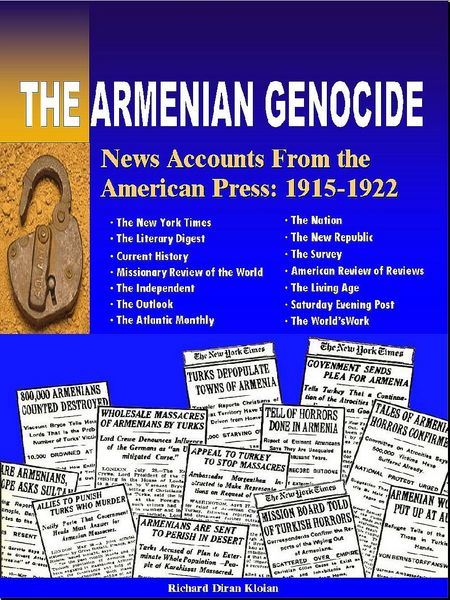
kloian 225x300 Searching for 1915: Newspaper Coverage of the Armenian Genocide
Kloian’s ‘The Armenian Genocide: News Accounts From the American Press (1915-1922)’
In teaching my university courses on comparative studies of genocide, I have often asked students to study the headlines from 1915. In so doing, they can better learn how the world began to know about such events, struggled to comprehend such horrific deeds, and searched for the words to describe such nightmarish scenes.
Of course, such original archival research of old newspapers can be daunting in terms of travel, time, access, and even technology. I know this first-hand. As a young professor in the 1980’s, I spent many hours reading the old Toronto Globe for the year 1915. I studied column after column and page after page of the daily newspaper coverage for the entire year of 1915. I peered at the articles on a microfilm reader. Systematically, I was searching for articles relating to the plight of the Armenians in the Ottoman Empire for that fateful year. I took careful notes and made photocopies of the most important articles. It was an important learning experience for me as an Armenian-Canadian. It also turned out to be a pivotal moment. From that point on, I would start to write about the Armenian Genocide—even more so when confronted by the troubling, ongoing denials by the Turkish government.
Fortunately for my students and I, the pioneering work has been done by others. This means that our task today of scanning the headlines and reading full newspaper accounts are easier, the sources more accessible.
The most innovative and path-breaking work on newspaper coverage of the genocide was conducted by Richard Kloian in his 1980 monumental book, The Armenian Genocide: News Accounts From the American Press (1915-1922). Working for many years to gather diverse material and employing far less advanced technology, Kloian surveyed the American press for the key seven-year period. He focused on coverage in the New York Times, Current History, Saturday Evening Post, and the Missionary Review of the World. The volume he delivered at nearly 400 pages was epic and pioneering. It not only included a vast comprehensive account, but also a very useful five-page chronological table listing the main headlines.
The New York Times alone accounted for over 120 articles in 1915 on the terrible plight of the Armenians in the Ottoman Empire. This extensive coverage underlined the considerable interest by both the press and the public, and helped ensure that substantial information was available. It also revealed that there had been key and unprecedented extensive access to important and timely information, often from confidential U.S. government sources and missionary accounts. Kloian’s book has undergone a number of editions and printings and is still available. It is an essential reference work for anyone doing sustained research on the Armenian Genocide. I continue to use different editions of the book both for research and teaching.
A few years after Kloian’s influential book appeared, the Armenian National Committee (ANC) in both Australia and Canada sought to produce similar edited volumes for their respective countries. In 1983, the Australian ANC printed The Armenian Genocide as Reported in the Australian Press, a volume of just over 100 pages. It included newspaper articles from the Age, the Daily Telegraph, Sydney Morning Herald, and World’s News. The text was supplemented with a number of powerful photographs. A revised edition is in progress.
In that same decade, the Canadian ANC printed the bilingual two-volume set Le Genocide Armenien Dans La Presse Canadienne/The Armenian Genocide in the Canadian Press, providing about 280 pages of documents. Accounts were taken from various newspapers such as the French-language Le Droit, La Presse, Le Devoir, L’Action Catholique, and Le Canada, and the English-language Vancouver Daily Province, Toronto Daily Star, Montreal Daily Star, the Gazette, the Toronto Globe, Manitoba Free Press, Ottawa Evening Journal, London Free Press, and the Halifax Herald.
A decade and half later in 2000, Katia Peltekian in Halifax, Nova Scotia, edited the 350-page book Heralding of the Armenian Genocide: Reports in the Halifax Herald, 1894-1922. This volume covered the Hamidian massacres of the 1890’s, the Adana massacres in 1909, and the Armenian Genocide during World War I and after.
With great determination and skill, Peltekian has now followed up her earlier Canadian volume with a new 1,000 page two-volume set titled, The Times of the Armenian Genocide: Reports in the British Press. This collection covers the period 1914-23 and includes hundreds of entries from both the Times and the Manchester Guardian. As with earlier volumes, it contains an exceedingly useful multi-page chronological summary of the headlines. This overview table, along with selected excerpts, proves quite useful in the classroom setting.
For those wishing to have a scholarly annotated account of the press coverage, Anne Elbrecht published Telling the Story: The Armenian Genocide in the New York Times and Missionary Herald: 1914-1918. Her book, a former MA thesis, was printed by Gomidas Press and offers a chronological comparison of the press coverage in the New York Times and the Missionary Herald. It is a highly readable volume.
Vahe Kateb’s MA thesis, “Australian Press Coverage of the Armenian Genocide: 1915-1923,” analyzes the press coverage in Australia and explores a number of key genocide-related themes in the Victoria-based the Age and the Argus, Queensland’s the Mercury, and in New South Wales’ the Sydney Morning Herald. Kateb’s thesis is a valuable analytical study that should be more widely distributed and published as a book.
As we approach 2015, at least one major new project is underway to comprehensively collate international press coverage on the Armenian Genocide. Rev. Vahan Ohanian, vicar general of the Mekhitarist Order at San Lazzaro in Venice, is coordinating a multi-volume project that will cover the Hamidian and Adana massacres and the 1915 genocide. Several prominent genocide scholars will pen the introductions to the different volumes. This project, along with the earlier volumes, are essential in assisting the world to be more informed about the Armenian Genocide. Accordingly, it would be helpful if university libraries and Armenian community centers and schools acquired these volumes. They will help us to remember 1915 and prepare for the historic memorial year of 2015.

List of publications mentioned in article
Richard Kloian, The Armenian Genocide: News Accounts From the American Press (1915-1922) (Anto Printing, Berkeley, 1980 [1st], 1980 [2nd], 3rd [1985]), 388 pages for 3rd edition; also Heritage Publishing, Richmond, n.d.; with 392 pages).
Armenian National Committee, The Armenian Genocide as Reported in the Australian Press (ANC, Willoughby/Sydney, 1983; 119 pages)
Armenian National Committee of Canada, Le Genocide Armenien Dans La Presse Canadienne/The Armenian Genocide in the Canadian Press, Vol. 1, 1915-1916 (ANCC, Montreal, 1985; 159 pages).
Armenian National Committee of Canada, Le Genocide Armenien Dans La Presse Canadienne/The Armenian Genocide in the Canadian Press, Vol. I1, 1916-1923 (ANCC, Montreal, n.d. c1985; 121 pages).
Katia Peltekian, Heralding of the Armenian Genocide: Reports in the Halifax Herald, 1894-1922 (Armenian Cultural Association of the Atlantic Provinces, Halifax, 2000; 352 pages).
Katia Peltekian, The Times of the Armenian Genocide: Reports in the British Press, Vol. 1: 1914-1919 (Four Roads, Beirut, 2013; 450 pages/976 pages total for two volumes).
Katia Peltekian, The Times of the Armenian Genocide: Reports in the British Press, Vol. 2: 1920-1923 (Four Roads, Beirut, 2013; 426 pages/976 pages total for two volumes).
Anne Elbrecht, Telling the Story: The Armenian Genocide in the New York Times and Missionary Herald: 1914-1918 (London, Gomidas, 2012; 235 pages).
Vahe Kateb, “Australian Press Coverage of the Armenian Genocide: 1915-1923” (MA thesis, University of Wollongong, 2003)