Sunday, September 21, 2014

Catholicosate of Cilicia to Sue Turkey over Historic Headquarters in Sis

YEREVAN (A.W.)—Catholicos Aram I of the Great House of Cilicia of the Armenian Apostolic Church said the Holy See was preparing to initiate legal claims against Turkey to regain ownership of the historic headquarters of the Catholicosate of Sis.
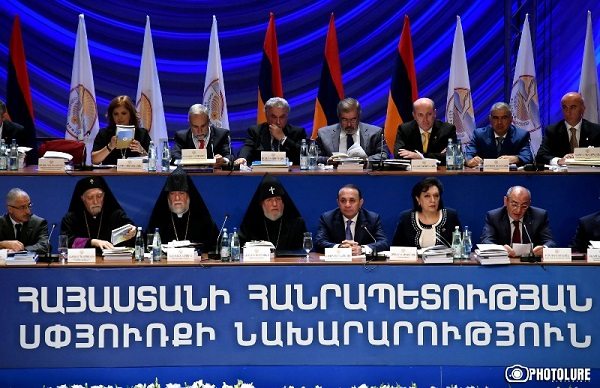
A scene from the diaspora conference
A scene from the diaspora conference (Photo by Photolur)
“The Armenian Catholicosate of the Great House of Cilicia will soon present its legal claims to Turkey’s Constitutional Court, demanding the return of its historic seat, the Sis Catholicosate, to its rightful owners—the Armenian Church and the Armenian people,” said His Holiness.
Aram I’s message was delivered before attendees of the fifth Armenia-Diaspora Pan-Armenian meeting at the Yerevan Opera House on Sept. 19, organized and hosted by Armenia’s Ministry of the Diaspora.
During the speech, Aram I said, “We cannot remain indifferent towards the abuse of the rights of the Armenian nation. Indifference amounts to the betrayal of the nation.” The Armenian Genocide Centennial will be marked by such initiatives and acts of commemoration that will leave permanent stamps on—and give new direction to—the Armenian Cause, he said. His Holiness also discussed the efforts of recent years, noting, “It is now time that we move Hai Tahd efforts beyond the recognition of the Armenian Genocide into the legal sphere.” During the past two years, under his supervision, a great deal of work has been carried out to reach that goal in collaboration with international law experts, he added.
“If Turkey’s Constitutional Court rejects our claims, we will immediately present our case to the European Court of Human Rights,” he said. “If we win the case, the honor and victory will belong to our nation and church. And if we lose the case, that will also be a victory, because in presenting our case we will have reminded the perpetrators and the international community that the Armenian nation remains committed to demanding its rights no matter the number of years that distance it from the onset of the genocide.”
Finally, His Holiness noted that this legal initiative would require significant funding, but that he trusted he would receive the support of the Armenian people, because the Armenian Church is essentially the people, and any church center ultimately belongs to the people.
The city of Sis (modern-day Kozan) was where the headquarters of the Catholicosate of the Great House of Cilicia was located from 1293 to 1921. During the Armenian Genocide, the Armenians of Cilicia were subjected to massacres. The last Catholicos in Sis was Sahak II, who fled to Syria with the surviving Armenian population of Cilicia in 1921.
His Holiness’s speech was delivered during the opening ceremony of the conference, which also featured speeches by Armenian Prime Minister Hovik Abrahamian, Artsakh President Bako Sahakian, Catholicos of All Armenians His Holiness Karekin II, Catholic Patriarch Nerses Petros XIX, and Armenian Revolutionary Federation Bureau Chairman Hrant Markarian.

‘New Turkey’ A Scary Place and Armenian Genocide Reparations Study


‘New Turkey’ A Scary Place, Says Dink Award Winner


ISTANBUL (Today’s Zaman)—Turkey’s ruling Justice and Development Party’s (AK Party) oft-quoted promise of a “new Turkey” is a scary place, where rights violations and threats against opponents are common, according to Şebnem Korur Fincancı, the winner of the International Hrant Dink Award and head of the Turkish Human Rights Foundation (TİHV).
In an interview with Today’s Zaman, Fincancı shared her opinions about the government’s new slogan — “New Turkey.” She said: “The new Turkey rhetoric is very scary. This means new violations and more threats, and we are already seeing the signs of this. We know about the actions of this government that promotes the new Turkey. The new Turkey is about having crowds jeer at the mention of a mother who has lost her son.”
The TİHV head was referring to a rally speech by President Recep Tayyip Erdoğan, who had his audience boo at the mention of the name Gülsüm Elvan, the mother of 15-year-old Berkin Elvan. Berkin died last year after being in a months-long coma that was caused by a tear gas canister being fired at him by the police during last year’s Gezi protests when he was out buying bread. The canister struck him in the head.
The International Hrant Dink Award was presented to Professor Fincancı on Sept. 15 — Hrant Dink’s birthday — for her activism regarding the plight of the Saturday Mothers, a group of women whose children disappeared while under state custody.
In response to a question about what she felt about the Dink award, Fincancı said: “I am flattered and humbled because I have been given an award that was earlier given to the Saturday Mothers. I am also a bit heartbroken. They are the ones who have suffered and are still suffering. What would our murdered brother [Dink] have done if he were with us at this time? I felt confused emotions that day.”
She also shared her opinions about the future of the murder trial of Hrant Dink, who was shot dead by an ultranationalist teenager outside the offices of the Turkish-Armenian Agos newspaper in Istanbul in January 2007.
“I don’t think the murder will be illuminated at this time. It looks like it will become one of the many trials that will be stonewalled with one trial after another. The course of the trial and the stance of the government on this issue indicates that. Temizöz’s release gives an idea about the future of the Hrant Dink trial.”
The activist was referring to the release of Col. Cemal Temizöz on Sept. 12. Temizöz, notoriously known as the “death well colonel” due to his role in the death of more than a dozen people in acid wells in the early ‘90s, was released by a high court. The trial against him was launched after investigators found human bones in wells in the Cizre district of Şırnak province, believed to be the remains of people killed by the illegal structure established by Temizöz.
She also said that she has no hopes that the current government will take steps to improve Turkey’s human rights records because “we know that they [the government] are the main actors who commit rights’ violations.”
Fincancı said activists and democrats should make their best efforts to change this course. “Detentions period were shortened because people demanded this. That was a result of the fight for human rights. We have to keep the government and the state at work. There can be reversals at times, and there can be disappointments, but we should continue to speak out about the negatives,” she said.
A medical doctor, Fincancı has dedicated her professional career to the struggle against torture in Turkey. She has been the president of TİHV since 2009. In the 1990s, when torture was prevalent in Turkey, she was subjected to oppression at the hands of the state since she wrote articles on medical ethics and penned reports documenting torture. Fincancı currently teaches and serves as a dissertation advisor at the graduate and postgraduate levels in the department of forensic medicine at Istanbul University’s medical college, and she teaches in Galatasaray University’s school of law.
The International Hrant Dink Award is presented annually by the International Hrant Dink Foundation at a ceremony held on Dink’s birthday.

Armenian Genocide Reparations Study Group Publishes Final Report


YEREVAN—The Armenian Genocide Reparations Study Group (AGRSG) has just completed its final report, “Resolution with Justice – Reparations for the Armenian Genocide.” The report offers an unprecedented comprehensive analysis of the legal, historical, political, and ethical dimensions of the question of reparations for the Armenian Genocide of 1915-1923, including specific recommendations for the components of a complete reparations package.
Prior to formation of the AGRSG in 2007, the limited discourse on reparations for the 1915-1923 Armenian Genocide included abstract notions of territorial return, consideration of particular aspects such as insurance lawsuits, academic and other works focused on a specific part of the overall topic, and sometimes valuable short works treating the issue but without comprehensive or detailed analysis.
The AGRSG was formed in 2007 by four experts in different areas of reparations theory and practice. Their mission was to produce the first systematic, comprehensive, in-depth analysis of the reparations issues raised by the Armenian Genocide. Funded initially by a grant from the Armenian Revolutionary Federation-Dashnaktsutyun, the AGRSG members are Alfred de Zayas, Jermaine O. McCalpin, Ara Papian, and Henry C. Theriault (Chair). George Aghjayan has served as a special consultant.
After early agreement that some form of repair is an appropriate remedy for the legacy of the Armenian Genocide as it stands today, the AGRSG prepared a preliminary report, which was released for limited distribution in 2009. Completion of the draft was followed by three symposia. The first was a panel discussion featuring three of the report authors, held on May 15, 2010 at George Mason University in the United States, in conjunction with the university’s Institute for Conflict Analysis and Resolution. The second was a major day-long symposium featuring the four co-authors and a number of other experts on reparations for the Armenian Genocide, conducted at the University of California, Los Angeles (UCLA) School of Law through its International Human Rights Law Association, on October 23, 2010. The third was a panel by two of the report authors held in Yerevan, Armenia, on December 11, 2010. The AGRSG is now issuing for broad distribution its final report, an extensive revision and updating of the 2009 preliminary report.
The AGRSG final report remains the only systematic, all-encompassing, in-depth approach to Armenian Genocide Reparations. The report examines the case for reparations from legal, historical, and ethical perspectives (Parts 4, 5, and 6, respectively), offers a plan for a productive reparative process drawing on transitional justice theory and practice (Part 7), and proposes a concrete reparations package (Parts 3 and 8). The report also includes background on the Armenian Genocide (Part 1) and the damages inflicted by it and their impacts today (Part 2). Through its broad dissemination, this report fills a crucial gap in the scholarly work and policy discourse on the Armenian Genocide. It will give Turkish and Armenian individuals as well as civil society and political institutions the information, analysis, and tools to engage the Armenian Genocide issue in a systematic manner that supports meaningful resolution.
The present time is optimal for release of the report. The 100th anniversary year of the beginning of the Genocide, 2015, will see greatly heightened international political, academic, media, artistic, and public interest in the Genocide. In addition, in the past few years, reparations for the Genocide have gone from a marginal concern to a central focus in popular and academic circles. Much of that focus has been on piecemeal individual reparation legal cases. This report represents a decisive step toward a much broader and all-embracing process of repair that is adequate to resolve the extensive outstanding damages of the Genocide. Furthermore, genuine, non-denialist engagement with the legacy of the Genocide is growing in Turkey. Finally, in the past decade, there has emerged a global reparations movement involving numerous victim groups across an array of mass human rights violations. The Armenian case has a place within that movement.
The complete final report will be available in PDF format online. The Executive Summary and Introduction of the final report are already available on the site.
Inquiries about the AGRSG and its report can be directed to Henry Theriault at htheriault@worcester.edu, +1 (508) 929-8612, or Department of Philosophy, Worcester State University, 486 Chandler Street, Worcester, MA 01602, U.S.A.
1. The positions taken and perspectives expressed in the report are those of the AGRSG members alone, and do not necessarily represent the views of the Armenian Revolutionary Federation.

Friday, August 29, 2014

California Senate Recognizes Artsakh’s Independence

click for more
SACRAMENTO—The California State Senate, led by incoming Senate President Pro Tem Kevin De Leon, by an overwhelming majority of votes on Wednesday passed Assembly member Mike Gatto’s resolution, AJR 32, encouraging Artsakh’s (Nagorno Karabakh) continuing efforts to develop as a free and independent nation and formally calling upon the upon the President and Congress of the United States to support the self-determination and democratic independence of the Nagorno-Karabakh Republic, reported the Armenian National Committee of America – Western Region. Though the resolution has officially passed, the finally tally will not be available until early tomorrow morning as Senators absent from the floor during the vote have until the end of the day to cast their vote.
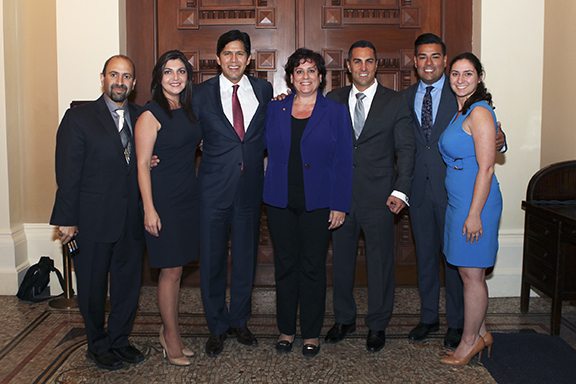
From Left: ANCA WR Legislative Affairs Director Haig Baghdassarian, ANCA WR Executive Director Elen Asatryan, incoming Senate President Pro Tem Kevin De Leon, ANCA WR Chair Nora Hovsepian, author of AJR 32 Assemblymember Mike Gatto, Senator Ricardo Lara, ANCA WR Government Affairs Director Tereza Yerimyan
In his opening remarks, Senator De Leon recognized the presence of ANCA WR and ACA in support of the resolution, provided background information on the resolution and the region, and continued on to state, “The ethnic Armenian people in this region have suffered tremendously and deserve a free and independent homeland where they won’t be in danger of persecution. California can be a front line leader that seeks to motivate change in the world…With that in mind, I ask you to support democracy, freedom, a people’s resolution to conflicts and international recognition and recognition of Artsakh,”
His remarks and sentiments were echoed by fellow colleagues Senators Tom Berryhill and Ricardo Lara.
“As Americans, we should understand the desire to be an independent nation, free of tyranny and free to form a government that best reflects our values. It is our own history. Many times on this floor we address the plight of the oppressed and express our desire, as a state legislature, for people to be free and to be able to determine their own destinies. AJR 32 is no different. The peoples of Nagorno-Karabakh Republic did not elect to become part of Azerbaijan in 1921; they were forced into it by the Soviets. It is now their understandable desire to be free. Since declaring its independence Nagorno-Karabakh has held free, transparent and democratic elections. It is fitting that the United States stands behind regions seeking democracy. I urge your Aye vote,” stated Senator Berryhill.
“I rise today to speak in strong support of this important resolution, which encourages and supports the Nagorno-Karabakh Republic’s continuing efforts to develop as a free and independent nation. The resolution states that this region has historically been Armenian territory, populated by an overwhelming majority of Armenians, and yet was illegally severed from Armenia by the Soviet Union in 1921. Senate District 33 is home to a thriving and vibrant Armenian community – people who have embraced important American values of freedom, democracy, and justice. This resolution asks the President and Congress to extend those fundamental values to the people of the Nagorno-Karabakh Republic, and encourages their continued development as a free and independent nation. I ask for your support of this important resolution,” stated Senator Lara.
AJR 32 was adopted by the CA State Assembly in May 2014 by a sweeping vote of 70 to 2 under the leadership of Speaker Emeritus John Perez.
“Today, under the great leadership of incoming Senate President Pro Tem Kevin De Leon and Assemblymember Mike Gatto, the State of California stood strong on our nation’s core values of liberty, freedom and independence for the people of Artsakh. We are extremely grateful to the CA Senate for their resounding support of this resolution and Artsakh’s need to develop as a free and independent nation,” stated ANCA WR Chair, Nora Hovsepian. “ We, along with our grassroots, are proud to have worked alongside Senator De Leon and Assembly members Mike Gatto, Katcho Achadjian, Adrin Nazarian, John Perez, and Scott Wilk in making today’s victory possible and thank them profoundly for their unwavering leadership towards advancing a cause that is so dear to all of us,” added Hovsepian.
California is home to tens of thousands of Armenian-Americans who are refugees of pogroms against Armenians in Sumgait (1988), Kirovabad (1988), and Baku (1990), and the ethnic-cleansing of the Armenian population of Azerbaijan. Dozens of refugees from the region, many from the Shahumian district of Artsakh, were present for the historic vote along with representatives from the Armenian National Committee of America – Western Region and the Armenian Council of America.
The Armenian National Committee of America – Western Region (ANCA-WR) worked closely with Senator De Leon’s office as well as the author, Assemblyman Mike Gatto, Co-Author Katcho Achadjian, and Assembly members Adrin Nazarian and Scott Wilk to garner support for the resolution. In weeks and days leading up to the vote, aside from having their Government Affairs Director Tereza Yerimyan and Legislative Affairs Director Haig Baghdassarian work day-in and day-out with local activists to educate officials about the resolution and the issues in the region, the ANCA WR also activated its grassroots in sending letters and making calls to elected officials, urging them to support AJR 32.
“The passage of this important resolution was a long and challenging journey that started with the introduction of this resolution back in January. We worked so hard to make it move forward, and we are so proud today that the California State Senate stood with me in support of the people of Artsakh in their ongoing quest for freedom, democracy, and independence,” stated lead author of AJR 32, Assemblymember Mike Gatto.
“This resolution couldn’t have come at a better time, given the recent escalated level of violence along the Artsakh-Azerbaijan border, and as our freedom fighters continue to defend their right to live under a government of their own choosing. The people of Artsakh deserve nothing less and need this support now, more than ever before,” stated ANCA WR Executive Director Elen Asatryan.
The State of California now joins Massachusetts, Rhode Island, Maine and Louisiana in adopting legislation which supports the independence of Artsakh.
The Armenian National Committee of America-Western Region is the largest and most influential Armenian American grassroots advocacy organization in the Western United States. Working in coordination with a network of offices, chapters, and supporters throughout the Western United States and affiliated organizations around the country, the ANCA-WR advances the concerns of the Armenian American community on a broad range of issues.

Sassounian: Justice Dept. Files Reveal Activities of Firms Lobbying for Turkey

click for more
Last week, I described the terms of the $1.4 million contract signed by the Gephardt Group, the lobbying firm of former House Majority Leader Dick Gephardt, to promote Turkey’s interests in Washington.
Realizing that its relationship with the United States has seriously deteriorated, the Turkish government has been pouring millions of dollars into the coffers of several U.S. firms, hoping to improve its image by whitewashing the dark stains of its dictatorial regime. For that purpose, Ankara on May 12 signed a contract with former Turkish national swimming champion Huma Gruaz and her Chicago-based public relations firm Alpaytac, Inc., for $1,420,000 a year. Oddly enough, instead of making monthly payments, the Turkish government gave Alpaytac $1 million up front upon signing the agreement, and paid the balance of $420,000 in the first three months. Alpaytac thus replaced the public relations firm of Fleishman-Hillard, which had received $779,805 from the Turkish Embassy for the 6-month period from Nov. 1, 2013 to April 30, 2014, at which time its contract was terminated.
In addition, Ankara benefits from the activities of the Turkish Coalition of America (TCA), which spent over $1 million to sponsor 170 congressional trips to Turkey since 2000. The TCA was founded in 2007 by Massachusetts microchip millionaire Yalcin Ayasli, who has donated close to $140,000 in the past 18 months to several pro-Turkish members of Congress, according to Al-Monitor.
Most people are unaware that pursuant to the Foreign Agents Registration Act, American firms representing foreign clients are required to report to the U.S. Justice Department their day-to-day activities every six months.
Alpaytac’s six-month report is not yet due. However, we would like to present excerpts from the detailed files the Gephardt Group and its subcontractors—Greenberg Traurig LLP, Lydia Borland, Brian Forni, and Dickstein Shapiro LLP—submitted to the Justice Department regarding their specific activities on behalf of Turkey from Aug. 1, 2013 to Jan. 31, 2014:
– On Sept. 19, 2013, forwarded a letter from Turkish Parliament Speaker Cemil Cicek to Vice President Joe Biden and Sen. Patrick Leahy.
– Sent emails to Reps. Castro, Cohen, Connolly, Deutch, Esty, Foxx, Frankel, Gabbard, Kennedy, Schneider, Wagner, and Whitfield and Sen. Murphy regarding the upcoming visit of Turkey’s Foreign Minister Ahmet Davutoglu; contacts were also established with several other members of Congress to discuss Syria, Iran sanctions, Hamas, and missile defense.
– Dick Gephardt reported making campaign contributions from Sept. 24 to Dec. 12, 2013 to: Reps. Alcee Hastings ($1,000), Barbara Lee ($1,000), Marjorie Margolies ($1,000), Richard Neal ($1,250), Brad Schneider ($500), Debbie Wasserman-Schultz ($1,500), Marc Veasey ($1,000), and Henry Waxman ($1,000); and Sens. Dick Durbin ($2,500), Mary Landrieu ($1,000), Claire McCaskill ($1,000), Mark Pryor ($1,500), and Ron Wyden ($2,500).
– Gephardt Group employees contributed to Sens. Dick Durbin ($500) and Jeanne Shaheen ($1,500); and Reps. Steve Cohen ($500), Colleen Hanabusa ($1,250), Jim Moran ($500), Brad Schneider ($500), and Henry Waxman ($500).
– Employees of Gephardt Group subcontractor Dickstein Shapiro LLC contacted Ben Branch, legislative director to Cong. Gregory Meeks, “regarding legislation focused on Turkish regional issues.” On behalf of Dickstein Shapiro, former House Speaker Dennis Hastert met with Turkish Ambassador Namik Tan and Sen. Ron Johnson “regarding U.S.-Turkey relations.”
– Other Dickstein Shapiro employees contacted the offices of Reps. George Holding, Eddie Bernice Johnson, Sheila Jackson Lee, Ileana Ros-Lehtinen, Gregory Meeks, Chellie Pingree, Robert Pittenger, Dana Rohrabacher, Ed Royce, and Ed Whitfield; and Sens. John Boozman, Ron Johnson, Rand Paul, and Roger Wicker to discuss Turkish regional issues, Cyprus, Travel to Turkey, and U.S.-Turkey relations.
– Dickstein Shapiro employees contributed over $60,000 to the political campaigns of congressional candidates from July 20 to Dec. 19, 2013, including Sens. Lamar Alexander ($2,500), Kay Hagan ($9,000), Amy Klobuchar ($2,000), Mitch McConnell ($2,500), Mark Pryor ($2,500), and Tim Scott ($1,000); and Reps. Sanford Bishop ($2,500), Emanuel Cleaver ($1,500), Rick Crawford ($2,500), Steve Daines ($2,500), John Dingell ($1,000), Bill Huizenga ($2,500), Eddie Bernice Johnson ($1,000), Adam Kinzinger ($2,500), Mike McIntyre ($5,000), Buck McKeon ($1,500), Dutch Ruppersberger ($2,500), and Ed Whitfield ($2,500).
Since the lobbying firms hired by Turkey are obligated by law to report their detailed activities, it is important to regularly check their Justice Department filings to find out who they are contacting in Congress, for what purpose, and how much are they contributing to their political campaigns.

Tuesday, August 19, 2014

Pope Francis to Hold Mass for Armenian Genocide Centennial

BUENOS AIRES—Pope Francis will hold Mass for the Armenian Genocide Centennial in the Basilica of St. Peter in the Vatican, on April 12, 2015. The Announcement was made by the Cardinal Archbishop of Buenos Aires Mario Poli during a mass in the Armenian Catholic Parish of Our Lady of Narek on Sunday, Aug. 17, reported Presna Armenia.
Pope Francis
Pope Francis
Pablo Hakimian, the pastor of the Armenian Catholic Parish of Our Lady of Narek, said that the announcement of a Mass for the Armenian Genocide centennial is in response to an invitation by the Armenian Catholic Church.
“The Pope replied to the invitation from the Armenian Catholic Church a year ago through Patriarch Nerses Bedros XIX to hold a mass for the recognition of the Genocide,” Father Hakimian told Prensa Armenia.
On June 3, 2013, Pope Francis held a meeting with a delegation led by Patriarch Nerses Bedros XIX, during which he also met a descendant of Armenian Genocide survivors and stated, “It was the first genocide of the twentieth century.” The Turkish Ministry of Foreign Affairs responded with a statement of its own: “The expressions of Pope Francis are absolutely unacceptable.”
This is not the first time Pope Francis has publicly recognize the Armenian Genocide. In 2006, when he was still known as Cardinal Bergoglio of Buenos Aires, he called the Genocide “The gravest crime of Ottoman Turkey against the Armenian people and the entire humanity.”
More recently, in May 2014, Pope Francis received His Holiness Karekin II, Supreme Patriarch and Catholicos of All Armenians. During the meeting, he said that we should never forget the blood poured by the Armenians in the last century. In June 2014, Pope Francis also received His Holiness Aram I, Catholicos of the Great House of Cilicia.
Pope Francis is not the first Pope calling on Turkey to admit its crimes. John Paul II also recognized the Armenian Genocide. In September 2001, during his farewell ceremony at the Zvartnotz International Airport in Yerevan, he said “The Armenian people have paid dearly for their frontier existence, so much so that the words ‘holiness’ and ‘martyrdom’ have become almost identical in your vocabulary. The terrible events at the beginning of the last century, which brought your people to the brink of annihilation, the long years of totalitarian oppression:none of these has been able to prevent the Armenian soul from regaining courage and recovering its great dignity.” Pope John Paul II also said a prayer at the Tzitzernakaberd Memorial, during which he said: “Wipe away every tear from their eyes and grant that their agony in the twentieth century will yield a harvest of life that endures forever. We are appalled by the terrible violence done to the Armenian people, and dismayed that the world still knows such inhumanity.”
The scheduled Mass on April 12, 2015, may be one of the largest events organized around the Genocide Centennial.

Sunday, August 17, 2014

Islamic State Commander Says Turkey Instrumental in ‘Success’


Islamic State Commander Says Turkey Instrumental in ‘Success’


Islamic State fighters ride through streets as part of a military parade after gaining significant victories in Iraq. (Photo: Reuters)

REYHANLI, Turkey—A senior commander of the Islamic State (formerly the Islamic State of Iraq and Sham) has told the Washington Post that Turkey’s support was instrumental in the success of his organization, which now controls great swathes of Syria and Iraq. In an interview with the Washington Post on Aug. 12, the 27-year-old commander identifying himself as Abu Yusef explained that the Islamic State received most of its supplies from Turkey and had many of its fighters from Syria treated at Turkish hospitals. Abu Yusef, speaking to the Washington Post in the southeaster Turkish town of Reyhanli near the Syrian border, says much of that has changed as the Turkish government has begun cracking down on IS operations.
“It is not as easy to come into Turkey anymore,” Yusuf says. “I myself had to go through smugglers to get here, but as you see, there are still ways and methods.”
“We used to have some fighters — even high-level members of the Islamic State — getting treated in Turkish hospitals. And also, most of the fighters who joined us in the beginning of the war came via Turkey, and so did our equipment and supplies,” Yusef told the Washington Post.
Turkey closed its doors on the Islamic State when the extremists took their war into Iraq, capturing 80 Turkish citizens in the process, 40 of whom are still in captivity. But now, Yusef says, the Islamic State has enough resources in Syria and Iraq that it no longer needs Turkey’s support.
The piece, authored by Anthony Faiola and Souad Mekhennet, gives an exhaustive account of Turkey’s relationship with the Islamic State. It can be read on the Washington Post’s website.

Gulen-Linked Schools in Calif. to be Investigated by State

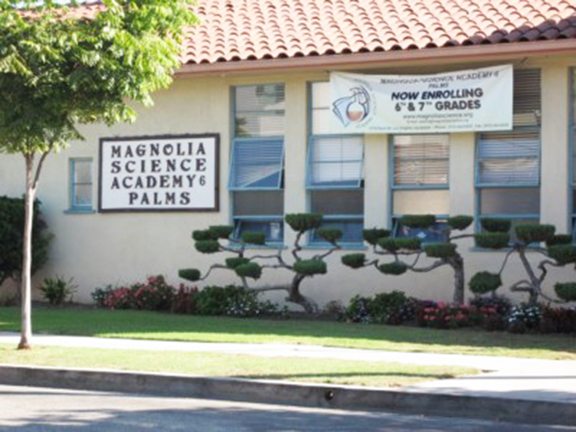
SACRAMENTO, Calif. (Asbarez)—The Joint Legislative Audit Committee on Aug. 14 approved a statewide audit of the Magnolia Science Academies of California, which runs 12 tax payer-funded charter schools in the state that have ties to the Gulen Institute, affiliated to the Turkish cleric Fethulah Gulen.
Magnolia Science Academy 6 in Palms is one of the schools cited for financial mismanagement.
The audit, requested by State Assemblymember Adrin Nazarian, brings forth major concerns of misappropriation of tax payer funds of the 12 Magnolia charter schools and their parent company, the Magnolia Education and Research Foundation (MERF).
In August of 2012, the Los Angeles Unified School District (LAUSD), Office of Inspector General’s (OIG) audit on Magnolia Science Academies revealed major irregularities and misappropriation of funds for two of eight Magnolia Charter Schools in their jurisdiction: Magnolia Charter Schools number 6 and 7. In March of 2014, the LAUSD granted a conditional renewal of the Charter agreements, with reauthorization pending the results of the OIG’s findings.
“Charter Schools play an important role in the public education system by delivering a high quality education to our students. I am deeply troubled that public education funds are being abused by the Magnolia Academies. It was important to bring this request forward to ensure that our tax payer dollars aren’t being misspent at the expense of the students and the taxpayers who support public education,” said Nazarian.
The audit, which doesn’t have an official start date, will take 7-10 months to complete.
On June 27, the Los Angeles Unified School District issued findings indicating that Magnolia Charter School Academy 6 and 7’s conditional renewal were rescinded based on material fiscal and operational findings and fiscal mismanagement based on a forensic review of the schools and Magnolia Educational and Research Foundation. Magnolia sought a preliminary injunction to block the District from implementing the nonrenewal of the two schools.
During a July 25 hearing, Judge Luis A. Lavin granted the injunction in order to not disrupt the student community, but ordered a strict investigation into the finances of the MERF and the Magnolia schools.
The LAUSD said it viewed Judge Lavin’s protective orders as affirmation of the serious conditions the District faced with Magnolia. “Our primary concern has always been the students who attend Magnolia,” Superintendent John E. Deasy said. “While it is never an easy decision to disrupt a school community, Magnolia’s fiscal mismanagement and serious fiscal issues gave the District no choice. Now that Judge Lavin has provided these additional protective measures, the schools can remain intact while the administrative appeals process reaches its inevitable conclusion.”
Throughout the hearing on the preliminary injunction, Judge Lavin repeatedly indicated that the preliminary injunction is in no way a ruling on the merits of whether Magnolia should continue to operate. A trial setting conference will be held on October 14, 2014, and a hearing on the merits will be set sometime in January 2015.
If Magnolia fails to comply with any of the conditions outlined above, LAUSD can petition the court on an ex parte motion to dissolve the preliminary injunction.
On the national level, Gulen-affiliated schools have come under investigation for questionable financial practices, to filling teacher positions with often unqualified people brought in from Turkey.
Gulen-affiliated charter schools in Arizona, Louisiana, Pennsylvania, Texas and New Jersey have been under investigation by the FBI since 2011