Wednesday, March 13, 2019

Rabbi Schneier Takes Evangelical Pastors On a Propaganda Tour of Azerbaijan

BY HARUT SASSOUNIAN
For several years, the government of Azerbaijan and its diplomats overseas have gone to great lengths to win over Jews worldwide, American Jewish organizations, and Israel.
Azerbaijan is simply copying Turkey’s sinister behavior that until recently wooed Jewish organizations in the United States and Israel’s government to block the passage of a congressional resolution recognizing the Armenian Genocide. Many Jewish groups ended their immoral cooperation with Turkey, after Turkish President Rejep Tayyip Erdogan began making anti-Semitic statements and threatening Israel.
Just like Turkey, Azerbaijan’s outreach to Jewish organizations and Israel is based on the typical anti-Semitic belief that Jews control American politicians and it is therefore in Azerbaijan’s interest to be on the good side of ‘powerful’ Jews. According to the Israeli newspaper Haaretz, “many countries nurture their relationship to Israel in hopes of finding favor with influential American Jewish organizations who will in turn speak well of them to the U.S. government.”
Furthermore, Azerbaijan’s pro-Jewish efforts are based on the fact that it purchases billions of dollars of modern weapons from Israel. In return, Azerbaijan sells a large amount of oil to Israel. There have been also intelligence reports that Azerbaijan has provided Israel with several bases on its border with Iran, should Israel decide to attack Iran’s nuclear facilities.
Rabbi Marc Schneier met with Azerbaijani President Ilham Aliyev during a visit in 2015
The latest example of the collaboration between American Jewish leaders and Azerbaijan is the visit to Baku on March 3-8 by a group of U.S. evangelical pastors led by New York-based Orthodox Rabbi Marc Schneier “to promote interfaith dialogue and highlight cooperation with Israel,” according to the Associated Press. This was the first ever evangelical delegation to visit the Muslim Shiite nation. The Rabbi described Azerbaijan as “the most beloved and respected Muslim country in the eyes of the Jewish American community,” reported Trend, an Azeri news agency. Schneier spoke at an event in the U.S. Congress last year celebrating the close friendship between Azerbaijan and Israel.
The group of 12 U.S. evangelical pastors met Pres. Ilham Aliyev of Azerbaijan, the foreign minister, Muslim Sheikhs, local church leaders, and Israel’s ambassador. Rabbi Schneier told the Associated Press that Pres. Aliyev “announced during the delegation’s visit that the country’s first-ever Jewish cultural center would be built in Baku with Kosher dining options and a hotel to accommodate Jewish guests.” Schneier heads the Foundation for Ethnic Understanding based in New York and founded the Hampton Synagogue in Westhampton Beach, New York. As a sign of their cozy relationship, Azerbaijan’s national airline flies directly to Tel Aviv and Pres. Aliyev hosted Israel’s prime minister in 2016.
Not surprisingly, Azerbaijan’s Foreign Minister Elmar Mammadyarov took advantage of his meeting with the evangelical leaders to disparage Armenia and distort the facts of the Artsakh conflict. He said, “the recent statements of the Armenian leadership highlighted that such statements undermine the peace process.”
Pastor Adam Mesa, who leads the Abundant Living Family Church in Rancho Cucamonga, California, told the Associated Press that it was his first time in a Muslim majority country. The pastor said he was encouraged to take part in the trip because of Azerbaijan’s supportive Israeli stance and interreligious efforts. “It’s incredible that a Muslim majority country is the one that has to actually lead the charge on religious dialogue and community and solidarity.”
Rabbi Schneier confirmed to the Associated Press the political agenda behind the religious group’s visit: “from a political point of view, listen there is no question you know that Azerbaijan is looking to strengthen its relationship with the U.S. administration, with the United States Congress. Israel is very much a conduit to that.”
As in the case of Cong. Alcee Hastings, Azerbaijan seems to have picked another disgraced individual to disseminate its propaganda. The 60-year-old Rabbi Schneier has been married six times, the last on March 2017. In February 2018, the State of Florida ordered Schneier to pay $5,000 a month for $64,594 in unpaid child support he owed to his third wife for the care of their 19-year-old son. Rabbi Schneier was expelled in June 2015 by the Rabbinical Council of America for breaching the code of ethics by carrying on an extramarital relationship. In June 2010, the Rabbi announced to his congregation that he was suffering from “bipolar disorder.”
According to Wikipedia, “under pressure from his congregation for his multiple divorces and philandering, Schneier resigned in 2016 from his pulpit position at the Hampton Synagogue, which he had founded in 1990. Congregants had threatened to withhold pledges and payments until he left the synagogue.”
The New York Post reported that after cheating on his third wife, Rabbi Schneier in 2006 married Tobi Rubinstein, “a sexy worshipper,” who became wife No. 4. “In 2010, Tobi hired a private investigator who turned up explicit photos of her husband and Gitty Leiner, a then-30-something worshipper, getting hot and heavy in the Holy Land on what Schneier had told his wife was a routine business trip. Marriage No. 4 ended in divorce soon after.” The Rabbi ended up marrying Gitty Leiner in 2013 — wife No. 5. The couple had a child in 2014, “but then in 2015, Schneir was caught dining out in Queens with sexy young Simi Teitelbaum” who became his sixth wife in 2017! Interestingly, The Post reported that “Schneier explained away his unholy extramarital hookups by saying he was mentally ill and seeking treatment.”
Rabbi’s ex-wife Toby Gotesman told the Post: “When I left him, he was making $800,000 … that included a $500,000 salary, plus hundreds of thousands in additional compensation, including mortgage payments on his 5,000-square-foot Westhampton Beach home, said to be valued at around $3 million.”
Rabbi Schneier’s visit to Azerbaijan last week was not his first. He has been there several times in recent years on propaganda tours. One wonders if the Rabbi has received any compensation from Pres. Aliyev for his ‘valuable’ services. His multiple trips to Azerbaijan makes the Rabbi look more like a lobbyist for Azerbaijan than a religious figure!
I would urge Armenian evangelical church leaders to contact the 12 pastors who visited Baku last week in order to counter the propaganda they were fed against Armenia and Artsakh. I would also like to know if these pastors and Rabbi Schneier came back from Baku with suitcases full of the usual Azeri “gifts” of caviar, rugs, and other valuable items!

Monday, March 11, 2019

ANCA’s Raphael Lemkin Policy Lecture Focuses on Transitional Justice

WASHINGTON, D.C. – Inspired by the recent adoption of the landmark Elie Wiesel Genocide and Atrocities Prevention Act, the Armenian National Committee of America (ANCA) launched the Raphael Lemkin Policy Series with a lecture by Dr. Henry Theriault, President of the International Association of Genocide Scholars. The series aims to foster an ongoing Capitol Hill conversation among legislative, civil society, academic and other stakeholders about preventing and punishing genocide.
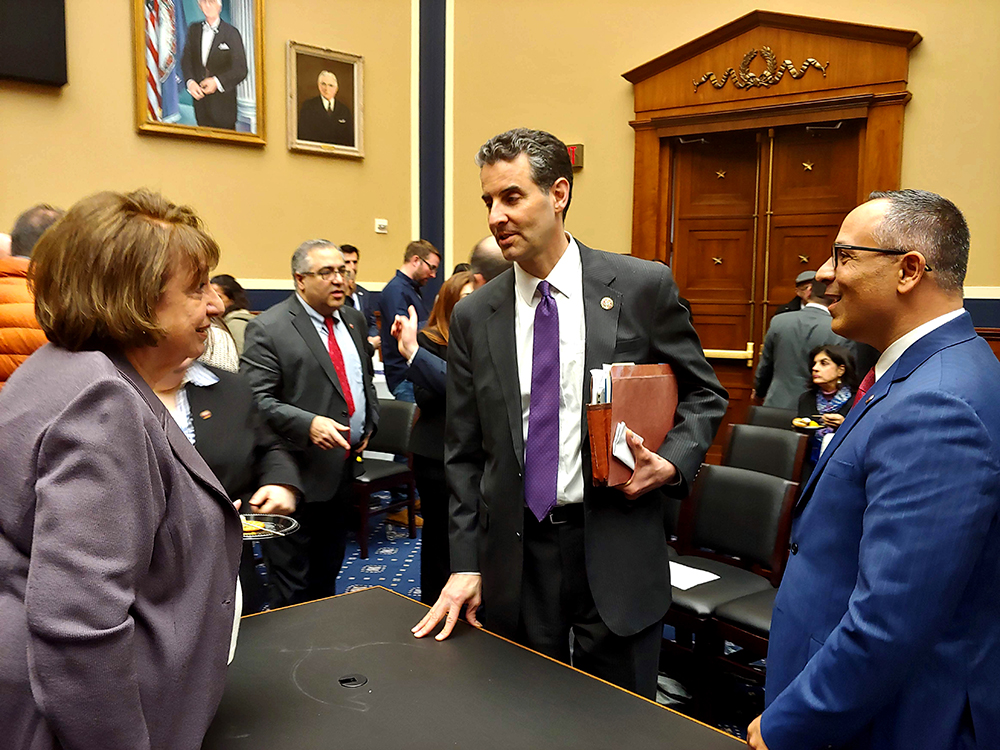
“It is wonderfully appropriate that this policy series is named for Raphael Lemkin, the man who first described the crime of genocide as a specific and distinct act, the effort to exterminate a whole people based on ethnicity, nationality, religion, or some other trait,” noted Congressman Adam Schiff (D-CA), who was today’s host. “Raphael Lemkin did the world and the cause of fundamental human rights a great service in his work, and that is the work that we carry forth today in fighting for the full recognition of the Armenian Genocide. Only by confronting the truth of past genocides can we hope to respond to modern day mass violence. Today’s lecture is an important step in that fight,” concluded Congressman Schiff. U.S. Representative John Sarbanes (D-MD), a leading member of both the Hellenic and Armenian caucasus was on hand to show his support.
ANCA Programs Director Tereza Yerimyan welcomed Congressional staff, representatives of the Embassy of Armenia, Republic of Artsakh Representative, His Excellency Robert Avetisyan, former U.S. Ambassador to Armenia John Evans, Genocide Watch Founder and President Dr. Greg Stanton, Raphael Lemkin expert Jim Fussell, In Defense of Christians President Toufic Baaklini and Greater Washington DC area human rights supporters to the lecture. “In the wake of Congress passing and the President signing into law, the Elie Wiesel Genocide and Atrocities Prevention Act of 2018, a measure that states that it is U.S. policy to regard the prevention of genocide and other atrocity crimes as a core national security interest and a core moral responsibility, we see signs of progress, but also the need for more serious conversations on Capitol Hill about the prevention and punishment of genocide,” explained Yerimyan. “Today, we look to begin that conversation, with Dr. Henry Theriault, President of the International Association of Genocide Scholars (IAGS) and Associate Vice President for Academic Affairs at Worcester State University.”
“We do have a challenge. The world is very different from Lemkin’s time (who died in 1959), and yet, genocide is still a fundamental, incessant problem that we face. ‘Never again’ really seems to mean ‘ever again,’” began Dr. Theriault, who noted that there has been a steady stream of genocides which have occurred from the 19th century all the way through to the 21st century. “But Lemkin, if there is one part of his legacy, in the midst of the darkest challenge, you find some things to hold on to, that are signs of progress.” Dr. Theriault cited as progress the 1988 U.S. ratification of the United Nations Genocide Convention, the first prosecution of genocide in 1998, key interventions in Kosovo and East Timor, last year’s Congressional passage of the Elie Wiesel Genocide Prevention Act, and a number of transitional justice initiatives.
“There needs to be a legitimate, serious fundamental process for dealing with past mass violence that actually addresses the problems and, I would argue, includes a reparative process. That means the perpetrator group needs to give up the gains of the genocide and assume responsibility for helping to reconstitute the victim group as much as possible,” said Dr. Theriault, because, he stressed, without justice, “the message to other would-be perpetrators is absolutely clear: Genocide pays and you can just go on with it, and no one will do anything about it.”
Commenting on two instances of where U.S. policy helped stop genocide and sought to address genocide denial, Dr. Theriault first cited the efforts of former Senator Tom Harkin (D-IA), Senator Jack Reed (D-RI) and Congressman Jim McGovern (D-MA) who led efforts to stop the genocide in East Timor by ending support for and arms sales to the perpetrating regime in the early 1990’s. Then, citing the ongoing U.S. policy of not properly referencing the Armenian Genocide, Dr. Theriault spotlighted the courage of former Ambassador to Armenia John Evans in making specific, accurate references to this crime, for which he paid the heavy political price of being recalled from office. “By saying a word [genocide], you can create an ethical challenge that wasn’t just about Armenians but was really about how the U.S. addresses the reality of mass violence. It was the legacy of Morgenthau. It was the moment where we used Lemkin’s word and in doing that, it brought about a change [. . .] — a moment where people actually felt that for the first time somebody was actually standing up to acknowledge the history in an official way.”
Dr. Theriault concluded, “The lesson of Lemkin that we can take is that we are in a position to do something about genocide. It seems daunting. It took Lemkin decades to get a law against genocide. It took the world half a century to begin to deal with genocide. These are lifetime commitments – but making that commitment and keeping that commitment […] maybe we will have a genocide-free world because of the things that people in this room are doing now.”
The Lemkin series is made possible by the ANCA Endowment Fund and the generosity of the Aramian Family – led by sisters Sue, the late Martha, and the late Margo – long-time benefactors of educational and charitable projects in the Armenian homeland and the diaspora.
The lecture was streamed live on the ANCA Facebook page.

Saturday, March 2, 2019

Monumental loss: Azerbaijan and 'the worst cultural genocide of the 21st century'

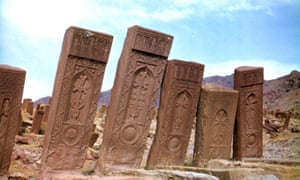
Some of Djulfa’s thousands of khachkars, circa 16th century, photographed in the 1970s, before their destruction.
 Lost to time … some of Djulfa’s thousands of khachkars, circa 16th century, photographed in the 1970s before their destruction. Photograph: © Argam Ayvazyan archives, 1970-81
The 21st century’s most extensive campaign of cultural cleansing to date may not have happened in Syria, as you might assume, but a largely ignored part of the Transcaucasian plateau.
According to a lengthy report published in the art journal Hyperallergic in February, the Azerbaijani government has, over the past 30 years, been engaging in a systematic erasure of the country’s historic Armenian heritage. This official, albeit covert, destruction of cultural and religious artefacts exceeds Islamic State’s self-promotional dynamiting of Palmyra, according to the report’s authors, Simon Maghakyan and Sarah Pickman.
Maghakyan, a Denver-based analyst, activist and lecturer in political science, labels it “the greatest cultural genocide of the 21st century”. He grew up with stories about his father visiting a beautiful, mysterious place called Djulfa. Located in the Azerbaijani enclave of Nakhichevan, on the banks of the Araxes river, it was the site of a medieval necropolis, the largest ancient Armenian cemetery in the world. Visitors through the centuries, from Alexandre de Rhodes to William Ouseley, had noted the remote location’s splendour.
At its height, the graveyard counted around 10,000 khachkars, or cross stones, standing to attention, the earliest dating back to the 6th century. Unique to Armenian burial traditions, these distinctive tall steles of pinkish red and yellow stone feature crosses, figurative scenes and symbols, and highly decorative relief patterning. By the time the Soviets formalised the autonomous regions of Nagorno-Karabakh and Nakhichevan in 1920, after decades of plunder, less than 3,000 khachkars remained. Subsequent episodic vandalism led Unesco in 2000 to order that the monuments be preserved.
Pinterest
The New Tears of Araxes, a short film by Simon Maghakyan and Sarah Pickman showing the destruction of Djulfa. Watch it on YouTube here.
But that had little effect. On 15 December 2005, the prelate of northern Iran’s Armenian church, Bishop Nshan Topouzian, filmed – from across the river in Iran – the Azerbaijani military methodically laying waste with sledgehammers to all that remained of Djulfa. The soldiers loaded the debris on to truck beds and dumped it into the Araxes.
The footage can be found in a 2006 film entitled The New Tears of Araxes posted on YouTube, edited by Maghakyan and scripted by Pickman. It is chilling. Satellite research shows that, in 2003, the uneven, textured landscape was dotted with multiple small structures. By 2009, it is flattened and empty.
The Azerbaijani government has repeatedly refused international inspectors entry to the site, it has not responded to requests for comment – including for this article – and it has denied Armenians ever lived in Nakhichevan. Such stonewalling renders independent verification difficult, but the sheer amount of forensic evidence that Maghakyan and Pickman present makes a rock-solid case for at least not being deterred. Their contention is that the dramatic events at Djulfa marked the final stage of a broader campaign to denude Nakhichevan of its indigenous Armenian Christian past.
Underlining quite how little international attention has been paid to this story, most of the material on which this report is based was gathered not by official bodies but by individuals, who, like Maghakyan and Pickman, have operated on their own dime.
Armenian art researcher Argam Ayvazyan in 1981, next to a 14th-century khachkar in Nors, near his birthplace.
Pinterest
 Armenian art researcher Argam Ayvazyan in 1981, next to a 14th-century khachkar in Nors, near his birthplace. Photograph: © Argam Ayvazyan archives, 1970-81
Local researcher Argam Ayvazyan, now exiled in Armenia, photographed 89 Armenian churches, 5,840 khachkars, and 22,000 tombstones between 1964 and 1987 – which the report states have all disappeared. A Scotsman named Steven Sim travelled on a whim to eastern Turkey in 1984 and has taken in excess of 80,000 slides and photographs over the past 35 years documenting ancient Armenian heritage across the region: “It was the nearest faraway place to Britain, at the time, that was cheap to go to,” he says. He’s been regularly returning ever since, amassing a 1,000-tome library – with many books by Ayvazyan – mostly on Armenian architecture.
Azerbaijan’s erstwhile national treasure Akram Aylisli, meanwhile, has lived under virtual house arrest since 2013, when he published writing critical of his government’s actions. He first protested what he termed “evil vandalism” in a 1997 telegram to the country’s president. “Such senseless action,” he wrote, “will be perceived by the world community as a manifestation of disrespect for religious and moral values.”
Sim points out that the Hyperallergic report fails to adequately explain the artistic value of what has been lost. Armenian architecture is unique, he says – deceptively minimal in appearance but highly sophisticated structurally and built to withstand the landscape’s seismic volatility. He describes the diminutive churches as more sculpture than building; single-volume dome-topped structures that look like they’ve been cast in stone. The khachkars, meanwhile, are regional, the meaning of the iconography and symbolism they display largely lost to time. That loss is most keenly felt with the destruction of the Djulfa cross stones, which featured scenes of daily medieval life – people riding horses, carrying water jugs, or picnicking in gardens, the food laid out on carpets – and strange mythical creatures including a four-legged hooved beast with two bodies, a single head and wings. “I’ve looked at thousands of khachkars throughout Armenia,” Sim says, “and I’ve only ever seen one which has this twin-bodied single-headed animal. But they all had them in Djulfa.”
The world rightfully recognised Isis’s wrecking of Palmyra as a war crime, an immense loss for the Syrian people and humanity as a whole. Maghakyan hopes Armenians and Azerbaijanis alike will see what has happened in Nakhichevan as a crime against all, committed by a ruthless regime. The Azerbaijani historian who acted as peer reviewer for the article, but wished to remain anonymous due to fears for their safety, told Maghakyan that the report was “for all of us, regardless of ethnicity and religion”, but especially for Azerbaijanis who had not lost or surrendered their conscience.

What Unifies Us as A Nation--ARMENIA

Young Armenians waving the tri-color in Yerevan
BY STEVEN J. DER-HAROUTUNIAN
The recent call for replacing the national anthem, Mer Hairenik, with the former Soviet Armenia anthem can only be viewed as an attempt to drive a wedge between our people when in fact the purpose of the revolution was to unify our nation.
When the obvious why is asked, we are given some dribble about musicality, why of course citing the trivial and impertinent armchair criticisms of some otherwise respected musicologists as the basis. While I will defer to others to scientifically debate the merit of one tune over another an anthem on the other hand cannot simply be judge in that manner. A National anthem doesn’t exist in a vacuum.
How an anthem can be solely measured by its musical quality 100 years after its adoption is shocking to the conscious of most of our nation who has answered the call of that anthem and its flag and all those symbols which represent Armenia and give character to the long struggle of the Armenian nation for its freedom and independence.
That anthem captures the sacrifice made by countless patriotic men women and children in that struggle for independence whether that was standing on the front at Saradarabad in 1918, standing in a hall in Davenport Iowa in 1946, on the cliffs of Shoushi in 1992 or holding onto the faith as a family in the darkest days in the early 1990s and standing firm on their small plot of land and choosing to stay without food, warmth and often without adequate shelter and tough it out as Armenians on their ancestral land rather than to leave for the chance of a better life in Russia, Europe or America as thousands of others did.
That anthem tells their story. A sacred story. A story of faith, struggle for freedom to live and if necessary die as Armenians for Armenia rather than to live and then to disappear among other nations un-moored to their land and lost like flotsam in the sea.
That is what is so confusing about this whole artificial controversy. Why is the musicality of the anthem now being challenged and called for replacing? Who are these adventurist political figures that today call for that?
Mer Hairenik does not need to win a Grammy award or be at the top of a charts to be our anthem. Its musicality is judged by what is represents and that is first and foremost freedom. No alternative song blessed by those who took away that freedom and held Armenia as a vassal state in their empire can ever ever be our anthem no matter how pleasant a rhythm and lyrics it have upon the ear, it is an insult to the heart and soul of our freedom and independence and what was spent and it spent to keep it in blood, sweat and treasure.
Which brings us to the question: Why would anyone raise this issue today?
When the Prime Minister has stated that repatriation, economic investment and military preparedness are the goals of this new government, how does replacing a 100-year-old national anthem accomplish any of those? In fact all this toxic divisive proposal has done is divide our nation, when in fact we should be standing united to face the real challenges our country faces such as population loss, unemployment and under employment, economic dependence and exploitation, poverty, inadequate healthcare and the need for a vigilant defense.
Today we as a nation look to leaders who will address those existential threats to Armenia and in doing so once again unify us as a nation. Mer Hairneik is one of the key symbols that does that.
Our nation looks to the Armenian government to responsibly act to unify us a nation not allow for dangerous opportunists to divide us.

Sunday, February 10, 2019

Macron Declares April 24 National Day of Armenian Genocide Commemoration in France

French President Emmanuel Macron and the first lady, Brigitte, at the Dizidzernagapert Armenian Genocide Memorial Complex in October, 2018
French leader angers Turkey
PARIS—President Emmanuel Macron of France on Tuesday said that his country would observe April 24 as “national day of commemoration of the Armenian Genocide.”
He made the declaration at the annual gala dinner of the Coordinating Council of Armenian Organization in France (CCAF), fulfilling a campaign promise he made while running for president in 2017.
“France is, first and foremost, the country that knows how to look history in the face, and was among the first to denounce the killing of the Armenian people in 1915 as genocide, calling it was, and in 2001 after a long struggle recognized it as law,” Macron told the crowd gathered at the CCAF gala.
France “will in the next weeks make April 24 a national day of commemoration of the Armenian genocide,” he added.
French President Emmanuel Macron speaks at the CCAF annual gala on Feb, 5 in Paris
Macron and his wife, Brigitte, visited the Dzidzernagapert Armenian Genocide Memorial Complex in Yerevan while they were visiting Armenia during the Francophonie Summit in October.
Official Ankara was quick to express it anger at Macron’s statement, calling it “a political lie.”
Turkish presidential spokesman Ibrahim Kalin “strongly condemned” Macron’s statement about the Armenian Genocide, reported the Anadolu news agency.
Kalin also accused Macron of “trying to rescue himself by using historical events as political fodder”.
Macron said he had informed Turkish President Recep Tayyip Erdogan about the decision to declare April 24th a National Day of Commemoration of the Armenian Genocide ahead of his announcement.
“We have disagreements over the fight against the Islamic State, human rights and civil liberties in Turkey and on the Genocide,” Macron was quoted as saying by Euronews.
Legendary singer Charles Aznavour's son, Nicolas, presented French President Emmanuel Macron with a duduk during the CCAF gala in Paris on Feb. 5, 2019 (Photo by Jean Eckian)
Legendary singer Charles Aznavour’s son, Nicolas, presented French President Emmanuel Macron with a duduk during the CCAF gala in Paris on Feb. 5, 2019 (Photo by Jean Eckian)
At the CCAF event, Macron paid tribute to the memory of legendary singer Charles Aznavour. In October, the French President led a state funeral for Aznavour, declaring him a national hero.
“Some heroes become French by spilling their blood. This son of Greek and Armenian immigrants, who never went to secondary school, knew instinctively that our most sacred sanctuary was the French language,” and used it like a poet, Macron said at Aznavour’s funeral ceremony. “In France, poets never die,” he added, standing before the coffin draped in the French national flag.
The French president also praised Aznavour’s “loyalty to his roots.” “Armenians of all countries, today I am thinking of you,” he said.
To honor his father’s legacy, Aznavour’s son, Nicolas, Aznavour, presented a duduk to Macron during the CCAF dinner on Tuesday.

Friday, February 1, 2019

ANCA-WR, Elected Officials Condemn Hateful Acts at Armenian Schools

The front entrance to Ferrahian School property, which includes Holy Martyrs Armenian Apostolic Church, Encino, Calif. (Image circulated on social media)
ENCINO, Calif.—Just over 12 hours after an unknown suspect allegedly hung Turkish flags at two Armenian private schools in southern California, the local Armenian community joined the Armenian National Committee of America-Western Region (ANCA-WR) and the Armenian Genocide Committee to condemn the vandalism.
Inside the gymnasium of Holy Martyrs Ferrahian High School in Encino, California on Tuesday evening, community leaders and school officials held a press conference hosted by the Armenian Genocide Committee to update the public and concerned families on the ongoing police investigation.
Gated entrance to AGBU Manoogian-Demirdjian School in Canoga Park, Calif. (Photo credit: thearmenianreport)
Ferrahian principal Sossi Shanlian informed everyone that surveillance cameras captured a masked man allegedly trespassing onto school property at around four in the morning on Tuesday. Shanlian said the suspect, dressed in black clothing with face and head covered, jumped the front gate and started hanging Turkish flags in the parochial school’s courtyard. At Ferrahian, the Turkish flags were hanging feet away from the steps leading to the Armenian church on-site. The suspect also allegedly targeted AGBU Manoogian-Demirdjian School in Canoga Park, which is about five miles away.
After a preliminary investigation that failed to use the term “hate crime,” local law enforcement is now taking this matter seriously and designating it as such, according to the ANCA-WR. “I’m sorry to the Armenian community,” said Los Angeles Police Department captain Ernest Eskridge. “This is a very serious crime. We are doing our best to bring this suspect to justice.” Captain Eskridge also expressed his commitment to ensure the Armenian community is at peace.
But peace is something that’s been difficult to come by for the Armenian people. As the chair of the ANCA-WR Nora Hovsepian explained, one of the targets, Ferrahian, was founded almost 60 years ago by a generation of Armenian Genocide survivors. “This is a direct affront to them and to their descendants,” said Hovsepian. To this day, the government of Turkey continues to deny the events of 1915.
Street view from White Oak Avenue of Ferrahian High School (Photo sent to Armenian Weekly)
That lack of recognition is one reason why several local elected officials felt compelled to attend and stand in solidarity with the Armenian community. Los Angeles City Councilmember Paul Koretz, one of several proponents of Armenian Genocide recognition in the state, equated the hate crime at these two southern California Armenian schools to that of a Nazi swastika plastered on a Jewish school building. Los Angeles City Councilmember Bob Blumenfield, who represents Canoga Park, recalled Holocaust Remembrance Day in his comments saying, “This kind of hate is pervasive.”
School administrators say the young school community is shocked yet strong, despite the circumstances. Shanlian said this has become a teachable moment for the students. After a short assembly Tuesday morning, Shanlian said Ferrahian students “broke out in a spontaneous expression of their unity, love and respect for the Armenian culture and heritage.” They also took down all the Turkish flags and replaced them with even more Armenian flags.
Classes on Wednesday are still in session at both schools. Security will also be heightened; parents can expect to see police near and on-campus as they continue their investigation.

Sunday, January 27, 2019

The Turks in Germany Who Defeated Denial

536
0
BERLIN — Since June 2, 2016, the German Bundestag (Parliament) has been counted among those political institutions worldwide that have officially recognized the Armenian Genocide. The names of the parliamentarians associated with launching the initiative and organizing the political muscle to force it through are known. But if those individuals served as midwives, they were not the ones to conceive the idea. In the beginning was a small group of Turkish citizens living in Germany who came together in an association called Soykırım Karsıtları Dernegi (SKD), the Society against Genocide. At the beginning of December, they observed their 20th anniversary in Frankfurt and they had good reason to celebrate.
The festivities took place in a community center where some members had held birthday parties or wedding receptions. There were Turks, Armenians, Greeks, Arameans, Kurds and Germans, young and old, there was music, sung in all the languages, and dancing, and a buffet with everything from mezze to baklava. Ali Ertem, the founder and chairman of the SKD, told the members and guests that he had decided to throw away his prepared remarks and to speak from the heart. To summarize the experience of his association, he began with the question of why the organization was founded. Many years ago at Bochum university he met the Armenian Mihran Dabag, then also a student, who first told him about the crimes committed by the Young Turk regime against the Armenians. Like many Turks who first learn about the genocide when they come to Germany, he decided to look into it, and his research quickly proved the case. Moved by the moral responsibility to act on this new knowledge, he set up the association with the commitment to get Turkey to recognize the genocide, and the first petitions began to circulate.
Ertem and his associates soon thereafter organized a visit to Armenia, which was to become an annual event every April 24. On his first visit, he was asked by his hosts why he set up the SKD, considering the policy of denial that reigned in Turkey. He answered with an anecdote about an old Shi’ite wise man. The man lived as a farmer with his family, at the foot of a mountain, and his sons had been urging him to move to a region with more sunlight, for the crops. The man refused, and instead he began to dig at the base of the mountain every day. In response to queries, he explained that by digging, he was preparing to move the mountain; if he did not complete the task in his lifetime, his sons would continue it, and after them, their sons. And so on, until the mountain had been relocated. “We have broken the monopoly on the genocide,” Ertem said. “The situation inside Turkey is tough, to be sure,” he said, “but we are moving mountains.”
Dogan Akhanlı was the guest speaker. The German-Turkish author has been jailed and persecuted repeatedly by Turkish authorities, most recently a year ago when he was arrested in Spain on Turkish orders and released only after an international mobilization. As a result of this harassment, his fame as an author has been enhanced and his books are selling well.
His address filled out the story of the SKD and its significance, He recalled that in a speech he was invited to deliver on April 24, 2011 at the Paulskirche in Frankfurt, at the annual genocide commemoration event, he had characterized the SKD as the pioneer in the process of coming to terms with the genocide against the Armenians and Aramaeans. Akhanlı said that “denial of the genocide and expulsion of the Armenians and Aramaeans and Pontus Greeks was not only a social phenomenon inside Turkey.” Outside the country, intellectuals with a Turkish background, even those committed to working through past history, shied away from using the term genocide — until Hrant Dink’s murder in 2007. He cited the usual argument, that one couldn’t use the term genocide for events occurring prior to its having been coined as a juridical term, and reviewed the work done by Raphael Lemkin, which led to the UN Genocide Convention. Since then, he said, there is no question among researchers that this was genocide. So, it is wrong to talk about some “Armenian question.”
Ali Ertem speaking at a Seyfo (Assyrian Genocide) event
Akhanlı noted, “The response to the so-called ‘Armenian question’ of the last century was annihilation. At present there remains only the Turkish question: Turkish denial of the genocide, Turkish defamation of the diaspora, Turkish arrogance and lack of respect for the victims and their descendants.”
Get the Mirror in your inbox:
 
 
It was thanks to the diaspora, he continued, that the fight for recognition continued and sustained the memory of the victims. “And yet,” he said, “when I came to Germany in the beginning of the 1990s as a refugee, I had only a vague idea of the dimensions of the Young Turks’ violence.” At the time no books on the subject were available in Turkey, and only in that decade did some works appear, those published by Belge in Istanbul, and German books like those by Taner Akçam. It was in that period that he met Ali Ertem and the other founding members of the SKD, who “were the first people in Germany, perhaps worldwide, who named by name the crime against the Armenians and openly pronounced it.” He recalled the series of meetings, exhibitions, round table discussions and readings that the SKD organized, thus bringing together for the first time the successor generations of the perpetrators and the survivors.
Yet it took a good 20 years before the Bundestag would pass its resolution. Akhanlı said it was above all “thanks to the struggle of the SKD” that the resolution passed. In November 1999 the SKD had gathered signatures from more than 10,000 Turkish citizens and sent the petition to the Turkish parliament demanding that it recognize the genocide in accordance with the 1948 UN Convention, but the petition was returned by mail, unopened. So, in April 2000, the SKD together with the Berlin-based Working Group Recognition (AGA), delivered the petition to the German Bundestag, demanding that it recognize the genocide and urge Turkey to follow suit. Of the 16,000 signatures of German residents, 10,000 were Turkish citizens, and support came from prominent individuals worldwide.
In closing, Akhanlı recalled the proposal he had launched in the Paulskirche address in 2011, that Germany expand working through its history, to include other atrocities committed during the colonial period. He had also proposed the creation of an Action Reconciliation Service for Peace (Aktions Sühnezeichen Friedensdienste-ASF) for Turkey. The ASF, founded by the Evangelical Church in 1958, has been active as a peace organization, promoting reconciliation in dealing with the legacy of Nazism, and had a major impact on Akhanlı’s own development. Although there are individuals in Turkey eager to collaborate, the difficulty, the speaker explained, lies in the fact that, without genocide recognition on the part of Turkey, there are no institutional forces ready to act. One organization that has pursued peace work, he said, is Anadolu Kültür, and it has come under assault since the failed coup attempt in 2016. Its founder Osman Kavala sits in jail.
“But nevertheless,” he concluded, “we have a core group, the SKD, which is fighting indefatigably and uncompromisingly against racism and anti-Semitism, against current and historical violence, which has made an admirable contribution to reconciliation and which is celebrating its 20th birthday today.”
On a personal note, Akhanlı said this “association of solidarity work” had had the “magical effect of saving me from the jaws of arbitrary and arrogant power and made it possible for me to be here with you and to celebrate. Heartfelt thanks!”