Friday, May 15, 2015

Byurat: My Grandfather’s Legacy--Armenian Genocide commemoration event in Ankara

The following talk was given by Seda Byurat in Ankara on April 25. Byurat is the great-great-granddaughter of prominent Armenian writer Smbat Byurat, who was arrested and killed in 1915. Byurat currently is a student at UC San Diego. The commemoration was co-sponsored by 18 human rights groups and political organizations from Turkey, including the Human Rights Association, Dur-De, and the leading pro-Kurdish political party HDP. The commemoration event featured remarks by writers, artists, and human rights activists from Turkey and the Armenian Diaspora. Armenian Weekly Editor Nanore Barsoumian, scholar and activist George Aghjayan, co-founder and board member of the Genocide Education Project Roxanne Makasdjian, scholar Khatchig Mouradian, and Alternative Radio founder and director David Barsamian were among the speakers.
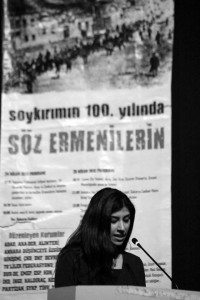
Seda Byurat speaking at the Armenian Genocide commemoration event in Ankara (Photo: Mehmet Ozer)
“Yes I am sure we will be killed. But the intent of the war is clear. The Turks will lose a lot, but the Armenian race will not die. I am a dead man now. Save my writings.”
Those were Smbat Byurat’s last words, etched on the prison walls in Ayas, where he and other prominent Armenian intellectuals were imprisoned during the onset of the Armenian Genocide. These words encompass the attitude the Armenian people have held over the past 100 years. Whether it is in the nation of Armenia or the Armenian Diaspora, Armenians have survived.
We have survived by creating resilient Armenian communities. We have survived by reading Taniel Varoujan’s poems. We have survived by listening to Komitas’s songs. We have survived by reading Smbat Byurat’s plays. We have survived by our strong passion and the connectivity we feel for our culture and land. Even if we cannot walk through the hills of Zeitun or swim in Lake Van or pray in one of the 1,001 churches in Ani, those places are forever with us and within our souls.
Smbat Byurat’s legacy is found amongst the Armenian people, but even more so it is found within myself. He was my grandfather’s grandfather, and I grew up hearing his stories every day. His story has helped shaped the person I am today.
Even now, I am reminded of his legacy as I have a picture of him hanging in my room. Every day when I see his picture, I am reminded of the great struggles he endured and the strides he made to further the Armenian cause and demand justice in the tumultuous climate of the Ottoman Empire. From the years spent imprisoned in Marash and Aleppo to furthering Armenian intellect from Zeitun to Constantinople to Cairo.
His passion for the Armenian land and culture is evident through his poems and plays and even through his biography—it was described that his adoration for the Armenian land and people could be felt with every breath he spoke. I am inspired by his perseverance and determination. I myself want to ensure that truth, equality, and justice come for the Armenian people.
However, this struggle is not limited to Armenians and the genocide of 1915. This is a struggle for humanity and this struggle cannot be ended with the Armenian people alone. The truth does not exist if Armenians are the only ones advocating for it. There exists an undeniable connection that Armenians and Turks have; we can either acknowledge it and do nothing about it, or we can embrace it and fight for justice together.

Byurat delivered a version of this speech at the April 22 concert in Istanbul, dedicated to the memory of the Armenian intellectuals arrested in the city on April 24, 1915, and the weeks that followed. Here is the link to that concert (Byurat’s speech, and her reading of Smbat Byurat’s letters from prison begin at the 2:28 minute mark): https://www.youtube.com/watch?v=pp75AEvS6pk

There Is No Peace without Justice

There Is No Peace without Justice

The following talk was given by Armenian Weekly Editor Nanore Barsoumian in Ankara on April 25. The commemoration was co-sponsored by 18 human rights groups and political organizations from Turkey, including the Human Rights Association, Dur-De, and the leading pro-Kurdish political party HDP. The commemoration event featured remarks by writers, artists, and human rights activists from Turkey and the Armenian Diaspora. Alternative Radio founder and director David Barsamian, scholar and activist George Aghjayan, co-founder and board member of the Genocide Education Project Roxanne Makasdjian, Seda Byurat, the great-great-granddaughter of prominent Armenian writer Smbat Byurat, and scholar Khatchig Mouradian were among the speakers.
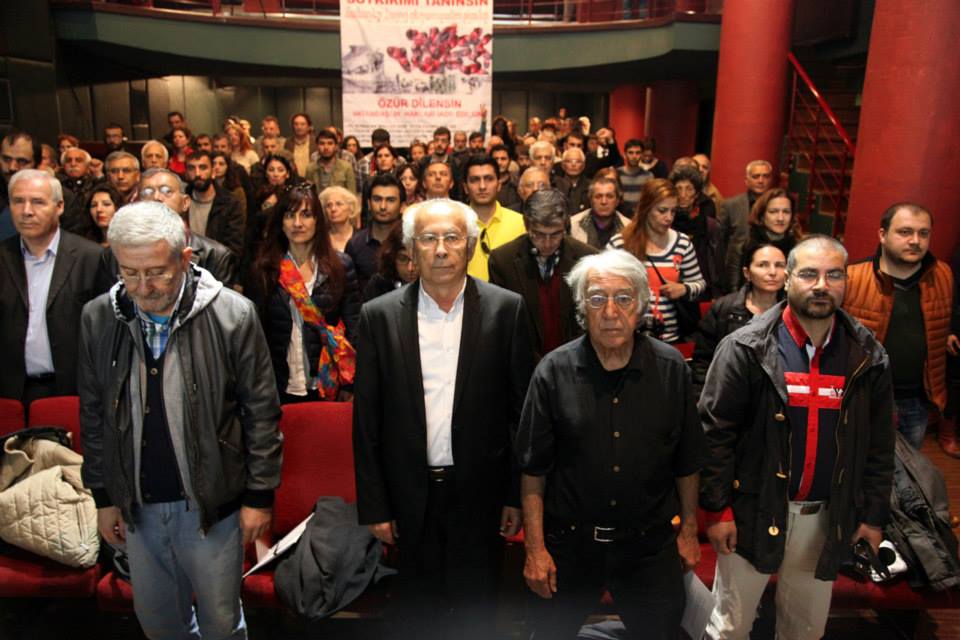
Hundreds gathered for a commemoration of the Armenian Genocide in Ankara (Photo: Mehmet Ozer)
The genocidal process targeting Armenians had just begun when the Armenian version of the newspaper I edit, the Hairenik Daily, published the following telegram on May 6, 1915:
Treason against Armenians in Bolis [Istanbul]. All our ungers [comrades] and the intellectuals of the community, even former Minister Mardigian, former Patriarch Arsharouni, and other clergymen arrested. Situation frightful. Immediately organize protest meetings on international soil and appeal to government to influence through Ambassador in Bolis. Otherwise the Armenian people will be annihilated.
Fast forward to 2015.
It was about a month ago when I received an e-mail from a friend.
He told me he had an ad—that a friend hoped we could publish it in the Armenian Weekly.
When I saw the ad, I almost fell out of my chair.
It was a drawing of a young boy with bright blue eyes, and it had a message under it from a 109-year-old woman whose last wish is to find her older brother.
The woman and her brother had been orphaned during the genocide, and were separated after they were put in an orphanage.
The woman remembers crossing the blood-red waters of the Arax River, and she remembers her brother and the way she would ride high up on his shoulders.
We ran the ad on the front page of our newspaper.
***
Nanore Barsoumian delivering her remarks (Photo: Mehmet Ozer)
Now think of all that was robbed from this woman—her parents, maybe grandparents, her home, maybe a favorite tree she used to climb, maybe that stray cat she used to play with when she would go visit her grandmother every Sunday. She lost her beloved brother, and she has not forgotten him even after 100 long years.
But most of all she lost her home and her land.
She was robbed of her right to stand where her grandparents, her great grandparents and their parents had stood, toiled, sweated, and finally bled. She lost all that they had built for centuries.
***
But this crime has countless victims, and survivors.
There are survivors and descendants of survivors among your neighbors, your teachers, your politicians, your grandparents, and your children. Tens of thousands of orphaned children were brought in to live with Turkish and Kurdish families. Some have told their children about it. Many have not. It must have been tremendously hard and painful to be a member of a hated people. I have met some of these survivors—as have my friends who are here with us today, and as have you…whether you have realized it or not.
Yes, this crime has countless stories of destruction, uprooting, and murder, but it also has stories of heroism and the triumph of compassion.
Let’s not bury these survivors with the crime. Haven’t they suffered enough? Let’s not bury justice with the crime—because there can never be peace without justice. And let’s not bury hope with the crime—because all of us, all our children, deserve better.

Wednesday, May 13, 2015

Socialist Youth World Council Adopts Resolution Calling for Armenian Genocide Recognition, Reparations

YEREVAN (A.W.)—The International Union of Socialist Youth (IUSY) World Council unanimously passed a resolution on the 100th anniversary of the Armenian Genocide, condemning the denial of the genocide and demanding justice for the crime. The World Council, which took place in Yerevan and was hosted by the Armenian Youth Federation (AYF) of Armenia, adopted the resolution on May 9.
The resolution, which was proposed collectively by the AYF regions represented, states that IUSY supports the “Armenian people’s struggle for the recognition and reparation of the Armenian Genocide by calling upon Turkey to start an immediate process of eliminating the consequences of the Armenian Genocide and initiate a process of restoring the rights of the Armenian people.” It also notes that “IUSY believes this is the only reliable road to reconciliation of the two countries and nations.”
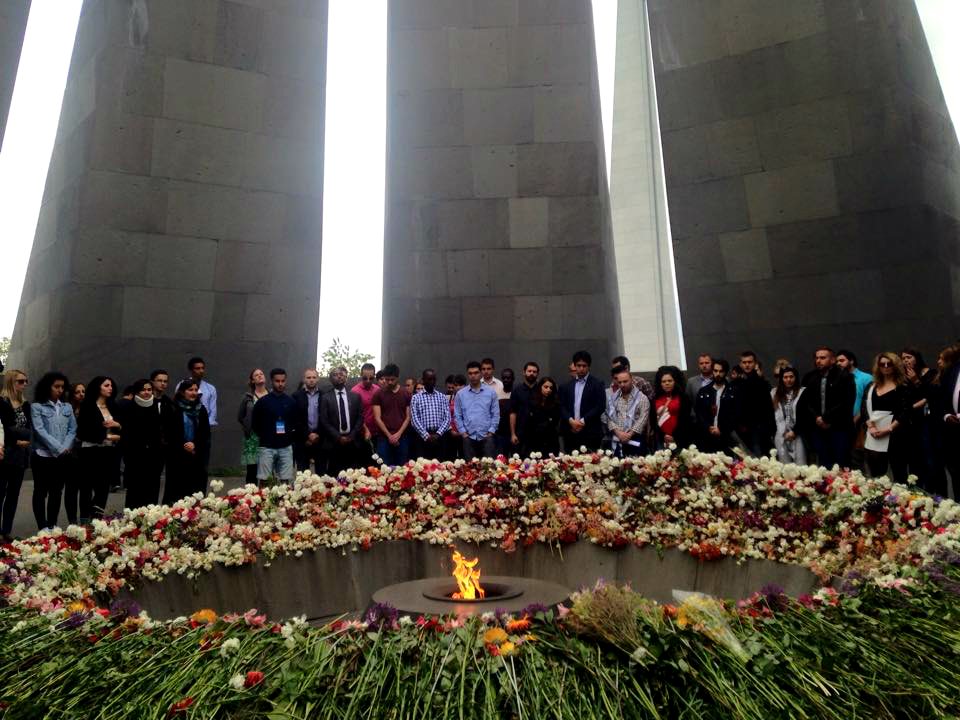
IUSY delegates paying their respects at the Armenian Genocide Memorial at Dzidernagapert (photo: Patil Aslanian)
“The fact that the resolution was unanimously passed speaks measures,” said Nairi Khachatourian, who is in Yerevan representing AYF Eastern United States. “IUSY is sending a strong message to Turkey that true reconciliation between Armenia and Turkey can only be built upon recognition, reparations, and real justice.”
Titled, “An Equal World Is Possible,” the IUSY World Council includes participants from 60 countries, with over 160 delegates representing various socialist youth organizations, in addition to over two dozen AYF representatives from Armenia, Artsakh, and the Diaspora.
Earlier that day, participants of the council paid their respects to the 1.5 million victims of the genocide at the Armenian Genocide Memorial at Dzidernagapert.
Below is the text of the resolution:
***
PROPOSAL BY THE ARMENIAN YOUTH FEDERATION (AYF)
Resolution on the 100th anniversary of the Armenian Genocide
The International Union of Socialist Youth (IUSY), being a faithful follower of the principles of justice, democracy, equality, and human rights, reaffirms its position on the Armenian Genocide as the world commemorates the 100th anniversary of the first Genocide of the 20th century.
The Armenian Genocide opened a whole new circle of genocides that were encouraged by the impunity of the perpetrators of the first genocide as well as inspired by its techniques and genocidal methods.
Genocide is a crime under international law contrary to the spirit and aims of the IUSY. This is why:
IUSY condemns the genocide against the Armenian people which was planned and carried out by the Ottoman Empire and various regimes in Turkey in 1915-23. During these years more than 1.5 million Armenians, living in their ancestral homeland (what is largely known as Eastern Turkey today), were brutally exterminated; their heritage was confiscated and largely destructed. The small number of Armenians who survived was spread all over the world.
IUSY strongly condemns the denial of the Armenian Genocide by the Turkish government as well as all the attempts of the Republic of Turkey to mute and bribe every initiative that is aimed at the recognition and reparation of the Armenian Genocide. IUSY believes that the denial of the genocide is a double crime that ought to be punished and has nothing in common with the right of freedom of expression.
IUSY supports the Armenian Youth Federation’s (AYF) and the Armenian people’s struggle for the recognition and reparation of the Armenian Genocide by calling upon Turkey to start an immediate process of eliminating the consequences of the Armenian Genocide and initiate a process of restoration of the rights of the Armenian people.  IUSY believes this is the only reliable road to reconciliation of the two countries and nations.
IUSY sees education as one of the most vital and constructive ways of fighting any form of extremism. With this, we call upon our member organizations to spread the knowledge of the Armenian Genocide, because only by knowing and condemning past genocides can we prevent new ones from taking place.

29 Heroes Recognized for Contributions to Armenian Community at Centennial Banquet in DC

29 Heroes Recognized for Contributions to Armenian Community at Centennial Banquet in DC

Presidents Wilson and Reagan, the American Red Cross, the New York Times, and Numerous Foreign Governments among Recipients

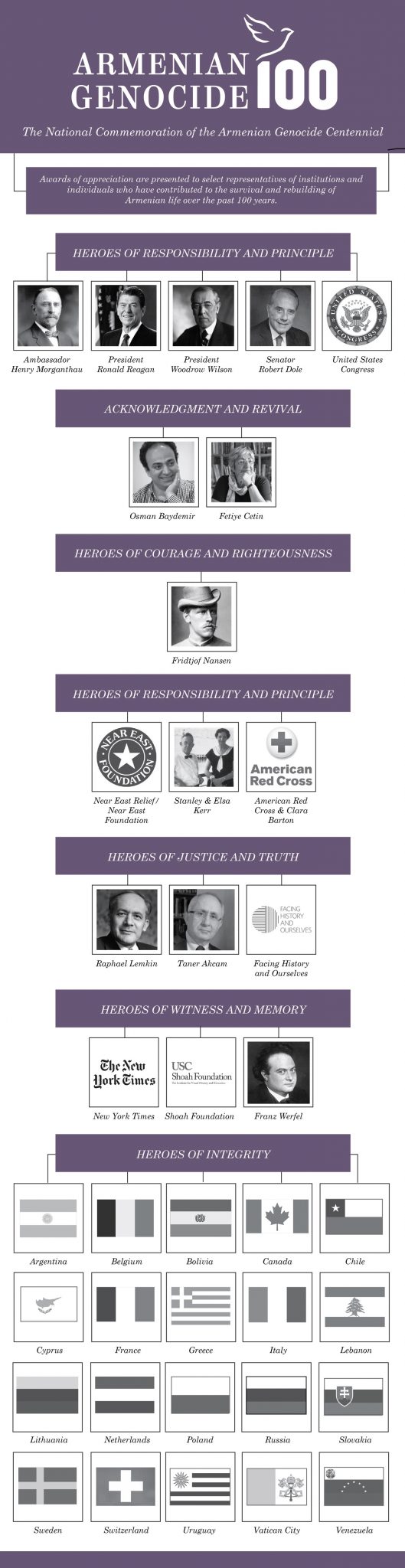
WASHINGTON—Twenty-nine individuals and organizations were given Hero Awards on May 9 in a show of gratitude from the Armenian community to those who helped save hundreds of thousands of lives during the Armenian Genocide from 1915-23, and have worked for its recognition thereafter.
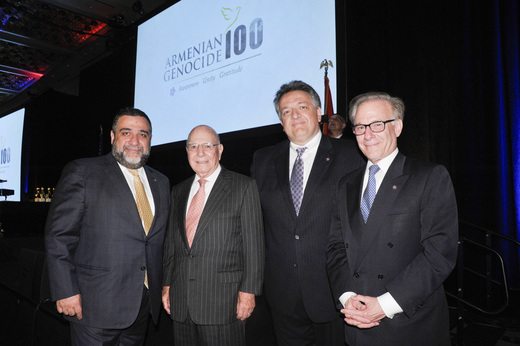
(L-R) Ruben Vardanyan, Paul Ignatius, Noubar Afeyan, and David Ignatius
At a banquet sponsored by the U.S. National Commemoration of the Armenian Genocide Centennial (NCAGC), descendants of genocide survivors and many others gathered to honor the nearly 1.5 million lives lost during the genocide and to thank those whose selfless and heroic actions enabled the Armenian community to survive and thrive.
The evening first welcomed guests at a reception featuring exhibitions on the history of the genocide, musicians playing Armenian music, and displays of Armenian artwork. Guests gathered in the banquet hall for the formal dinner, which included remarks by former Secretary of the Navy Paul Ignatius, former U.S. Ambassador Edward Djeredjian, and journalist Lara Setrakian.
“If not for the actions of these men, women, groups, and governments, the Armenian community as it is today would not exist,” said Noubar Afeyan, NCAGC chair, who is himself the descendant of a genocide survivor.
 Prof. Taner Akcam
“While this Centennial is a solemn commemoration of the tragic events 100 years ago, we owe an enormous debt of gratitude to those saviors whose brave actions helped us survive,” he continued. “We must now unite and work together to forge a more peaceful future free of genocides.”
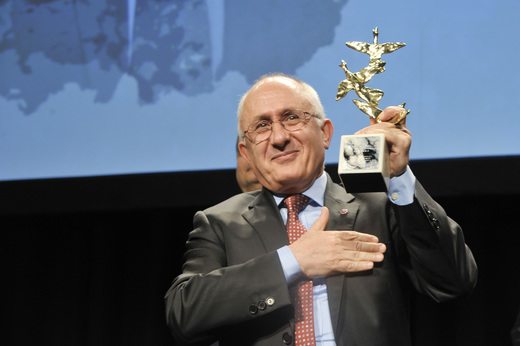
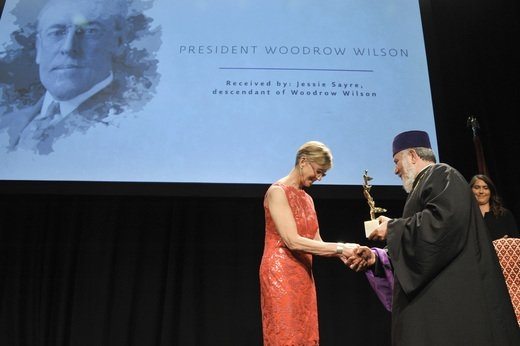
At the ceremony, a diverse group of awardees—including representatives of the United States Congress, former U.S. presidents, and numerous foreign governments and institutions—were honored for their contributions to the survival and rebuilding of Armenian life over the past 100 years. John Heubusch, the executive director of the Ronald Reagan Presidential Foundation, accepted the award on behalf of the late 40th U.S. president and the last commander in chief to have recognized the genocide formally while in office.
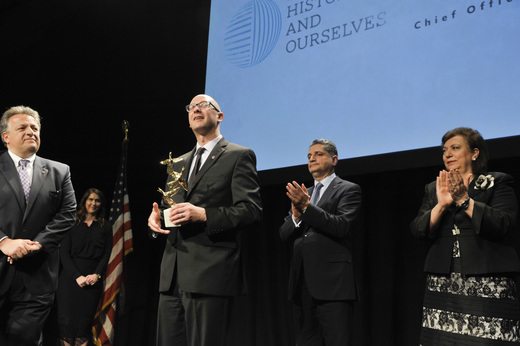
Adam Strom of Facing History and Ourselves
“On behalf of our foundation, I am truly honored to accept this award for President Reagan,” said Heubusch. “The president cared deeply about these issues and was proud to lend his voice to the Armenian community. He was proud to have acknowledged what occurred 100 years ago was, in fact, a genocide.”
Saturday’s banquet concluded a three-day weekend of commemorative events marking the Centennial of the Armenian Genocide in Washington. With a focus on promoting awareness, gratitude, and unity among participants, the NCAGC led a series of events that included an Ecumenical Service at the National Cathedral, led by His Holiness Karekin II, Supreme Patriarch and Catholicos of All Armenians, and His Holiness Aram I, Catholicos of the Great House of Cilicia of the Armenian Church; performances by renowned Armenian musicians at the Strathmore; a Divine Liturgy at the Shrine of the Immaculate Conception; and various other cultural exhibitions.
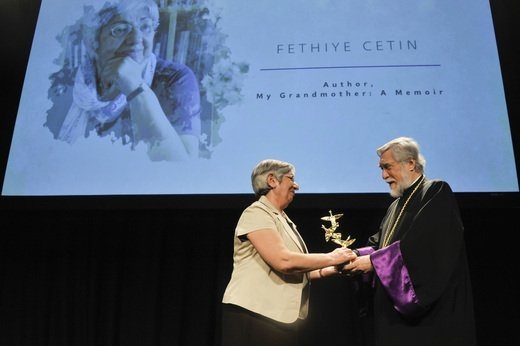
Fethiye Cetin, author of ‘My Grandmother’
“Tonight, we gather for this final event in Washington to commemorate the tragedy that occurred 100 years ago and to honor the heroes who emerged,” said Afeyan. “But tomorrow we look forward to the next 100 years,” he said. “It is not enough for Armenians to survive. We must dare to be alive, dare to thrive, and come together to commit to a future free of genocide.”
List of the 29 individuals and organizations given Hero Awards
President Woodrow Wilson’s great granddaughter Jessie Sayre
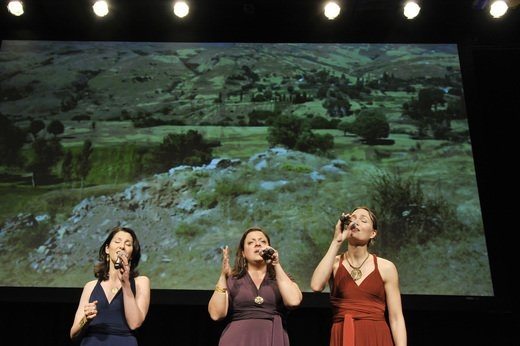
Zulal trio performing

Friday, May 8, 2015

Armenian President Visits U.S. Holocaust Memorial Museum

WASHINGTON—On May 6, Armenia’s President Serge Sarkisian visited the U.S. Holocaust Memorial Museum as part of his three-day trip to Washington, D.C. The President’s visit took place on the eve of the U.S. commemoration activities marking the 100th anniversary of the Armenian Genocide. From May 7-9 in Washington, D.C., the National Commemoration of the Armenian Genocide Centennial is hosting a series of events commemorating the anniversary. Thousands will gather from across the country, and internationally, to join in remembering and honoring those lost in the genocide 100 years ago.
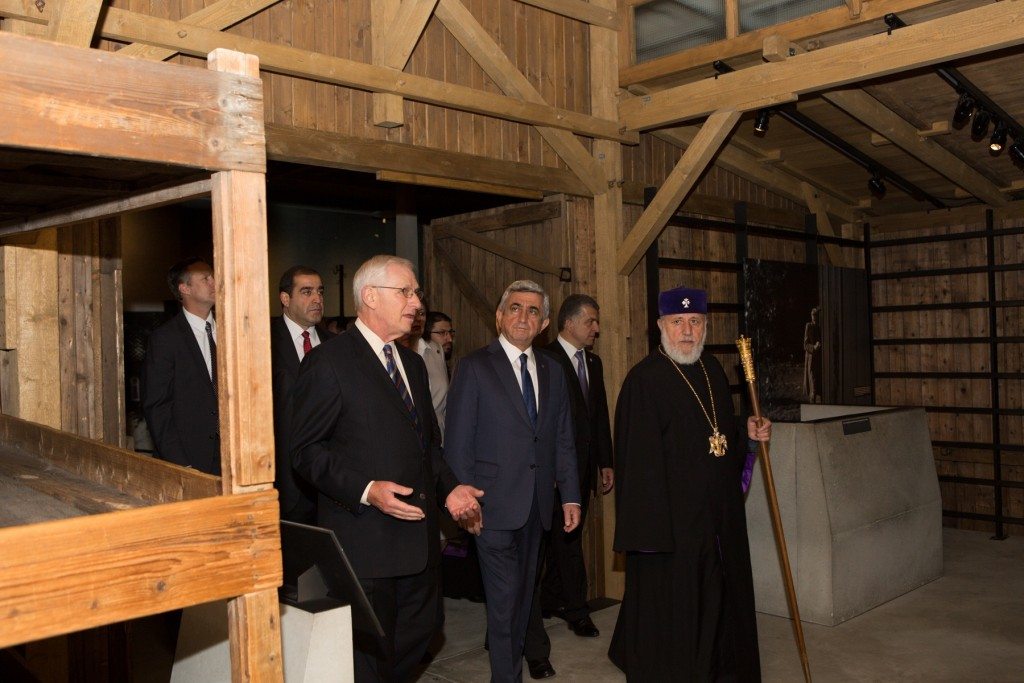
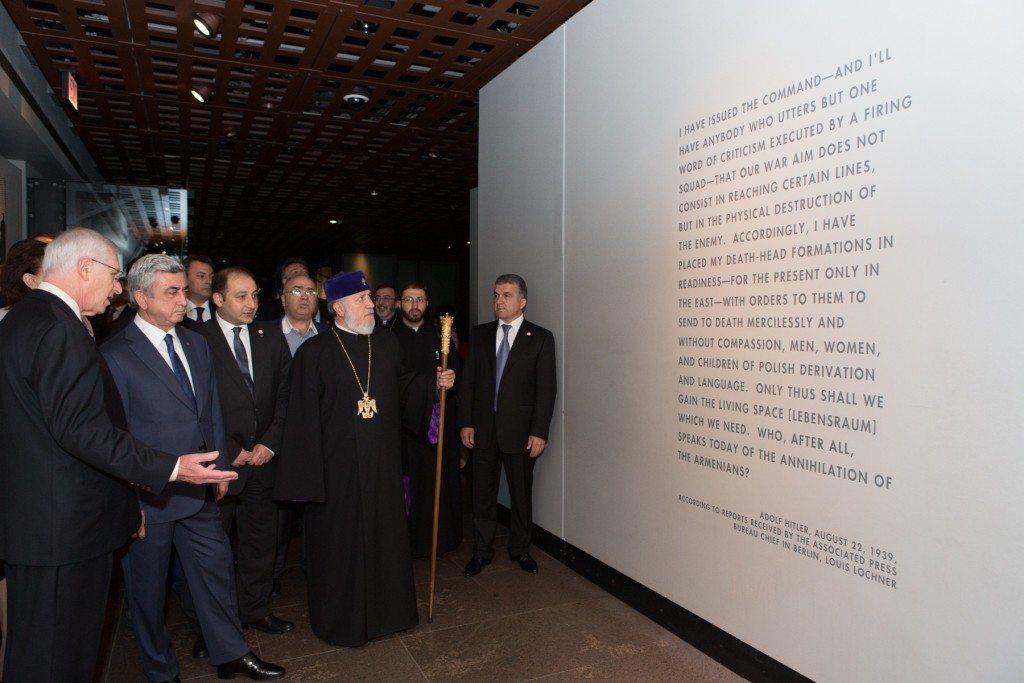
Arthur Berger, Senior Advisor to the United States Holocaust Memorial Museum, leads Armenian President Serge Sarkisian; His Holiness Karekin II, Supreme Patriarch and Catholicos of All Armenians; the Armenian Foreign Minister and Minister of Diaspora Affairs; Archbishop Khajag Barsamian, the Primate of the Eastern Diocese; and others on a tour of the U.S. Holocaust Memorial Museum. (Photo: U.S. Holocaust Memorial Museum)
“It was an honor to have the opportunity to visit this memorial and museum. We, Armenians, Jews, sons and daughters of other nations that have survived genocides shall continue working together to fight for recognition, condemnation of all genocides and other crimes against humanity, as that is the most efficient way of preventing them in the future,” said Sarkisian.

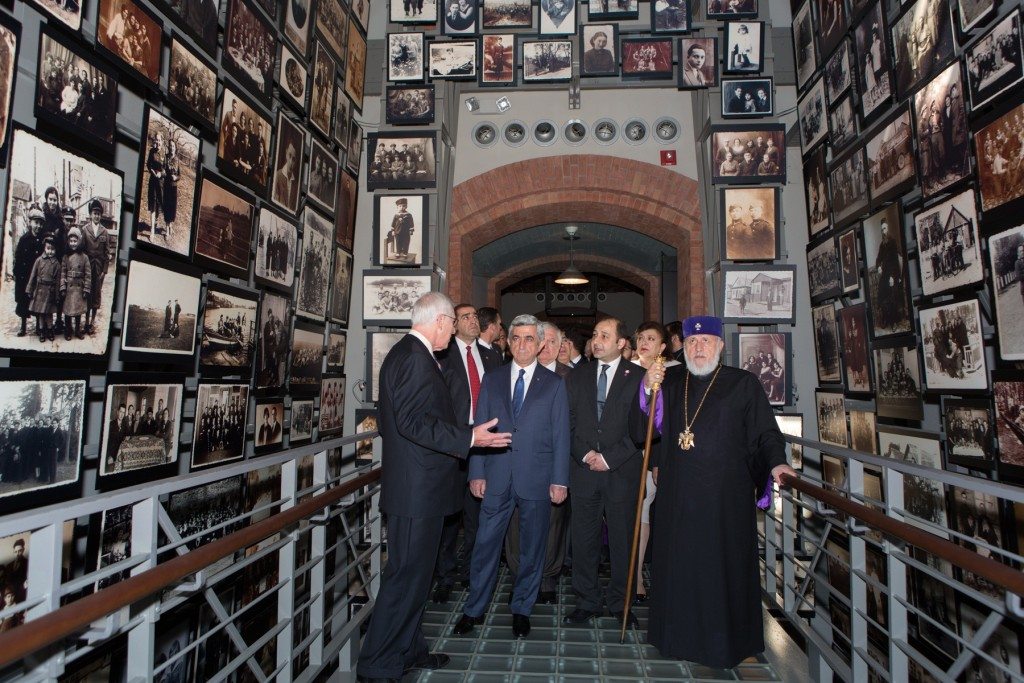
Arthur Berger, Senior Advisor to the United States Holocaust Memorial Museum, leads Armenian President Serge Sarkisian; His Holiness Karekin II, Supreme Patriarch and Catholicos of All Armenians; the Armenian Foreign Minister and Minister of Diaspora Affairs; Archbishop Khajag Barsamian, the Primate of the Eastern Diocese; and others viewing the Tower of Faces exhibit (Photo: U.S. Holocaust Memorial Museum)
U.S. Holocaust Memorial Museum Statement on Armenian Genocide
Last month the U.S. Holocaust Museum issued a statement on the Centennial of the Armenian Genocide.
Below is the full text of the statement:
Museum Statement on the 100th Anniversary of the Armenian Genocide
WASHINGTON—On the 100th anniversary of the Armenian Genocide, the United States Holocaust Memorial Museum remembers the suffering of the Armenian people. The Ottoman government, controlled by the Committee of Union and Progress (İttihat ve Terakki Cemiyeti), systematically eliminated the Armenian ethnic presence in the Anatolia region of its empire. Between the spring of 1915 and the end of autumn 1916, Ottoman authorities arrested, deported, conducted mass killings, and created conditions intended to cause widespread death among Armenian Christians.
At least 664,000 and possibly as many as 1.2 million Armenian men, women, and children died in massacres, in individual killings, or as a consequence of systematic ill-treatment, exposure, starvation, and disease. Knowledge of these atrocities quickly spread around the world and aroused widespread activism and even protests from representatives of the Ottomans’ World War I allies, Germany and Austria-Hungary.
The origins of the term “genocide” rest, in part, in the events of 1915–16 in Anatolia, then part of the Ottoman Turkish Empire. Polish-Jewish lawyer Raphael Lemkin highlighted early exposure to the history of Ottoman attacks against Armenians, anti-semitic pogroms, and other cases of targeted violence as key to his beliefs about the need for the protection of groups under international law. Inspired by the murder of his own family during the Holocaust, Lemkin tirelessly championed this legal concept until it was codified in the United Nations Convention on the Prevention and Punishment of the Crime of Genocide in 1948.
An accurate understanding of history rests on objective research conducted by scholars of all nationalities and disciplines. The Museum calls on all governments and private institutions to make freely available complete archives relevant to these events.
Arthur Berger, Senior Advisor to the United States Holocaust Memorial Museum, leads Armenian President Serge Sarkisian; His Holiness Karekin II, Supreme Patriarch and Catholicos of All Armenians; the Armenian Foreign Minister and Minister of Diaspora Affairs; Archbishop Khajag Barsamian, the Primate of the Eastern Diocese; and others stand in front of a quote from Adolf Hitler that references the Armenian Genocide. (Photo: U.S. Holocaust Memorial Museum)


Thursday, May 7, 2015

Why Is Armenian Genocide Recognition an Urgent Cause for the Free World Today?


Imagine that the German state that came into being after World War II had never acknowledged Nazi Germany’s Holocaust, and instead used all of its state powers to deny it. And then imagine if contemporary Germany used its international stature as a regional power to put pressure on the U.S. government and other countries not to use the word “genocide” when describing the Holocaust. Imagine if Germany today denied the existence of important Jewish cultural monuments on its territory, left them in disrepair, misidentified them as non-Jewish, or subjected them to abuse. If Germany had done these things, the entire Free World would still be fighting for the recognition of the Holocaust and the prosecution of Holocaust deniers.
Today, the Turkish state that followed the Ottoman Empire is engaged in all of the above vis-à-vis the genocide of the Armenians in Ottoman Turkey.
The Armenian Genocide was the first crime of its kind in the modern era, employing modern means of governmental management and organization, scientific censuses, statistics, as well as modern technologies such as telegraphy, on a geographical scale to annihilate the Armenian Nation. As such, it was a source of fascination for Hitler and the Nazis, and a reference for them as they planned the Jewish Holocaust.
What makes the Armenian Genocide different from the Holocaust or other genocides of the modern era is the continued attempt to falsify the very history of the region. It is a crime against history. It is an attempt to erase the history and historical identity of the land on which the Armenian people existed, land that was once the very heart of Historical Armenia.
The Armenian Genocide, therefore, is also an attempt at “Historicide” or “Historiophagy,” a new name for a crime against humanity that encompasses the attempt to deny the present and past and therefore the future existence of a people on their historical homeland.
What is astonishing about the Turkish state’s denial of the crime of the Armenian Genocide is that it holds the entire Turkish people hostage, unable themselves to come to grips with the original crime because of the mistaken position of their state. To fight for recognition of this genocide is thus also a way to free the Turkish people from their own dark past. The continued pressure on international governments by the Turkish state not to use the word genocide also forces these leaders into moral duplicity.
Turkey today continues to deny the crime, and as a result indirectly continues the crime of genocide. Through denial, the Turkish state implicates itself in the original crime. Genocide denial is a form of continued persecution of the descendants of the escapees of the genocide. Exiled escapees are unable to return and claim their stolen property, and cannot come to terms with the loss they have been subjected to because the crime is denied.
At the very core of the current Turkish state is its denial of the genocide and the ethnic and religious cleansing that was planned to create a state identified as Turkish, as opposed to the mosaic of cultures that the Ottoman state was. As such, the very being and becoming of the Turkish state itself is based on the crime of genocide.
Each participating element of the apparatus of that state is indirectly implicated in the original crime as long as it continues the suppression of the word genocide and the denial of the crime of genocide. As long as the Turkish state does not cleanse itself of this denial, by admitting and coming to terms with the legacy of the crime, it will remain indirectly implicated.
The Armenian Genocide is an urgent cause for the Free World because the perpetrators were never appropriately prosecuted. The international community has never fully acknowledged it because of Turkish state pressure, directly or indirectly through the insinuations of realpolitik. The recognition of the Armenian Genocide is and will remain an urgent cause for the Free World.

Wednesday, April 29, 2015

Sassounian: Armenians Should Now Pursue Legal Claims Rather than Further Genocide Recognition

Armenians experienced unforgettable days last week during the Centennial commemorations of the Armenian Genocide. In many respects, Turkish denialists’ much-feared “Tsunami” became a reality! While Armenians around the world were busy organizing commemorative events in recent years, their efforts were amplified by some unexpected developments, including Turkish President Erdogan’s irrational rhetoric and reaction.
The year began with Erdogan’s childish maneuver, switching the Gallipoli War Centennial to April 24, to derail the observances planned for the Armenian Genocide Centennial. The international media quickly exposed the Turkish president’s ploy, providing extensive publicity for the upcoming genocide anniversary.
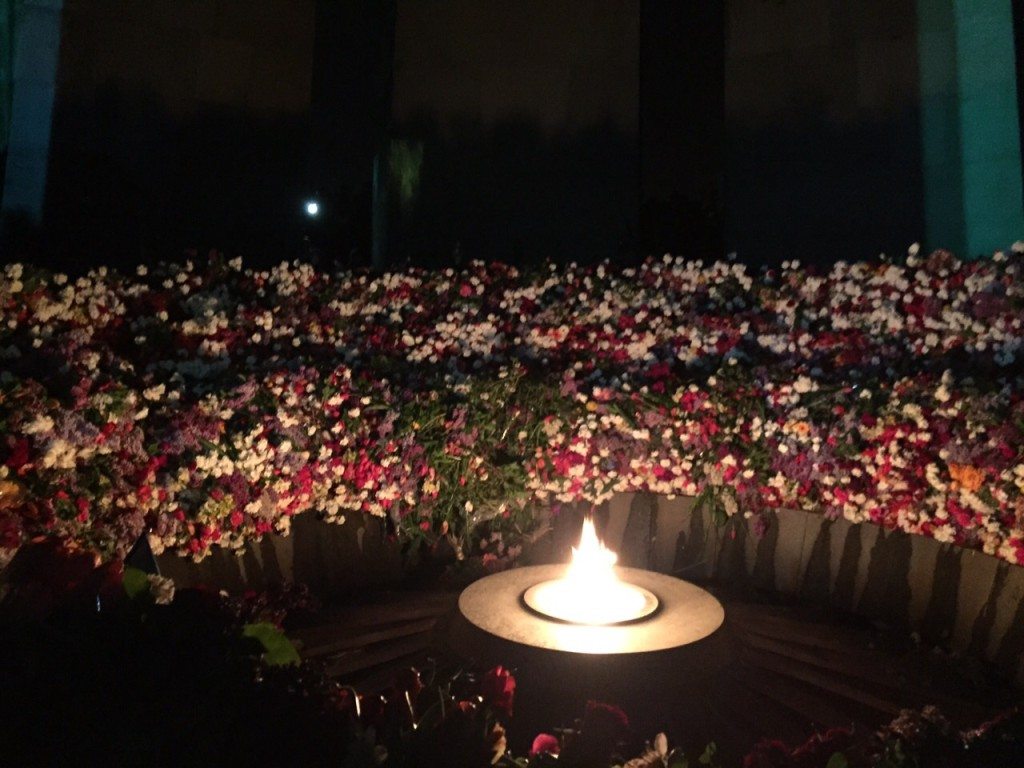
Flowers placed at the Armenian Genocide Memorial m=and Monument at Dzidzernagapert in Armenia (Photo: Harout Kassabian)
In early April, the Kardashians’ visit to Armenia generated thousands of articles and TV reports, and millions of social media posts. A few days later, Pope Francis created his own “Tsunami” by uttering his courageous words on the Armenian Genocide. Once again, Erdogan made matters worse for Turkey by insulting not only the Pope, but also 1 billion Catholics and the nation of Argentina, the Pontiff’s birthplace. Shortly thereafter, the European Parliament adopted a resolution on the Armenian Genocide, providing further media coverage of this issue.
Being in Armenia for the first time on April 24, and on the occasion of the Centennial, was a deeply moving experience. The Armenian government did monumental work inviting 1,000 dignitaries from 60 countries, including prominent scholars, legal experts, political leaders, parliamentarians from 30 countries, and survivors of other genocides. On April 22-23, the distinguished guests participated in a Global Forum “Against the Crime of Genocide,” where I delivered brief remarks castigating President Barack Obama’s failure to keep his promise on using the term “Armenian Genocide.” I explained that contrary to a widely held misperception, the United States has repeatedly recognized the Armenian Genocide.
On April 23, all six political parties represented in the Austrian Parliament issued a joint declaration recognizing the Armenian Genocide. As expected, Turkey overreacted by withdrawing its ambassador from Vienna. This is the second Turkish ambassador to be recalled to Ankara this month. As an increasing number of countries recognize the Armenian Genocide, Turkey may soon have fewer envoys, isolating itself from much of the world!
Also on April 23, German President Joachim Gauck delivered a powerful speech at a memorial service in Berlin, acknowledging not only the Armenian Genocide, but also Germany’s complicity in the Ottoman-Turkish genocidal campaign. Despite heavy pressure from Turkish leaders, the German Bundestag is expected to adopt a similarly worded resolution that would send shock waves throughout the 1,000 rooms of President Erdogan’s newly built palace, since Germany was Turkey’s ally in 1915, and continues its close relationship until today.
In the evening of April 23, the Catholicos of All Armenians Karekin II and the Catholicos of the Great House of Cilicia Aram I jointly presided over a historic rite of canonization in Etchmiadzin, declaring the 1.5 million Armenian Genocide victims to be Saints. Following this moving ritual, at the exact hour of 19:15 or 7:15 p.m., churches throughout the world began ringing their bells 100 times. Later that night, the System of a Down band performed a free concert at Yerevan’s Republic Square. The thousands of young people in attendance were highly energized despite the heavy downpour. The concert was aired live, disseminating the band’s genocide message to millions of people worldwide.
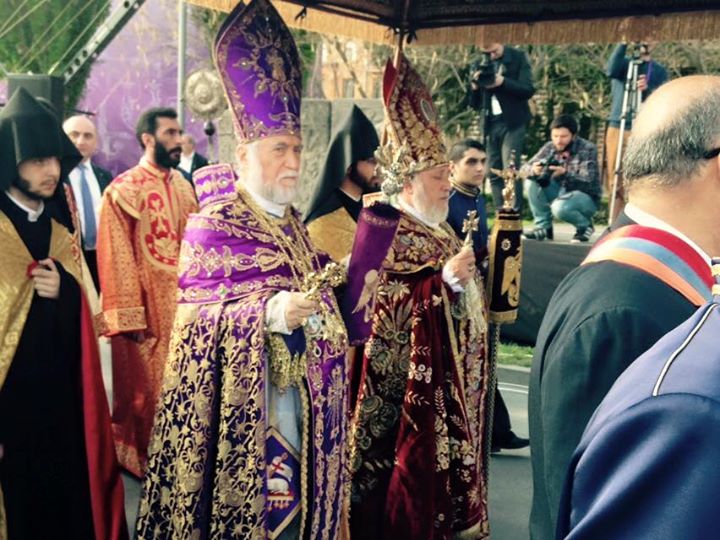
The Catholicos of All Armenians Karekin II and the Catholicos of the Great House of Cilicia Aram I jointly presided over a historic rite of canonization in Etchmiadzin, declaring the Armenian Genocide victims to be Saints. (Photo: Varant Meguerditchian )
On April 24, a memorable observance took place on the grounds of Dzidzernagapert, the Armenian Genocide Monument in Yerevan, with the participation of hundreds of religious leaders, ambassadors, officials, and the presidents of Russia, France, Cyprus, and Serbia. While the heads of two superpowers came to Yerevan on April 24, Turkey was unable to attract to Gallipoli the same caliber of leaders, despite its considerable efforts. It was perfectly fitting to this solemn occasion that the distinguished guests at the Yerevan Memorial spent several hours huddled in blankets like refugees, in freezing temperatures, sheltered under a large canvass from the rain.
One of the most stunning developments last week was Turkish Prime Minister Ahmet Davutoglu’s declaration that the Armenian “deportations were a Crime Against Humanity”—which, under international law, is tantamount to recognizing the Armenian Genocide. No one should be surprised if Erdogan dismisses Davutoglu after the June parliamentary elections.
Now that the Centennial is behind us, it is high time that Armenians turn the page on Armenian Genocide recognition and begin to systematically pursue their claims from Turkey through international, regional, and local tribunals.