Facing Turkey's Past: Struma and 1915
Posted: 09/18/2012 12:02
pm
Apology, in my opinion, is secondary. First and foremost, the emphasis
should be on this society's courage to face the sins of the past. We
were deprived of it until today. This is a frightened society. I am not
ashamed to say this: We were fed this fear, we were scared throughout
all our lives. Our ruling system has been based on fear. We have to
change that. The only way is to confront our past.
These are the words of
İshak Alaton, a prominent octogenarian Turkish
businessman of Jewish origin.
After releasing his memoirs not so long
ago, Alaton has become more and more
vocal, calling endlessly for an
end to the bloody Kurdish conflict as one of
the "wise men" ready to be
part of a dialogue on reconciliation, asking for
the courage to face
the crimes that were committed during the collapse of
Ottoman rule and
asking citizens to speak out.
When a ship called the
Struma was dragged to the port of Old İstanbul
in 1941, Alaton was a
15-year-old witness to the agony onboard. The
60-year-old vessel was the
last hope of 769 Romanian Jews fleeing the
Nazis, but its engines had
stopped at the Black Sea end of the
Bosporus. The issue led to pressure on
Ankara from Adolf Hitler's
regime, and after 72 days of despair, the Struma
was sent by Turkish
authorities back into the Black Sea, where it was
torpedoed by the
Soviet navy. Only one person survived.
"Those
responsible for this in Ankara are, to my mind, murderers. This
society, of
which I am a part, has a problem with hiding from its past.
We pretend that
if we lock them away the problems will be gone. But the
corpses that rot in
there poison the air that we breathe. Is any
serenity possible without
confrontation? Let us do it, so that we can
make peace with the
past."
The Struma disaster, a hidden episode in the republic's history,
is the
subject of a new book written by Halit Kakınç, and its preface is
written by, yes, Alaton himself.
It is not for nothing the subject of
"genies out of the bottle." is to
persist on the agenda of Turkey, opened up
in a sort of "Turkish
perestroika" by the ruling Justice and Development
Party (AKP) in the
past decade.
And, only days after the release of
the Struma book, another hit the
shelves -- a potential intellectual
bombshell.
"1915: Armenian Genocide" is its title and, not only due to
its cover
but also its groundbreaking content, it overwhelms many others on
the
subject that have been published. What makes the book outstanding and
unique is that it was written by Hasan Cemal, an internationally
renowned editor and columnist who is the grandson of Cemal
Pasha.
This kinship is key to understanding the book's historic
significance:
Cemal Pasha was a member of the triumvirate, whose other parts
were
Talat and Enver Pasha, responsible for the Great Armenian Tragedy,
which started with a mass deportation of Ottoman Armenians from their
homelands and ended with their annihilation between 1915 through
1916.
In his account, Hasan Cemal concludes it was genocide. He does not
intend, or pretend, to argue his case like a historian would. His is a
painful intellectual journey that takes us through his own evolution, a
rather ruthless self-scrutiny of his intellectual past that amounts to
an invaluable piece of private archeology.
He has done this before.
In other books, he questioned his "militarist
revolutionary" past (in the
'60s and'70s), confronting boldly his own
mistakes -- his deep disbelief in
democracy, plotting coups, his
experience as newspaper editor,
etc.
But this one is even more personal.
"It was the pain of Hrant
Dink which made me write this book," he told
the press. Dink was a dear
Turkish-Armenian colleague to many of us, as
he was to Cemal. He was
assassinated in broad daylight on a street of
Istanbul by a lone gunman in
January 2007, sending shockwaves around
the world.
"Look at my age;
it's been years and years that I have defended the
freedom of expression.
But should I keep secret some of my opinions,
only for myself? Should I
still have some taboos of my own? Should I
still remain unliberated? Is it
not a shame on me, Hasan Cemal?"
In the preface, he writes: "We cannot
remain silent before the bitter
truths of the past. We cannot let the past
hold the present captive.
Also, the pain of 1915 does not belong to the
past, it is an issue of
today. We can only make peace with history, but not
an 'invented' or
'distorted' history like ours, and reach
liberty."
The pain of Dink's memory -- which scarred many of us so
eternally --
may have been a crucial point for it, but by turning a
"personal
taboo-breaking" into a public one, Cemal opened a huge hole in the
wall
of denial of the state. It broke another mental dam.
This bold
exercise in freedom of speech will, in time, pave the way for
the correct
path. It is up to the individuals of Turkey to do the same,
and bow before
their consciences. Perhaps this is why there has been
such silence over this
book in the days since its publication. It is
also very difficult to find in
bookstores. There are rumors that some
chains are refusing to sell it. This
may be true, but it cannot now be
unpublished.
The genie is out of
the bottle but the ghosts of the past are also very
much alive. The "silent
treatment" is proof of that. If anything, it
shows how frightened people
are. Not only does the state owe an apology
for the past, but an even bigger
apology is necessary for enforcing,
decade after decade, a mass
internalization of denialism in this
country.
Sunday, September 30, 2012

Thursday, September 27, 2012
Sassounian: Azeri, Turkish-American Groups Denigrate US-Armenian Executive
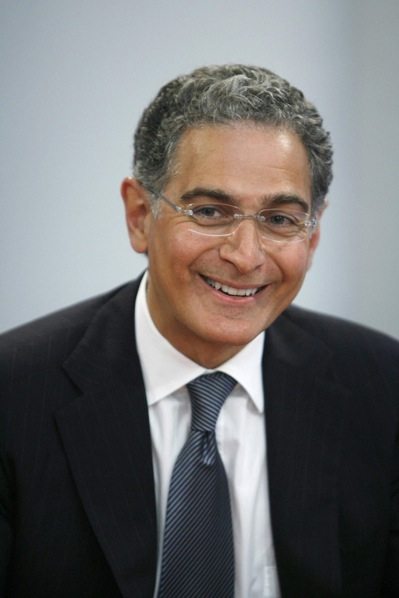
Mark Hoplamazian
The Azeri and Turkish groups attacked Hoplamazian for speaking at the Sept. 22 banquet of the “Armenian Assembly of America (AAA), an Armenian-American lobbying group, as a Hyatt executive.” They also expressed their unhappiness that he “serves on the Advisory Board of ‘Facing History and Ourselves,’ a non-profit group that ‘teaches about the Armenian genocide.’”
The four Turkic organizations claimed that “Mr. Hoplamazian’s engagement with ethnic special interest groups that spread antagonisms against Turkey and Azerbaijan may be in violation of the Conflicts of Interest clause of Hyatt’s Code of Business Conduct and Ethics.” However, a review of the hotel chain’s code, posted on its website, does not provide the slightest hint that the Hyatt executive violated any of its provisions.
In their letter, the Azeri and Turkish groups made a series of malicious statements by referring to the Armenian Genocide as an “allegation” and as “World War I-era inter-communal atrocities.” They falsely alleged that these “atrocities” were “never tried in any tribunal and no intent to exterminate Armenians was ever established. No sentences or court verdicts were issued in terms of the 1948 United Nations Convention on Prevention and Punishment of Genocide.”
By making such ridiculous claims, the leaders of these Turkic organizations simply exposed their ignorance of the basic facts of the Armenian Genocide. They conveniently forgot about the Turkish Military Tribunals of 1919 that sentenced the Turkish ringleaders of the Armenian Genocide to death. U.S., Swiss, and Argentinean federal courts have also reaffirmed the veracity of the Armenian Genocide. Furthermore, in 1985 the UN Sub-Commission on Prevention of Discrimination and Protection of Minorities adopted a report classifying the Armenian Genocide as an example of genocide.
The Azeri and Turkish groups also claimed that they represent “over half million Americans of Turkic descent.” This cannot be true simply because there aren’t that many Turkic people living in the United States, according to the latest U.S. census. Even if there were half a million Turkic Americans, it is highly doubtful that all of them would have given their consent to be represented by these organizations for such absurd misadventures. Most probably, these four groups altogether have a tiny fraction of the constituencies they claim.
Clearly, the faulty statements and silly accusations of these Turkic groups are intended to intimidate Hoplamazian and force him to disengage from any involvement in Armenian or genocide-related issues. More ominously, by targeting and making an example of the Hyatt CEO, Azeri and Turkish groups hope to discourage other Armenian-American executives from pursuing similar activities.
In their joint letter, the Azeri and Turkish groups indirectly threatened Hyatt’s corporate interests by indicating that the company “currently runs a total of four successful hotels in Istanbul, Turkey, and Baku, Azerbaijan.” One wonders if the governments of Azerbaijan and Turkey have authorized these two-bit groups to speak on their behalf. Moreover, do these organizations realize that they are undermining the business interests of their native countries by foolishly threatening a global corporation like Hyatt?
It would be highly regrettable if the unwise Azeri and Turkish campaign against prominent Armenian-American executives were to start an undesirable chain of events that leads the Armenian community to take counter-actions against successful Turkish-American businessmen, such as Muhtar Kent, the chairman and CEO of the Coca-Cola Company.
The Azeri-Turkish letter is highly unlikely to bring any tangible benefits to these groups, as Hyatt’s Board of Directors will most probably dismiss their baseless allegations. More importantly, such a racist assault on the integrity of an exemplary Armenian-American executive would energize Armenians on the eve of the 100th anniversary of the genocide to pursue more vigorously their just demands from both Turkey and Azerbaijan.
Lastly, it is outrageous that these Azeri and Turkish groupings kept totally silent when an Azeri officer axed to death a sleeping Armenian in Budapest, Hungary, but are now alarmed when an Armenian-American CEO exercises his right to free speech in Beverly Hills!
In Facing Its Adversaries, America’s Got a Hidden Lever: Armenia
BY DANIEL GAYNOR
From The Truman Project
Most Americans wouldn’t be shocked to learn that the largest American embassy in the world is in Baghdad, Iraq. But the second-largest is in a surprising place: Armenia. It begs the question: why?
The best explanation is a real estate mantra: location, location, location. Armenia, a landlocked country with just three million people, might be in the roughest neighborhood in the world. But in America’s eyes, it might be in the most important position of any US ally to advance President Obama’s foreign policy agenda.
What it lacks in natural resources–it has little oil, gas or jewels–it makes up for in geography. Few countries are in better position to shape US foreign policy than Armenia.
Armenia borders Turkey, Azerbaijan, Georgia and Iran. As a part of the former Soviet Union, it relies on nearby Russia extensively for trade and military backing. The US has a significant stake in all five countries, and Armenia is now coming into view as a potentially potent lever to advance American aims.
That is, if the Armenians can be won over.
As the US tries to woo Armenia to become a stronger ally in the region, the term “geostrategic” has never been more apt. Armenia is literally at the center of a number of countries that Washington considers among its top priorities. As President Obama tries to accomplish key foreign policy objectives–like preventing Iran from attaining nuclear bombs or seeing democracy flourish in Russia–he’s got to encourage Armenia to play along.
To Armenia’s south, one such issue is unfolding in Iran’s nuclear centrifuges. Last week, a media skirmish between the US and Israel boiled over when Israel’s Prime Minister, Benjamin Netanyahu, stated publicly that America had no “moral right” to say whether or not Israel could bomb Iran to prevent it from developing a nuclear weapon. President Obama reportedly called Netanyahu at 3AM to quell tensions.
America is racing to develop every diplomatic pressure point it can on Iran, lest Israel launch a preemptive attack and embroil America in a third Middle East war in ten years. One of those pressure points goes straight through Armenia.
While the US has cut off formal relations with Iran–Washington talks through Switzerland’s embassy there–it’s no secret that it employs a variety of foreign policy crowbars to influence and destabilize Iran’s ruling regime. Some, like President Obama’s latest round of economic sanctions, are well known. Partnering with Armenia is not, but could have a major impact. Through economic and diplomatic incentives, the US is actively trying to shape Armenia into an ally. As President Obama seeks to economically isolate Iran–his sanctions have cut the value of Iran currency in half–he is trying to regionally isolate the regime, as well. Armenia is key to that strategy.
For Armenia, the game is far less simple. Partnering with the US–with whom it has a good, but not great, relationship–could alienate the few friends Armenia has left in the South Caucasus region. It wants military cooperation with Russia, but economic access to the west.
While it has tried to deepen relations with the European Union and the US, Armenia’s two best friends at the moment are arguably the US’s most challenging adversaries: Russia and Iran. That’s not necessarily because of shared ideologies, or even shared interests; it’s because Armenia doesn’t have many friends to pick from.
Of its four neighbors, two–Turkey and Azerbaijan– have have closed off their borders to Armenia. To go on a road trip, every Armenian must pass through either Tbilisi, Georgia or Tehran, Iran.
Why the frosty reception? Turkey, which the New York Times recently called “the historic nemesis of the Armenians,” is still steaming mad over the negative PR associated with Armenian Genocide. The Turks claim rogue military elements are responsible; Armenians believe the Turkish government is reluctant to take the blame.
In either interpretation, the facts are stark: about 1.5 million Armenians perished in a war with Turkey between 1915 and 1918. The Turks closed off its border in 1993, and with it, a significant chunk of Armenia’s economy disappeared. In the decades since, Armenia has pressed for international recognition of the genocide–and rightfully so–but that has only stoked the fire with the Turks.
But, while one would think that the genocide rift is what led Turkey to close off its border, it’s not. Instead, Turkey is standing in solidarity with another neighbor over a contested territory.
Azerbaijan, another fromer Soviet republic, shut its borders with Armenia after the two battled over an Armenian-populated enclave in Azerbaijan, called Nagorno-Karabakh, in the 1990′s. Today, the territory remains a “semi-autonomous” area; meaning that the Azeris want it back, the Armenians believe they control it, and the Karabakhtis has declared independence (which no country has formally recognized).
Meanwhile, the relationship between Armenia and Azerbaijan is sliding downhill. Last week, Azerbaijan made a deal with Hungary to extradite a convicted Azeri murderer. (The man, eight years ago, nearly decapitated a sleeping Armenian serviceman with an axe at a NATO-sponsored English class.) He was returned under the condition that he would serve at least 25 more years in jail.
Instead, as the New York Times put it, he received “a new apartment, eight years of back pay, a promotion to the rank of major and the status of a national hero.” Uproar in Armenia ensued. Armenia’s President released a statement warning, “The Armenians must not be underestimated. We don’t want a war, but if we have to, we will fight and win.”
Meanwhile, Azerbaijan is enjoying the windfall from oil exports. Israel, in particular, has strengthened relations with the Azeris, purchasing 30 percent of their oil from them, as well as selling them over $1.5 billion in military supplies. The US is also a buyer of Azeri oil. As the New York Times points out, Azerbaijan invested more money in its military than Armenia’s entire state budget last year. Hardly the sign of harmonious relations to come.
So far, Armenia’s walked a diplomatic tightrope with skill. As my Lonely Planet travel book explains, “Despite its limited resources, Armenia has become a master at geopolitics. What other country in the world can say it maintains good relations with the US, Russia and Iran?”
Given the cards they’re dealt, Armenia has been a remarkable success story. If America hopes to engender greater cooperation, it’s got to sweeten the deal–through trade agreements, offering economic reforms and encouraging private sector development in Armenia.
Armenia became independent in 1991. Two decades later, it’s still trying to find its footing in the region. It may not have gold, oil, gas or jewels to give to the US. But, instead, it may have something more useful: a strategic position in the most critical—and potentially most dangerous—region in the world.
Daniel Gaynor is Truman’s Writer and Digital Strategist. He can be followed on Twitter @DannyGaynor
From The Truman Project
Most Americans wouldn’t be shocked to learn that the largest American embassy in the world is in Baghdad, Iraq. But the second-largest is in a surprising place: Armenia. It begs the question: why?
The best explanation is a real estate mantra: location, location, location. Armenia, a landlocked country with just three million people, might be in the roughest neighborhood in the world. But in America’s eyes, it might be in the most important position of any US ally to advance President Obama’s foreign policy agenda.
What it lacks in natural resources–it has little oil, gas or jewels–it makes up for in geography. Few countries are in better position to shape US foreign policy than Armenia.
Armenia borders Turkey, Azerbaijan, Georgia and Iran. As a part of the former Soviet Union, it relies on nearby Russia extensively for trade and military backing. The US has a significant stake in all five countries, and Armenia is now coming into view as a potentially potent lever to advance American aims.
That is, if the Armenians can be won over.
As the US tries to woo Armenia to become a stronger ally in the region, the term “geostrategic” has never been more apt. Armenia is literally at the center of a number of countries that Washington considers among its top priorities. As President Obama tries to accomplish key foreign policy objectives–like preventing Iran from attaining nuclear bombs or seeing democracy flourish in Russia–he’s got to encourage Armenia to play along.
To Armenia’s south, one such issue is unfolding in Iran’s nuclear centrifuges. Last week, a media skirmish between the US and Israel boiled over when Israel’s Prime Minister, Benjamin Netanyahu, stated publicly that America had no “moral right” to say whether or not Israel could bomb Iran to prevent it from developing a nuclear weapon. President Obama reportedly called Netanyahu at 3AM to quell tensions.
America is racing to develop every diplomatic pressure point it can on Iran, lest Israel launch a preemptive attack and embroil America in a third Middle East war in ten years. One of those pressure points goes straight through Armenia.
While the US has cut off formal relations with Iran–Washington talks through Switzerland’s embassy there–it’s no secret that it employs a variety of foreign policy crowbars to influence and destabilize Iran’s ruling regime. Some, like President Obama’s latest round of economic sanctions, are well known. Partnering with Armenia is not, but could have a major impact. Through economic and diplomatic incentives, the US is actively trying to shape Armenia into an ally. As President Obama seeks to economically isolate Iran–his sanctions have cut the value of Iran currency in half–he is trying to regionally isolate the regime, as well. Armenia is key to that strategy.
For Armenia, the game is far less simple. Partnering with the US–with whom it has a good, but not great, relationship–could alienate the few friends Armenia has left in the South Caucasus region. It wants military cooperation with Russia, but economic access to the west.
While it has tried to deepen relations with the European Union and the US, Armenia’s two best friends at the moment are arguably the US’s most challenging adversaries: Russia and Iran. That’s not necessarily because of shared ideologies, or even shared interests; it’s because Armenia doesn’t have many friends to pick from.
Of its four neighbors, two–Turkey and Azerbaijan– have have closed off their borders to Armenia. To go on a road trip, every Armenian must pass through either Tbilisi, Georgia or Tehran, Iran.
Why the frosty reception? Turkey, which the New York Times recently called “the historic nemesis of the Armenians,” is still steaming mad over the negative PR associated with Armenian Genocide. The Turks claim rogue military elements are responsible; Armenians believe the Turkish government is reluctant to take the blame.
In either interpretation, the facts are stark: about 1.5 million Armenians perished in a war with Turkey between 1915 and 1918. The Turks closed off its border in 1993, and with it, a significant chunk of Armenia’s economy disappeared. In the decades since, Armenia has pressed for international recognition of the genocide–and rightfully so–but that has only stoked the fire with the Turks.
But, while one would think that the genocide rift is what led Turkey to close off its border, it’s not. Instead, Turkey is standing in solidarity with another neighbor over a contested territory.
Azerbaijan, another fromer Soviet republic, shut its borders with Armenia after the two battled over an Armenian-populated enclave in Azerbaijan, called Nagorno-Karabakh, in the 1990′s. Today, the territory remains a “semi-autonomous” area; meaning that the Azeris want it back, the Armenians believe they control it, and the Karabakhtis has declared independence (which no country has formally recognized).
Meanwhile, the relationship between Armenia and Azerbaijan is sliding downhill. Last week, Azerbaijan made a deal with Hungary to extradite a convicted Azeri murderer. (The man, eight years ago, nearly decapitated a sleeping Armenian serviceman with an axe at a NATO-sponsored English class.) He was returned under the condition that he would serve at least 25 more years in jail.
Instead, as the New York Times put it, he received “a new apartment, eight years of back pay, a promotion to the rank of major and the status of a national hero.” Uproar in Armenia ensued. Armenia’s President released a statement warning, “The Armenians must not be underestimated. We don’t want a war, but if we have to, we will fight and win.”
Meanwhile, Azerbaijan is enjoying the windfall from oil exports. Israel, in particular, has strengthened relations with the Azeris, purchasing 30 percent of their oil from them, as well as selling them over $1.5 billion in military supplies. The US is also a buyer of Azeri oil. As the New York Times points out, Azerbaijan invested more money in its military than Armenia’s entire state budget last year. Hardly the sign of harmonious relations to come.
So far, Armenia’s walked a diplomatic tightrope with skill. As my Lonely Planet travel book explains, “Despite its limited resources, Armenia has become a master at geopolitics. What other country in the world can say it maintains good relations with the US, Russia and Iran?”
Given the cards they’re dealt, Armenia has been a remarkable success story. If America hopes to engender greater cooperation, it’s got to sweeten the deal–through trade agreements, offering economic reforms and encouraging private sector development in Armenia.
Armenia became independent in 1991. Two decades later, it’s still trying to find its footing in the region. It may not have gold, oil, gas or jewels to give to the US. But, instead, it may have something more useful: a strategic position in the most critical—and potentially most dangerous—region in the world.
Daniel Gaynor is Truman’s Writer and Digital Strategist. He can be followed on Twitter @DannyGaynor
Thursday, August 16, 2012
The Armenian Genocide as a Case of Preventing Self-Determination
The Armenian Genocide as a Case for Preventing Self-Determination

Ragip Zarakolu
The official attitude on the Armenian Genocide and the systematic practice of ethnic cleansing in Anatolia has reached a new stage with the recent statement by Vecdi Gonul, the former Turkish minister of national defense, to the effect that had these tragic events not occurred, the present-day Republic of Turkey could not have come into being. Repulsive as these words may be, we have to admit that they are much more honest than pure “denial,” and imply “admission” of what has happened.
However, that these tragedies should be presented as necessary, even indispensible, for the “building of a nation-state,” accompanied by a “take it or leave it” kind of challenge, also comprises an implicit element of “threat”: “We’ve done it before, so you’d better watch out or we’ll do it again!”
Were this “admission” to have been complemented with an apology, as Ahmet Insel writes in the newspaper Radikal, it could have provided a positive opening.
“Today, it is incumbent upon the Turkish state to extend an apology,” he writes. “We who continue to live on this territory owe it as an act of humanity to the Armenians [and to others-RZ] to apologize for what has happened (“An Apology Is Now a Must,” Radikal Iki, Nov. 16, 2008, p. 1).
In this context, I would like to draw attention to two books recently published, both of which facilitate the study and comprehension of the Armenian Genocide, one of the most tragic events in human history, relating to the national question and the exercise of the right to self-determination: Vahakn N. Dadrian’s magnum opus The History of the Armenian Genocide: Ethnic Conflict from the Balkans to Anatolia to the Caucasus (published in Turkish under the title Ermeni Soykirimi Tarihi/Balkanlardan Anadolu ve Kafkasya’ya Etnik Catisma by Belge Uluslararasi Yayincilik in 2008) and The Turks and Us by Shahan Natalie, famous for “Operation Nemesis” (the book was published in Turkish under the title Biz Ermeniler ve Turkler by Peri Yayinlari, again in 2008). These books provide an opportunity to understand not 1915 alone, but the period before and after as well. Shahan Natalie’s observation, “the Turks succeeded in building a nation” is interesting, provided one pose the question, “at what cost?”
In studying the Armenian tragedy of 1915, it would be useful, if one wishes to understand the question better, to look at the question from the perspective of “nation building,” “self-determination,” and the fundamental articles of the Genocide Convention.
The “Armenian Question” is one of the most significant instances of the method of leaving a problem to rot rather than solving it. In a certain sense, it is one of the last in a long line of problems created by the two-century-long dissolution of the Ottoman Empire.
While the Balkan peoples stepped into the process of nation formation earlier, that is, from the early 19th century onwards, partly under the influence of the French revolution, this process came on the order of the day much later for the Armenian people and the Turks themselves. However, in the latter case, the success of one, in a way, was achieved at the expense of the disappearance of the other.
Thus while the Armenian process of nation formation started earlier relative to that of the Turks, it was a belated process when compared with the Greeks, the Serbs, and the Bulgarians. On the other hand, an important difficulty derived from the fact that the Armenian people were torn between two despotic empires. This division had its impact all the way down to language. The Armenian language was to develop in two different branches, as Western and Eastern Armenian.
The model that was in front of Armenian nation building was that in the Balkans, which was, in effect, to serve as a model for Turkish nation building, as well. Hence, the tragic character of the relations between the peoples of the Balkans would reach an apogee in Anatolian territory and an ancient autochthonous people would be nearly wrested forcibly from its living spaces and be subjected to purge. This purge would not remain limited to ethnic cleansing, but would come to include all cultural space.
The result desired was to prove that the Armenian people never lived on this territory.
This, of course, forms a typical case of genocide cum ethnic cleansing.
In the wake of the 1908 revolution, an attempt at a democratic revolution that nonetheless was going to stop halfway, the political leaders and the organizations of the Armenian people opted for “coexistence.” They established political alliances with Ottoman parties and ran in elections on common lists. However, the fragility of projects for a common future in the Ottoman political arena and the impossibility of making these a reality summoned once again the old problems.
The efforts of Balkan socialists such as Benaroya to bring models such as a “federation” on the order of the day so as to pave the way to a common future and the defense of the idea of “decentralization” (i.e., autonomy by certain groups) unfortunately did not create a great echo in the country. This was the period of nation building, of building unitary states whatever the cost may be. Some Armenian intellectuals adopted a friendly attitude to the approach of the Turk Ocaklari (the Turkish Hearths) aiming at nation building. The great musician Gomidas tried, for instance, to extend support in these milieux to the search for a national identity through music, for they believed that separate identities could coexist. Up until that accursed year of 1914. Yet in a multinational empire where geographic cohabitation was the rule, the formation of a unitary national state could only be predicated upon campaigns of ethnic cleansing. And for the defense of the right to self-determination and separation, one had to have a certain proportion within the population, a majority.
The Russo-Ottoman and the Balkan wars resulted in waves of forcible migration both from the Caucasus and the Balkans into Anatolia. The newly formed Balkan states, in particular, were based on policies of strengthening the national fabric by forcing the “others” to migration, through policies of massacre and violence, and by assimilating the remaining populations.
In Macedonia, no ethnic group had a decisive plurality. This was a region coveted by three different nation states, the Serb, the Bulgarian, and the Greek. The fact that the different ethnicities each formed their own partisan group led to strife not only between the Ottoman state and these groups, but also between themselves. In the end, Macedonia came to be partitioned between these three states and every group drove the others out, melting the remaining population in the national crucible.
The utter lack of law and order in the Balkans forced the Ottomans to accept European powers to assume the role of gendarmes on the peninsula. A similar situation of lawlessness was to be seen in eastern Anatolia from the point of view of Armenians.
In 1914, the Ottoman government acquiesced under the pressure of the Great Powers, and in particular Russia, to start a reform program similar to that implemented in Macedonia in eastern Anatolia, which was densely populated by the Armenians. This created panic in the Ottoman government that even Anatolia was being lost. On the other hand, there was need for space for the great wave of migration from the Balkans.
The country was ravaged by an economic crisis as a result of the Balkan wars and the government was bankrupt. For its part, the great Ottoman Army, which had recently been modernized, had suffered humiliating defeat at the hands of the newly formed Balkan states, which had taken aback even the West. The fact that the Albanians, one of the most loyal subjects of the sultan, had, for the first time, overcome their religious division to rise in revolt, had given these small states the possibility of joining forces and the courage to make a move.
The Committee of Union and Progress (CUP) entrusted the task of reorganizing the devastated Ottoman Army to the Germans, and by starting a ruthless policy of violence in the military tried to establish a discipline akin to Prussian methods.
The Arabs, following in the footsteps of the Albanians, also started to vociferously put forth their demands. The Kurds, for their part, insisted in remaining loyal to the caliphate.
The CUP found the way out of this mesh of problems in entering World War I under the command of German militarism. It is a fact that Armenian leaders tried to talk the CUP leaders out of this orientation simply because this was bound to put the Armenian people in a difficult situation. In the meantime, the CUP leaders suspended the Armenian reform using the excuse of the war effort. The Armenians, so the argument went, could force the Muslim population to emigrate and could then impose the right to self-determination.
On the other hand, significant forces of the Ottoman Army were decimated under harsh winter conditions on the Allahuekber Mountains as a result of a campaign under the command of none other than Enver Pasha himself. The only method to prevent the formation of an Armenian state was to cleanse this people from its historic territory. This meant the deportation of an entire people, including women, the elderly, and children, who were to be put on an exile journey headed towards the Syrian desert. The excuse provided for this forced exile was “Armenian revolutionaries”; in other words, it was the “revolutionaries” who were held responsible for what happened to their own people. It is of interest to note that the official explanation provided for the entire world in 1916 has to this very day formed the overall substance of how Turkey defends itself.
It is, of course, true that some Armenian organizations had their partisan groups, and these did stage actions. But, contrary to what the official view has claimed to this day, this can never legitimize the wholesale annihilation of civilians. Today, even insurgent forces, let alone civilians, have rights and a status within the framework of the Geneva Conventions on war.
On the other hand, we know of the existence of Armenian soldiers and officers who served in the Ottoman Army up to the end of the war or died in Gallipoli or the Allahuekber Mountains. So much so that, on his return to Istanbul after the debacle, Enver Pasha published a statement praising the heroism of Armenian soldiers.
The accusation leveled at an entire people for “treason” on the basis of the actions of certain groups and the forcible deportation of this people in a manner that would necessarily destroy it cannot be understood without the logic of ethnic cleansing that lies behind them.
To cite a simple example, using PKK actions as an excuse, the entire Kurdish population has not been subjected to a kind of deportation that would leave only a handful of survivors. Even this simple example shows that holding Armenian revolutionaries responsible for the 1915 deportation is hardly convincing.
Nation building is the process that creates the highest number of victims in this world. It is also the creation of a single identity in a melting pot, a fictional thing. Benedict Anderson analyzes nation-building processes particularly in the post-World War II context and the prices paid. The suffering, the exile, and the massacres experienced during the formation of the nation-states of the Balkans are testimony to this. In a certain sense, it was the Armenian people that paid dearly the cost of this whole process in the Balkans.
On the basis of a mechanical outlook on history, the leaders of Turkey thought that the process in the Balkans was going to be followed by Armenian nation building. Those in charge had come to terms with the prospect of casualties and massacres, but no one imagined that this was going to turn into a genocide.
The CUP leaders wished to rule out the possibility of the establishment of Armenia in case the Ottoman state lost the war. But how could a people that had been physically decimated found a state?
On the other hand, Armenia was seen as a “nuisance” in the midst of the coveted empire called Turan. The Sevres Peace Treaty signed after the war stipulated a greater Armenia alongside a small Kurdistan.
But how to establish a state without a people? This indeed was the real reason the Sevres Treaty was stillborn.
Hence, the CUP method of solving the Armenian Question was, within the confines of its own logic, successful. And it also paved the way for the foundation of the Turkish nation-state. To an ambassador who was still talking about the Armenian Question in 1916, Talat Pasha’s answer was “no longer does there exist such a question” (Cf. Taner Akcam, Ermeni Meselesi Hallolunmustur, Iletisim Yayinlari, 2008). One wonders whether this was a method based on intuition against the right to self-determination, or if the lessons of the Balkans and the massacres practiced by German imperialism in West Africa served as a model.
From the military point of view, the Armenian Deportation can only be characterized as an “excellent” operation. When you look at the maps displaying the routes of forcible migration, you can sense the contribution of Prussian militarism in the preparation of these plans. Given their debacle in the Balkans, it seems hardly credible that the CUP adventurers would be able to execute such an operation all on their own.
One really wonders to what extent the experience of the atrocities perpetrated by the German colonial army in West Africa had its impact on all this. Is it pure coincidence that many German officers who were commanders in the Ottoman Army later took part in the early organization drive of fascism in Germany and participated in the 1923 Beer Hall Putsch of Hitler? The German military could have stopped the deportation, had they so willed. On the contrary, in the military operations in Zeytun, Urfa, and Van, where the Armenians put up a partial resistance, German soldiers actively participated, let alone prevented what was happening.
But the depopulation of this territory was in line with the wishes of many colonial powers. The German right wanted Anatolia to be opened up for German settlement in the future (Cf. Lothar Rathmann, Alman Emperyalizminin Turkiye’ye Girisi, trans. Ragip Zarakolu, 2nd ed., Belge Yayinlari, 1992).
For its part, when in 1916 the Russian tsar took hold of eastern Anatolia, he decided to settle Cossacks in the region to replace surviving Armenians, which of course created great consternation among Armenian intellectuals.
Had there been no Soviet Revolution, Armenia would not have come into existence. Just as it would have been very difficult for a state like Turkey to come into being. It is not the slightest irony of history that it was the same revolution of 1917 and the new international balance of forces that it brought in its wake that made it possible for these two states, which do not recognize each other officially, to exist.
To sum up, if you look into the UN Genocide Convention, you are bound to see that all the fundamental elements find their place in the Armenian case. The policies of the CUP, on the other hand, were reminiscent of those of a proto-fascist party. In other words, this was a case of fascism avant la lettre. Precisely in the same way as the de facto occurrence of genocide in 1915, even before the concept “genocide” itself had come into circulation.
The end result is that the Anatolian region has lost its Armenian sons and daughters. The ethnic cleansing operation later reached out towards the eradication of historic buildings and even cemeteries. How could a people that did not exist, that even left no trace behind it, reclaim its rights?
In the final analysis, the material basis for the exercise of the right to self-determination for the Armenian people was destroyed. It was not for nothing that Hitler, on the eve of the attack on Poland in 1939, asked at a meeting the question, “Who remembers the Armenian people nowadays?” (Cf. Kevork Bardakciyan, Hitler ve Ermeni Soykirimi, editor: Ragip Zarakolu, Istanbul, 2006).
Translated from Turkish by Sungur Savran.
Ragip Zarakolu is the longtime director of the Belge Publishing House, which for more than three decades has challenged publishing taboos on subjects such as the Armenian Genocide and minority rights in Turkey. Zarakolu is also chair of the Freedom to Publish Committee of the Turkish Publishers Association, and a member of the Turkish PEN Center.
Conference on Armenian, Jewish, and Tutsi Genocides Held in Rwanda
Conference on Armenian, Jewish, and Tutsi Genocides Held in Rwanda

From
l to r. row 1: Donald Miller, (unknown),John Bosco Siboyintore, Wendy
Lower, Peter Balakian, Bianca Bagatourian, Deborah Lipstadt, Hadley
Rose; row 2: unknown, Tom Nhadiro, Jean-Pierre Karegeye, Glen Ford,
Solange Umulisa, Jose Kagabo
The Memorial Cenre houses a museum that includes exhibits on the Armenian genocide, the Holocaust, the Cambodian genocide, the Bosnian genocide, and genocide in Darfur. The two-day conference featured papers by distinguished scholars from the United States, Europe, and Rwanda. Its primary focus was the analysis of denial as a facet of genocide’s aftermath. The Rwandan media including Rwanda TV covered the conference and The Rwandan New Times ran a feature article “Scholars Discuss Impact of Genocide Denial.”
The Master of Ceremonies and conference co-organizer, playwright Bianca Bagatourian, called the conference to order on Tuesday morning July 17, noting that many things, including “the legacies of denial perpetrated by the Turkish state, anti-Semitic groups, and Hutu nationalists, connect the three unambiguous cases of genocide in the twentieth century.” Because denial is always an issue following genocide, Jean-Pierre Karegeye, Tom Ndahiro, Jose Kagabo, and Hadley Rose all discussed various dimensions of the denial issue in Rwanda today, and Rose discussed the problems that arise in drafting genocide ideology laws.
Noted Holocaust scholar and conference participant, Deborah Lipstadt emphasized that: “Denial of genocide whether that of the Turks against the Armenians, or the Nazis against the Jews, or the Hutu against the Tutsi is not an act of historical reinterpretation. Rather, the deniers sow confusion by appearing to be engaged in a genuine scholarly effort. The abundance of documents and testimonies that confirm the genocide are dismissed as contrived, coerced, or forgeries and falsehoods. . . . Denial of genocide strives to reshape history in order to demonize the victims and rehabilitate the perpetrators.”
Conference co-organizer Peter Balakian later stated that “denialism is the final stage of genocide, as it attempts to falsify history and create a counterfeit universe for the survivors and their legacies, and it must be studied and analyzed in order to be exposed for the ethical problems it creates.”
The conference included a dynamic combination of lectures and presentations that dealt with facets of genocide and dimensions of denial: Dr. Peter Balakian, Colgate University, US: The Armenian Genocide and Modernity; and A Fetishized Foreign Policy: Turkish State Denial of the Armenian Genocide. Dr. José Kagabo, Ecole des hautes études en sciences sociales, France: On Genocide Against the Tutsi in Rwanda: Different Forms of Denial; Dr. Jean-Pierre Karegeye, Macalester College, US: Denying the Tutsi Genocide: An African Paradigm? Dr. Deborah Lipstadt, Emory University, US: To Debate or Not To Debate: Strategies for Addressing Genocide Denial – Like Trying To Nail a Blob of Jelly to the Wall; Dr. Wendy Lower, Claremont McKenna College, US: Landscapes of Destruction and Refuge—Topography of Genocide in Killing Fields of Eastern Europe; Tom Ndahiro, Researcher, IGSC, Rwanda: When Racial Hatred is Fashionable, and Bigotry Eulogized; Dr. Donald Miller, University of Southern California: The Role of Survivor Testimony in Countering Genocide Denial: Comparing Oral History Testimony of Armenian and Tutsi Genocide Survivors; Hadley Rose, Esq.: Re-Drafting Rwanda’s Genocide Ideology Law; Dr. Gregory Stanton, George Mason University, US: Tactics of Denial: A Comparison of Denial of the Armenian Genocide by the Turkish State and Denial of the Tutsi Genocide in Rwanda by Hutu Power Genocidaires.
During both days, audiences that included Rwandans, Europeans, and Americans showed great interest in the presentations at the Kigali Genocide Memorial Centre, which is now central to the cultural life of the city and is also visited by thousands of tourists annually. The Kigali Memorial Centre was established by the Aegis Trust, founded by Dr. James Smith, who also created the Holocaust Memorial and Education Centre in the UK. The staff of the Centre, led by Ms. Solange Umulisa, Deputy Director, did a superb job of making the conference a groundbreaking international event. “Having a scholarly symposium on Armenian, Jewish, and Tutsi genocides and their aftermaths,” Balakian noted, “in an important sub Saharan African country like Rwanda opens up new pathways for intellectual work.”
Thursday, August 9, 2012
We Are Our Brothers’ Keeper - A Secret Alliance, PRO ARMENIA and the Jewish Responses to the Armenian Genocide
We Are Our Brothers’ Keeper - A Secret
Alliance,
By: Vartkes Yeghiayan
With a foreword by Antonia Arslan
“I read this book in one breath…this is not a novel. It
is a history of Armenians and Jews.”
The book is available for purchase online through our website. For more information please visit www.centerar.org and click on publications.
###
Contact:
Center for Armenian Remembrance (C.A.R.), Glendale, CA
Sunday, July 29, 2012
OPRAH.COM PICKS ARMENIAN GENOCIDE EPIC “THE SANDCASTLE GIRLS” AS BOOK OF THE WEEK
 |
|||||||||||||||||||||||||||||||||
|
|||||||||||||||||||||||||||||||||
|
|||||||||||||||||||||||||||||||||
 |
|||||||||||||||||||||||||||||||||
|
|||||||||||||||||||||||||||||||||
 |
|||||||||||||||||||||||||||||||||


Subscribe to:
Comments (Atom)