Tuesday, April 9, 2013

Silk Road for Agha Shahid Ali (1949-2002)

Silk Road
    for Agha Shahid Ali
    (1949-2002)

I drove in snow to Clinton.
My car slid into a field of stubble.
Cows appeared and disappeared in drifts
the color of your Dacca gauzes, which were
next to nothing; for you—they were all summer,
where the sun came like hammered gold on a broken dome.
You wrapped a shredded paisley—vermillion,
madder, cochineal—in a rag-worn prayer rug
I left in your car—for your trip to summer over there.
The white-out turned the bridge into a road
north to where Armenia was just a giant step
and bodies were ploughed crystal.
* We drove from Bollywood to Deansboro
for scotch, and then the road turned
and you were driving through an undivided Punjab
where the wheat flared all summer
and you floored your Peugeot
outside of Amritsar, that city of red silk
and gold from which the road north took you
to almost nothing—where silk worms disappeared
in rotting leaves and the voice of Begum Aktar
was stinging air as you crossed the border
into your mother's monsoon which in Urdu
meant divergence and convergence of surface
heating air, and there and there and there
where the road sped up the way our extravagant passions
burn the esoteric leaves that fry our wires
till the car door opens and we're sucked out
into the clouds over Calcutta,
where the waterlogged slums are flooded
in the brain. That was your storm
of bangles, broken ghazallines on prison walls,
vanishing elephants that were ploughed crystal.
* Shahid: beloved in Persian, witness in Arabic, you drove back
in the early upstate spring on the road to Hamilton
where the cows stared blankly at your car
the mud fields were plain and cold,
pot-holes smashed the tires,
the road was next to nothing,
and you asked me—looking out the window
at the trees and back roads: how can gray
drizzly light, just be gray drizzly light?

Peter Balakian

The Massachusetts Review
Spring 2013

Sunday, April 7, 2013

Attacks on Elderly Armenian Women in Turkey Awaken Fears

ISTANBUL — The man in the ski mask struck in the twilight of late afternoon, strangling the elderly woman from behind, beating her senseless and leaving her for dead. He ran off with 50 Turkish lira, about $30, and her engagement ring, a last memory of her long-dead husband.
Lynsey Addario for The New York Times
Turfanda Asik, 88, was attacked and robbed in Samatya, the Armenian quarter of Istanbul. “He just beat me, over and over again,” she said.
Lynsey Addario for The New York Times
Armenian Turks prayed at a church in in Samatya.
“He just beat me, over and over again,” said the woman, Turfanda Asik, 88, who spent two weeks in an intensive care unit. “He hit my back, my skinny back. What have I done to him? What did he want?”
Ms. Asik was left bruised and blinded in one eye. Her beating is thought to be the first of a string of attacks in the last few months on elderly Armenian women in Samatya, Istanbul’s historic Armenian quarter. Until recently in Samatya, a neighborhood of wooden houses built long ago and centuries-old churches, residents left their doors unlocked.
As brutally as she was beaten, Ms. Asik was lucky. One victim of the attacks died from her wounds.
Along the crooked streets of Samatya, where a conquering sultan resettled Armenian Christians after capturing Constantinople in 1453, and in its teahouses, churches and social clubs, the attacks have awakened fears — rooted in past episodes of repression that residents say had waned in recent years as Turkey became more accommodating toward its minorities.
“The community is always living with fear because the Armenian community has always been under pressure,” said Rober Koptas, the editor of Agos, an Armenian newspaper here that has devoted several issues to coverage of the attacks. “We were always regarded as foreigners, as second-class citizens.”
Armenians and other minorities were once widely discriminated against in modern Turkey, subject to violent attacks by nationalists and shut out from prestige professions like the army officer corps. In Samatya, Armenians were typically artisans and merchants, many toiling in the maze of stalls at the nearby Grand Bazaar.
But in recent times their lot has improved, thanks to reforms brought on by Turkey’s efforts to join the European Union, a process that has lately stalled. Mr. Koptas, the newspaper editor, said younger Armenians like him — he is 35 — are speaking and writing “side-by-side with our Turkish compatriots.”
“The fear has decreased,” he said. “But for the older generation, it is always there.”
When the authorities recently arrested a suspect in the attacks who they said was mentally disturbed and of Armenian origin — not a fanatical Turk motivated by hatred, as many assumed — it only raised more suspicions among some residents of Samatya, who said they thought the police had merely found a convenient scapegoat.
Regardless of the perpetrator, the violence has recalled a tortured past and, perhaps, hinted at future tensions as Turkey prepares to face the 100th anniversary of the genocide of its Armenian population in the last years of the Ottoman Empire.
Even though that milestone is two years away, in 2015, the country is already questioning how the anniversary will be treated: as a chance for reconciliation and full recognition of the massacres by the Ottoman Army or an occasion for more tension and hate speech of the sort that appeared on social networks after the recent attacks.
“Turkey has to face this,” Mr. Koptas said. “Only with this will Turkey become a democracy.”
On a chilly afternoon in January, a few hundred protesters marched down a narrow street that connects with Samatya’s main square, which is bordered by cafes and open-air fish shops. “The Armenian people are not alone!” was one chant. “Shoulder to shoulder against fascism,” was another.
“This is normal,” said Ayse Demir, a student who participated in the protest, reflecting the sentiment that Armenians are constantly under threat. “Armenians can be killed.”
Another student, standing beside Ms. Demir, said, “There are lots of racist people in Turkey.”
Sedat Caliskan, 35, a taxi driver who is Muslim, stood watching the marchers. “For years, nothing like this has happened,” he said of the attacks. “I want to believe that these are isolated incidents.”
In simple terms, he spoke of a sense of harmony between Christians and Muslims in the neighborhood. “On Sundays they go to church, and on Fridays we go to the mosque,” he said.
Mr. Caliskan lives three doors down from the murdered woman’s home, which is adorned with red carnations and signs that read: “Don’t touch our Armenian neighbor” and “Don’t remain silent. Don’t be intimidated.”
As he sipped tea and watched the protesters, one longtime resident, a Greek man named Yorgi Eskargemis, a retired textile merchant, said that the neighborhood is still as beautiful as the days it was called “Little Paris.” But the attacks, he said, are a “stain” on the community.
Overhearing the conversation, a man standing at the cafe door piped up. “We are all brothers here,” he said.
Ms. Asik, whose first name means “fresh fruit” in Turkish, has outlived a husband and two children. Years ago, she gave up her day job in a butcher shop but kept her tiny apartment in Samatya. Recently, she lay on a daybed and wept.
“It really hits me hard in the heart,” she said, recalling what went through her mind as she was attacked in her building’s vestibule. “How could you keep hitting me so hard? Don’t you fear God?”
Sebnem Arsu contributed reporting.

ARMENIAN EVENTS IN THE CAPITAL DISTRICT -APRIL 2013--NEW YORK


ARMENIAN HERITAGE MONUMENT DEDICATION, April 7: The Knights and Daughters of Vartan are proud to announce the official dedication of the Armenian Heritage Monument which will take place on Sunday, April 7, at 1:00 p.m. At the Troy Riverfront Park. The dedication ceremony will include a short service by the local Armenian Church clergy, political dignitaries and national leaders of the Knights and Daughters. The public is cordially invited to attend. Following the dedication, a reception will be held across the street ( Uncle Sam Atrium) . Donations toward the upkeep and maintenance of the monument are now being accepted. Please contact Phil Natcharian at (518) 785-8767 for more information or to make a contribution. All donor names will appear in a souvenir Monument Dedication booklet to be distributed at the reception.


HELPING SYRIAN-ARMENIANS FUNDRAISER, April 13: The Homenetmen of Albany along with Homenetmen Eastern U.S. Region is seeking donations to help distraught Syrian-Armenians. All monies donated will be combined at a regional level and sent to Armenians in Syria. As a token of appreciation, Homenetmen is hosting a complimentary dinner to be held at St. Peter Armenian Church on Saturday, April 13, at 6:30 p.m. A video presentation with live footage from Syria’s current war will be shown followed by a brief program and discussion. All are invited to come and offer your support. To volunteer to assist with this event, please contact Isabel at (518) 542-5233. Checks should be made payable to ‘Homenetmen of Albany’ (Memo: Syrian-Armenian Fund) and can be mailed to Armenian-American Community Center, 1627 3rd Avenue, Watervliet, NY 12189 or brought to the dinner on April 13. For more information, e-mail events@homenetmen-albany.org.


TOWN OF COLONIE WILL FLY ARMENIAN FLAG, April 20-27:  In commemoration of the 98th Anniversary of the Armenian Genocide of 1915-1923, the Town of Colonie will fly the Armenian flag outside the Town Hall from April 20 to April 27.


Friday April 19TH 6:30PM Troy River Front Park at Armenian Heritage Memorial. Genocide Memorial Service followed by memorial dinner at Armenian comm. Center, 1627 3RD Ave., Watervliet. Hosted by ANCA.


Sunday April 21ST 2-4PM NYC at Time Square K and D of Vartan sponsored Genocide Memorial Event


AUTHOR OF THE SANDCASTLE GIRLS BOOK TOUR, April 25:  A recent selection of the St. Peter Church Book-of-the-Month Club, the author of The Sandcastle Girls, Chris Bohjalian, will be in the Capital District as part of his current book tour.  All are invited to this event sponsored by the New York State Writers Institute at the SUNY Campus Center Ballroom on Thursday, April 25, at 8:00 p.m.  For more information, call (518) 442-5621.


SATURDAY APRIL 27TH BLOOD DRIVE 8AM --1PM AT ST PETER ARMENIAN CHURCH LOCATED AT 100 TROY-SCHENECTADY RD. WATERVLIET....2 MILES EAST OF THE LATHAM CIRCLE.......(IN HONOR OF THE ARMENIAN GENOCIDE VICTIMS 1915-1923)...FOR MORE INFO CONTACT THE CHURCH OFFICE 274-3673 OR ORGANIZER LENA    LENAG@ALUM.RPI.ED


Sunday April 28th  St. Peter and Holy
Cross Church joint- service
commemorating the Armenian Genocide.  Service will be held at Holy Cross Church
 
FOR MORE INFO  CONTACT FR STEPANOS frstepd@gmail.com   OR    FR SHETILIAN   shetilian@gmail.com


RAFI TOPALIAN , EVENT ORGANIZER / CHAIRMAN / CO-FOUNDER
CAPITAL DISTRICT ARMENIAN GENOCIDE COMMITTEE
HILLTOP PLAZA #4
143 TROY SCHENECTADY RD.
WATERVLIET NY 12189

CELL: 518-272-2000

Wednesday, April 3, 2013

Armenian Designer Enlivens Boston Fashion Industry

Stepping into a Samuel Vartan dress is a transporting experience. Nevermind that one is perhaps, as I was, in his studio near the Fresh Pond Mall on a dark and dingy winter’s day. In the brilliant red floor-length dress, I was strolling down the gangway to a friend’s yacht for an evening gala off of Santorini. The warm breeze on my face, I smiled into the sunset, until I opened my eyes and remembered that I was in Boston. In March.
1x1.trans Armenian Designer Enlivens Boston Fashion Industry
Stepping into a Samuel Vartan dress is a transporting experience.
But one can always pretend—and one will want to, as soon as one sees the Samuel Vartan Collections, designed by Samuel Vartan Bizdikian, who has been a Boston resident for the last decade. Born in Athens in 1960 to Armenian parents, Vartan lived there until age six, when his family relocated to Beirut where his father studied at the American university and the Near East School of Theology. The family left Beirut in 1968, giving up a likely position for his father at the highly regarded Haigazian University, and immigrated to Montreal, Canada, where Vartan’s aunt and uncle were living. Vartan says he remembers there being “around 150 to 200 people, who had come to dissuade my father from going… The plan was I think to stay for 5 years and then leave. Obviously, as everyone knows, he did the right thing because a few years later, you know, it was just a nightmare there. ”
The move to Montreal turned out to be fortuitous in another way; the family’s arrival there in October 1968 is what Vartan considers now to have been his second birth. “Montreal really really really defines who I am, not only as a designer but as a person. I’m very proud of the fact that I was born in Greece, because I do love Greece and I’ve been there often, but growing up during your key years in a city like Montreal is a real gift.”
1x1.trans Armenian Designer Enlivens Boston Fashion Industry
A model wearing one of Samuel Vartan’s designs.
The thriving, European-influenced city provided the perfect environment for Vartan to explore his artistic interests. Majoring in film and communications at Dawson College, Vartan left his studies just before graduating. Consistently involved in the Montreal music scene, Vartan attributes his love of music to his family. “Our parents sang to us every night to sleep so we were all musically very well ear-trained. You know, we did the whole thing, we sang in the church choir, we were like the Armenian Von Trapp family.” During this time, Vartan also created many prize-winning short films and dabbled in stop-motion and 3D animation. “There was a point in my life, I think in the 80s probably the most, where there were several times I really felt like I was on top of the world because it was just so amazing to be alive and living in Montreal… It was a great city to express yourself, in many ways.”
Part-time work in a hospital and a popular clothing store, “Le Chateau,” provided him with the financial stability to pursue various avenues of artistic expression. Almost by accident, he discovered his interest in fashion design when he went fabric shopping with a friend from a rival band. When another friend opened a leather shop in the city, Vartan designed a few jackets for him, which sold well. The owner of a popular cafe then asked Vartan to design the outfits for its staff. One project led to another until Samuel Vartan Collections was registered in 1998 and incorporated in 2000.
Meanwhile, Vartan’s life was changing in other exciting ways. Unknowingly, he’d already crossed paths several times with his future wife, Kiky Papadopoulos, whose cousins were friends of his. After a long distance friendship and frequent phone conversations between Boston and Montreal, she visited him in Montreal and they were engaged in 2002. The couple married in 2003, and Vartan relocated to Boston, where his son Alexander Vartan was born in 2006.
1x1.trans Armenian Designer Enlivens Boston Fashion Industry
Samuel Vartan at a fashion show.
For two years Vartan sold his designs from a stand-alone boutique in Brighton, which attracted the attention of the local press. “I opened it knowing that I would close it within two years. My sole purpose was to have a boutique where people could see the way the clothes should be displayed, in the right setting.” Currently, the Samuel Vartan Collections are distributed to free-standing, high-end boutiques throughout the U.S. and Canada by his representatives at the Christina K. Pierce boutique fashion agency. Although generally a wholesaler, his designs are occasionally available for purchase by individuals. While he has no concrete plans yet for another stand-alone store, Vartan says he hopes to open a flagship store in Montreal or New York in the future. For the time being, he does not see a Boston store in his plans, citing the city’s need to increase support for local designers. “There needs to be a lot more unity here…amongst designers, stores, the media. In Montreal, if you want to put on a show, people jump in, saying, ‘How can we help?’ So they’re into it, into discovering new talent. Here, they do fashion shows based on boutiques that carried names that were already household names like Chanel, Armani, or whatever, Donna Karan. They do a fashion show, but who’s Boston’s voice? What are you doing about the local talent?’ ”
Vartan’s line includes the spring/summer “Mediterraneo” and winter/fall “Dark City” collections. The Mediterraneo designs are warm and light, influenced by the mild climates of Greece, Italy, and Spain, whilst the Dark City collection channels the atmosphere of an urban European underground. Vartan attributes his aesthetics to a variety of influences, including Art Deco style, actresses from the 1950’s and 1960’s, and even the film “Blade Runner.” The essential goal of his line is always to create designs that respect women and their bodies and that embody an effortless, flowing elegance. Dismayed by the tendency in the fashion industry to focus only on very thin women, he designs his clothing for all figures, explaining, “There is no right size. It doesn’t exist.”
Designing is a complex process, beginning with the sketch of an idea, dissected into a pattern that is then modeled with life-sized paper cutouts that hang from racks like disembodied paper dolls. Created first with a test fabric and tried on by a model, the design is tweaked until the desired result is achieved, and the final product is manufactured with high-quality fabric and becomes a part of the collection. While the majority of Vartan’s designs are for women, he does design some men’s clothing and plans to expand his men’s collection in the future.
When not designing in his studio, Vartan is occupied with photo shoots, interviews, and mentoring his many interns. He also speaks at schools from time to time and is very active in the Boston area Armenian community. He serves on the committee of the Armenian Business Network and is a member of the Knights of Vartan. He places huge importance on Armenians working as a community and contributing to it however they can, and envisions a bright future for what he describes as a resilient, survivalist people who thrive on laughter. His focus is positive and forward-looking; while he recognizes the need for acknowledgment of Armenia’s history and the crimes against it, he cautions against letting this need become all-consuming. “Genocide does define us to a certain extent, but it’s not the end of who the Armenians are and where we’re going… In my own way, I would just want my Armenian friends, community, and new families through my work to understand that being Armenian is a lot more than just owning a piece of land that says ‘Armenia.’ It starts in the heart, it starts in your upbringing, and also in the faith that you believe in… But I want us to be happy Armenians, and not bitter, like a lot of other cultures are still to this day about their history. Of course, a genocide is a terrible thing for anybody to experience or to go through, but if you don’t move on, you’ll become a thing of the past, and you’ll be part of the dust of the earth. That’s exactly what I don’t want my Armenian nation, my people, to become.”
And in the spirit of moving on, there is much on the horizon for Samuel Vartan Collections. The collections expand in response to demand, which has been growing consistently since Vartan’s first designs for friends in Montreal. Eschewing what he sees as cheap fame-chasing, he has refused several invitations to appear on Project Runway, preferring to let his work speak for itself.
His next Boston fashion show will be on June 20 at the Liberty Hotel in Boston, and his collections will be showcased during New York’s fashion week in September. More information about these events and the collections featured can be found at www.samuelvartan.com.

Chris Bohjalian to Speak at Columbia University

For years, the stories were told in hushed voices. The tragic true-life tales would escape the lips of the survivors in the privacy of their homes as they revealed their struggles to family members, not only to ease the burdens of their harrowing pasts, but to make sure one of the most mournful chapters in the history of their people would never be forgotten.
1x1.trans Chris Bohjalian to Speak at Columbia University
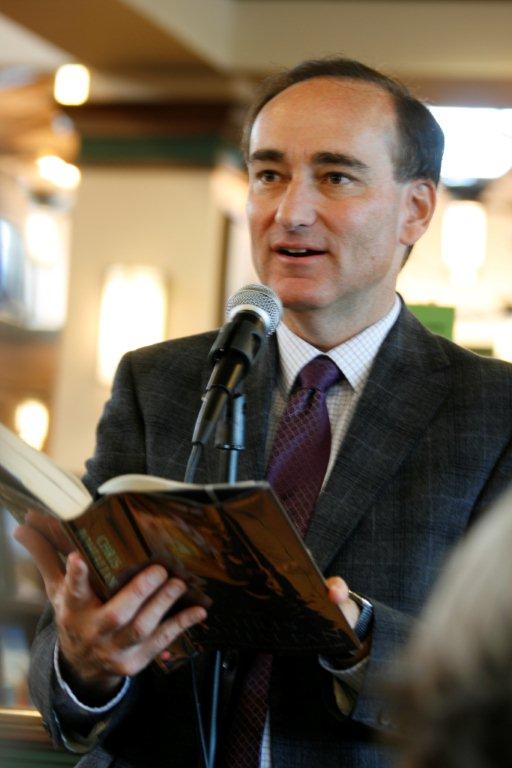
Chris Bohjalian (Photo by Tom Vartanedian)
For too long, it had been a story only for Armenians. With the emergence of a new generation of writers, however, came a new approach. They believed that the stories previously told in secrecy should now be told to the world. The latest of these is New York Times best-selling author Chris Bohjalian’s critically acclaimed novel The Sandcastle Girls. On Thursday evening, April 18, Bohjalian will lead a book discussion at Columbia University, in an event hosted by the Armenian Center at Columbia.
A love story that takes place during the Armenian Genocide between an Armenian engineer and an American nurse, The Sandcastle Girls follows a genocide survivor’s granddaughter as she tries to uncover her family’s history and the sorrows of the Armenian massacres that she learns about along the way.
Bohjalian, who is the author of 16 books, has received high praise and accolades from literary critics and readers since his first novel was published 25 years ago. His novel, Midwives, was chosen for Oprah’s Book Club, and Winfrey also selected The Sandcastle Girls as her Book of the Week last summer. Literary praise for Bohjalian’s writing and for the accurate historical portrayal of the Armenian Genocide in The Sandcastle Girls has been covered by such major news outlets as USA Today, Washington Post, and the Boston Globe.
Although the lamentable premise of The Sandcastle Girls is familiar to Armenians, it has been a moment of pride to have such a book published, as they continue to seek justice and worldwide acceptance for the atrocities committed against their ancestors.
“I have been overwhelmed by the support for this novel by the Armenian community around the world. I am deeply and profoundly grateful,” said Bohjalian, whose Armenian grandparents on his father’s side were survivors of the Armenian Genocide. “Whenever I’ve spoken to audiences that are predominantly Armenian, I have left moved beyond words,” he said.
The reaction from non-Armenians towards The Sandcastle Girls has been equally positive. “Consistently non-Armenians have asked me the same sort of question: Why did no one teach me this? Why does no one know this story? They are appalled and, sometimes, aghast,” said Bohjalian. “This is a part of our story that too few people know, and we all hope this novel will help open people’s eyes to a cataclysmic injustice.”
Mark Momjian, the chair of the Armenian Center, expressed the significance of Bohjalian’s appearance on campus. “The enormous power of Chris Bohjalian’s literary art has been recognized worldwide, and his masterful novel, The Sandcastle Girls, is of particular interest to the area’s Armenian-American community, who in just two years will be commemorating the centennial of the Armenian Genocide,” said Momjian. “I know the center’s friends and supporters are eager to hear this distinguished writer, whose originality and brilliance have touched so many hearts.”
Dr. Nicole Vartanian, the vice chair of the Armenian Center, said the Armenian Center is excited to be hosting Bohjalian upon the paperback release of The Sandcastle Girls. “His passionate portrayal of love and loss set amidst the backdrop of the Armenian Genocide has rightly earned him widespread praise from all corners of the literary community,” she said. “It seems particularly fitting that our event will take place at Teachers College, given the rich and robust educational content which forms the foundation of Chris’ novels. The Sandcastle Girls is an especially poignant example of this, as the story has educated masses of Chris’ loyal readers who learned the horrific events of the genocide through the quality of his research and the power of his prose.”
“My sense is that this may be the most important book I ever write,” said Bohjalian, who first attempted to write about the Armenian Genocide 15 years ago. “I hope with all my heart that this time I have gotten it right.”
The book discussion of The Sandcastle Girls will take place on Thurs., April 18, at 7 p.m. in the Cowin Conference Center (147 Horace Mann Hall) at Columbia University Teachers College, 525 W. 120th Street, between Broadway and Amsterdam Avenue. A question-and-answer session, reception, and a book signing will take place after the presentation.

Genocide Commemorative Billboards on Display in Massachusetts

By Rosario Teixeira
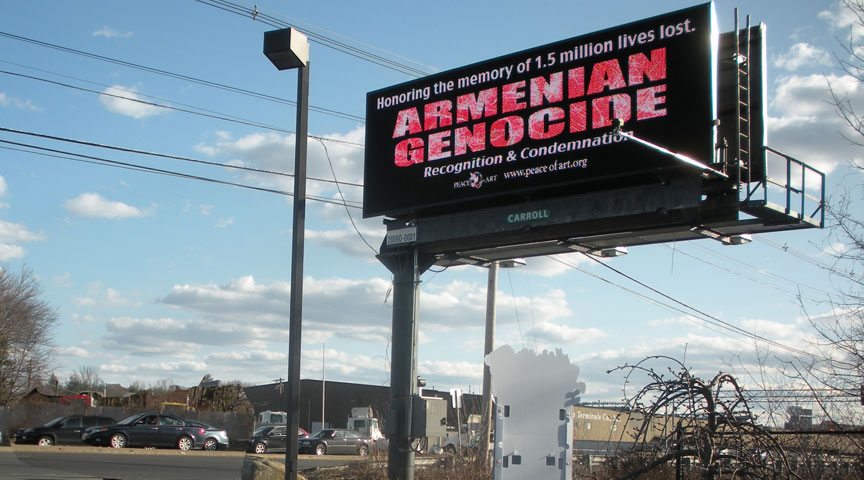
WATERTOWN, Mass.—During the month of April, in Foxboro, Watertown, and Cambridge, Peace of Art, Inc. will display Armenian Genocide commemorative billboards to honor the victims of the Armenian Genocide, and call for recognition and condemnation of the genocide.
1x1.trans Genocide Commemorative Billboards on Display in Massachusetts
Commemorate billboard in Foxboro
“With these billboards, we are honoring the memory of the victims of the Armenian Genocide, calling upon the international community to recognize the Armenian Genocide, and to condemn the perpetrators,” said artist Daniel Varoujan Hejinian, the president and founder of Peace of Art Inc., a non-profit educational organization. “Ninety-eight years have passed but the bloody handprints of the horrible events of 1915 stained the pages of the world history, when 1.5 million Armenians lost their lives.”
The 2013 billboard depicts bloody handprints on the words “Armenian Genocide” over a black background. One 10′ x 30′ digital billboard is on display on Route 1 in Foxboro, a quarter of a mile south of the main entrance to Gillette Stadium and Patriot Place. A second 11′ x 27′ billboard is on display in Watertown, on Mount Auburn Street, in the heart of the Armenian community, close to the Armenian cultural centers and churches. A third 11′ x 27′ billboard will be on display on Cambridge Street, near Lechmere Station, East Cambridge. This area, with high traffic and high visibility, is the gateway between Cambridge, Boston, and Somerville.
Since 1996, Hejinian has been calling for the recognition of the Armenian Genocide. In 2004, Peace of Art, Inc. began to sponsor the commemorative billboards. This year’s message further calls for the condemnation of genocide.
To date, the Armenian Genocide has been recognized by over 20 countries and 42 U.S. states. However, in spite of his campaign promise to recognize the genocide, in the last four years President Obama has failed to use the term “genocide” in reference to the slaughter of Armenians, which took place almost to a century ago.
The Armenian Genocide is not a matter of concern for Armenians alone but to everyone. Genocide is a crime against humanity. Without recognition and condemnation, the Armenian Genocide remains a wound that continues to bleed, under the handprints of the culprit.

Monday, March 4, 2013

Artsakh Newsletter summarizes key developments in the Nagorno Karabakh Republic


Nagorno Karabakh until 1918

Nagorno Karabakh in 1918-20

Establishment of Soviet Rule

Azerbaijans Discrimination

Struggle for Freedom 1923-88

Developments of 1988-90

Sumgait Massacre of 1988

Ethnic Cleansing Campaigns

Declaration of Independence

Armed Conflict 1991-94

Islamic Mercenaries in NK War

1990 USSR Law on Secession

A Genocide Gone Unpunished
Pogroms of Armenians in Sumgait (February 1988)
As it happened
"No half-measures or arguments about friendship of nations can calm down the people. Even if some doubted it before Simgait, no one sees a moral opportunity to insist on territorial unity of NKAO and Azerbaijan after the tragedy happened".
Andrei Sakharov, renown Soviet physicist and human rights activist
Pogroms, beatings and murder of Armenians in Sumgait, which is a town 30-minutes drive from Baku, took place in broad daylight as passersby kept looking. The crimes committed by Azeri thugs reached their high point on February 27-28. These events were proceeded by a wave of anti-Armenian rallies that shook entire Azerbaijan in February 1988. Almost the entire territory of the city with a population of 250,000 became an arena for unobstructed mass pogroms of its Armenian population. Azeri thugs broke into apartment buildings with prepared in advance lists of Armenian tenants residing there. Azeries were armed with iron rods (armature pieces), hatchets, knives, broken bottles, rocks and gas tanks. The number of these thugs can be determined by a simple fact that according to many witnesses, 50-80 people attacked each apartment. Similar crowds (numbering up to one hundred people each) went on a rampage in the streets.
Dozens of Armenian were killed (according to verified but incomprehensive data, number of murdered Armenians reached at least 53), majority of whom were set afire alive after being beaten and tortured. Hundreds of innocent people recieved injuries of different severity and became physically impaired. Women, among them minors, were raped. More than two hundred apartments were robbed, dozens of cars were destroyed and burned, dozens of art and crafts studious, shops and kiosks were demolished. Thousands of people became refugees. At best Azeries kept silence, some, calling themselves the intelligencia or the "salt" of Azeri nation, tried to justify what happened. These were Sumgait's true colors, which put the first mark on the long list of crimes against humanity committed by Azerbaijani authorities during the past decade.
Pogroms of Armenians in Sumgait amounted to genocide organized on the governmental level. In his address to the Supreme Council of the Nagorno Karabakh Autonomous Region, a leader of the Communist Party of Azerbaijan Mr. Hidayat Orujev, stated days before the massacre of Armenians in Sumgait: "If you do not stop campaigning for the unification of Nagorno Karabakh with Armenia, if you don't sober up, 100,000 Azeris from neighboring districts will break into your houses, torch your apartments, rape your women, and kill your children." The same Orujev is currently the State Advisor for Ethnic Policy in Heidar Aliyev's presidential staff.
This crime was not given its adequate political and legal evaluation. Not only its organizers and primary executors were set free, but also until today their names remained unknown to the world. Despite the fact that everything possible was done to conceal the circumstances of the crime committed in Sumgait and to distort its nature, there are enough documents, witness accounts and other facts that lead to one and only conclusion: the pogroms were organized and executed on high governmental level. Moreover, prime organizers and executors of the crime were the authorities of then Soviet Azerbaijan and certain nationalistic pro-Turkish Mafia circles linked in different ways to Azerbaijani authorities.
During 18 October-18 November 1988, the Supreme Court of the USSR reviewed one of the eighteen criminal cases filed after the Sumgait atrocities, in which, as the prosecution stated in its conclusion, "hundreds of people of Azeri nationality" participated. During the investigation many witnesses were questioned, the testimony of which stated the unusual cruelty and their organized nature of the crimes. Enraged mobs threw furniture, refrigerators, television sets and beds out of balconies and set them afire. Tenants were dragged from their apartments. If they tried to run and escape, the mob attacked them. The mob used metal rods, knives and hatchets, after which bodies were thrown into the fire. "He was still moving, trying to escape from fire, but five young men were pushing him back into the fire with metal rods" (witness A. Arkhipov). The Internal Ministry troops did nothing. Witness S. Guliyev revealed during the trial how they reacted to pogroms and killings: "A man was being beaten near the windows of a police station. The police gave up the town to dishevel. It was not [present] in town. I did not see it [there]." "The Police knew everything", -- stated witness D. Zarbaliyev, a son of an Internal Ministry major himself.
Division of one organized crime into separate and independent cases testified to the fact that the trial was biased and had an aim to conceal true organizers and perpetrators of the crime. The court qualified mass murders of Armenians as murders committed by hooligans. Moreover, during the trial, the criminal idleness of local party and soviet structures as well as the military regiments present in the city was not taken into consideration. By February 29 the army troops were in Sumgait. However, they were not defending Armenians, but rather defending themselves from the enraged mob, which was throwing rocks at the army troops.
Mass rallies, which gathered thousands and where direct calls to kill Armenians and begin with pogroms were made, also allow concluding that tragic events in Sumgait were organized. So does the obvious assistance of Sumgait law enforcement bodies to the mobsters and murderers, and later the involvement of officers of the Azerbaijani Interior Ministry and the KGB in the sabotage of criminal investigations and covering of criminals. The weapons of murder (sharpened armature pieces, spears and knives) were manufactured at Sumgait factories, rocks were delivered to the areas of pogroms in advance, roadblocks were installed on the escape routes from the town, lists of Armenian residents were given to the mobsters, telephones were disconnected by the workers of the local telephone company, electricity was shut off in entire blocks and neighborhoods of the town during the days that the pogroms took place, the mobs were well disciplined and subordinated hierarchically to one another. All of these contradict to the allegations that the crime had a spontaneous nature. It should be noted that immediately after the pogroms, following the orders of the Chairman of the Cabinet of Ministers (Prime Minister) of Azerbaijani SSR G. N. Seidov and an Azerbaijani Communist Party's Central Committee official Ganafayev, the belongings of Armenians, which were thrown out of their apartments to the streets, were hastily removed, yards and building entrenches were wash, and mobbed apartments and public buildings were frantically repaired. Seidov headed the government delegation that arrived to Sumgait on March 1, 1988. Thus, the physical evidence of the crimes was destroyed, which noticeably hampered the investigation. The bodies of many victims were later found in the morgues of Baku and other towns near Sumgait. During the May 21, 1988 plenum of the Central Committee of the Azerbaijani Communist Party, the former Secretary of Sumgait Committee of Communist Party D. M. Muslim-Zadeh blamed the authorities of Azerbaijan for the Sumgait tragedy.
The policy of silence around the genocide committed in Sumgait as well as the permissive attitude of the international community towards the Azeri perpetrators of the Sumgait genocide allowed the organizers and active participants of pogroms to avoid criminal punishment. Thus, the bloody campaign continued and soon embraced the entire territory of Azerbaijani SSR, reaching its high point in January of 1990 in Baku, when hundreds of Armenians fell victim to the pathological hatred of Azeri nationalists. In May, 1988 the Shushi regional Communist Party Committee initiated deportations of Armenians from Shushi. In September 1988, tragic events took place near Kojalu village (Nagorno Karabakh), where several Armenians were wounded and killed and the last Armenian residents were expelled from Shushi. In November-December of the same year, Azerbaijan was swept with a wave of Armenian pogroms. The most brutal of them tool place in Baku, Kirovabad (Gyanja), Shemakha, Shamkhor, Mingechaur and Nakhichevan Soviet Autonomous Republic of Azerbaijan. In Kirovabad, for example, Azeri mobsters burst into a retirement living community, took its residents away to the outskirts of the city and brutally murdered twelve old men and women, of which some were disabled.
The Sumgait tragedy and its bloody repetitions in Azerbaijan in 1988-1991, led to the disappearance of a 450,000-strong Armenian community of Azerbaijan and the military aggression against the Armenians of Nagorno Karabakh in 1992-1994. Although this has been commonly perceived as the main and only reason for pogroms, the roots of this tragedy are to be found not only in the unique mentality of the Azeris as a people, which, allegedly, could not do otherwise but to answer with pogroms and murders to Karabakh Armenian's peaceful demands for self-determination. Certainly, psychological and historic motives, which determined the social climate in Azerbaijan, are very important in order to understand why all of a sudden thousands of people grabbed hatchets and started killing their harmless neighbors.
Certain social climate, which would trigger a psychosis of murder, had to exist in order for an explosion of aggression and violence of this magnitude to occur. Recollections of a famous French writer of Azeri descent Um-al-Banin, who spent her childhood in Baku is a good illustration of this. Her writings demonstrate how an atmosphere of massacres (pogroms of Armenians in 1905-1906) can affect a child's mind. This is how she describes the games of Baku children in her book entitled "Caucasian Days": "On holidays we used to played a game called "Armenian Massacres", which we preferred of all others. Drunk with our racist passion, we would sacrifice Tamar (whose mother was Armenian) on the altar of our atavistic hatred.
First we would arbitrarily accuse her of killings of Muslims and then immediately shoot her several times over and over in order to renew our pleasure. Then we would tear off her limbs, tongue, head and innards and threw it to the dogs to show our disdain for Armenian flesh." In this environment several generation grew up - fathers and grandfathers of people who live today. It was then that the foundation for mutual hatred, which would burst into flames during the times of change in 1918-1920 and in 1988-1991, was cemented. But the serious reason, which led to the massacres, continued to exist. They were implicit but real.
Beginning from creation of Azerbaijani state in 1918, genocide was and still remains a tool in the arsenal of Azerbaijani politicians. The organizers of the Armenian genocide in Azerbaijan (1920-1991) were certainly inspired by the results of Turkey's anti-Armenian policy - a country, in which more than one and a half Armenians were killed by local nationalists as a result of an unpunished genocide of 1915-1923.

Today, just as ten years ago, it is obvious that the architects of the Azerbaijani state were concerned the least with the issue of ensuring prosperity for its national minorities. Instead they continued their policy of Turkization in all aspects of the state. This can be seen in the numerous public statements of top Azerbaijani state officials, including those of President Heydar Aliyev. Denial of the guilt of Azeries and Turks in the organization and execution of the Armenian genocide, shifting the blame to Armenians themselves, the policy of steeling the cultural heritage created by Armenians during many centuries in their homeland and territorial claims on a large part of Armenian historic lands put in doubt the possibility, which is expressed in the West, of co-existence of Azeri Turks and Armenians in the same state in the foreseeable future.


1334 G Street, Suite 200, Washington, DC 20005
tel: (202) 223-4330, fax (202) 223-4332, e-mail: info@nkrusa.org