Thursday, December 19, 2013

What I Choose It to Mean: On ‘Yeghern’ as the Armenian Translation of ‘Genocide’

“The term Yeghern, or Medz Yeghern, is the only word that really captures the essence of what happened in 1915. The survivors used that word. It is the only word that could really explain what happened in 1915. In a world without genocide denial, it would be the best word.”
–Khatchig Mouradian (2009)1

‘Medz Yeghern’: the Proper Name of the Genocide
In the concluding installment of this study on the semantics, history, and politics of the phrase Medz Yeghern, it is crucial to underscore that the exhausting search for recognition should not block the use of the words that our ancestors have bequeathed us. It has been argued that recognition has been sufficiently ensured by two resolutions of the House of Representatives, 3 federal court rulings, 42 state declarations by legislation or proclamation, a sentence in a document filed in 1951 by the U.S. government to the International Court of Justice and another sentence in Ronald Reagan’s proclamation,2 along with official declarations by 20 countries and statements of a host of scholars. “We don’t say that this is the end and the work of recognition has been done; simply, the emphasis should be put on reparation and the rights,” Giro Manoyan, the head of the ARF Bureau Armenian Cause office, declared recently.3
Armenians should not be obfuscated by denial, whether mainstream or from a lunatic fringe, which will probably be as lasting as affirmation. Another worrisome trend—misuse—should not obfuscate them either.
The systematic and premeditated annihilation of 1915-17 became one of the catalysts to Lemkin’s initial formulation of genocide—still without its name—in 1933. Thus, the particular (Medz Yeghern) gave birth to the general (tseghasbanutiun, “genocide”). However, I will allow myself to repeat that the common noun tseghasbanutiun is the legal term applied to any act of systematic and premeditated annihilation, from Namibia to Darfur and from Cambodia to Rwanda, and not the proper noun of the Armenian annihilation: in Armenian, the use of հրէական ցեղասպանութիւն (hreagan tseghasbanutiun, “Jewish genocide”), for instance, is as legitimate as հայկական ցեղասպանութիւն (haygagan tseghasbanutiun, “Armenian genocide”).
For instance, The French and Armenian inscriptions on the 1987 genocide memorial in Valence, France, read: “A la mémoire des 1.500.000 Armeniens victimes du genocide perpetré par l’état turc en 1915” / “Ի յիշատակ մէկ ու կէս միլիոն հայերու ցեղասպանութեան կատարուած 1915ի թուրք պետութեան կողմէ” (“In the memory of the 1,500,000 Armenians victims of the genocide perpetrated by the Turkish state in 1915”).
Clearly, “genocide” and tseghasbanutiun are the legal qualifiers of the act, not the actual name, a fact noticeable in both versions; the Armenian says: “In the memory of the genocide of one and a half million Armenians perpetrated by the Turkish state of 1915.” The proper noun is disclosed when tseghasbanutiun is paired with Medz Yeghern, as in the opening lines of the Armenian monolingual inscription beneath the khatchkar (cross-stone) in front of the Armenian Prelacy of Canada, in Montreal: «Կանգնեցաւ / “Կարմիր Աւետարան” խաչքար-յուշակոթողս / սրբազան նահատակաց հայոց /
Մեծ Եղեռնի ցեղասպանութեան 90-ամեակին առթիւ / 24 Ապրիլ, 2005… » (“This khachkar-memorial, ‘Red Gospel,’ was erected to the sacred martyrs of the Armenians on the occasion of the 90th anniversary of the genocide [tseghasbanutiun] of the Medz Yeghern, April 24, 2005…”).
The legal term tseghasbanutiun qualifies the legal term Medz Yeghern (“Great Crime”) in the same way that “genocide” qualifies the (non-legal) term Shoah (“Catastrophe”) in the title of Zeev Garber’s book, Shoah, the Paradigmatic Genocide: Essays in Exegesis and Eisegesis (University Press of America, 1994). The capitalization of the common noun tseghasbanutiun does not turn it into a proper noun, and the capitalization of “genocide” does not make “Armenian Genocide” a proper noun either, in the same way that the capitalization of “holocaust” does not turn “Holocaust” into a proper noun. “Armenian Genocide” is, thus, a sobriquet: a common name that conceals our proper name. Borrowing the words of literary scholar Marc Nichanian, we have to acknowledge that “Today, they [Armenians] are using a common name as a proper name. They do not respect the identity of the Event that has shaped them for the past 80 years. They do not respect their own memory of the Event.”4
Medz Yeghern may be used legitimately and in good faith instead of or alongside “Armenian Genocide,” as Shoah is currently used legitimately and in good faith instead of or alongside “Jewish Holocaust” by any number of non-Jews. Indeed, neither Shoah nor Holodomor, neither Porrajmos nor Sayfo, make the experience of their original users any more unique than Medz Yeghern; all of them are proper nouns of an event in history—regardless of any metahistorical interpretation—like Glorious Revolution, Renaissance, Risorgimento or Reconquista.

‘Yeghern’ = Genocide from 1965 to 2013
It is worthy to remember that word meanings are not etched in stone (for example, English gay meant “merry, happy, carefree” before it dropped out of use after the incorporation of the slang meaning “homosexual”).5 An unprejudiced examination of linguistic facts shows that over the past 50 years, while tseghasbanutiun was becoming the automatic translation of the legal term “genocide,” with other calques like azkasbanutiun or zhoghovrtasbanutiun falling along the way, the road from the particular to the general was also widening the semantic perception of yeghern. During the past hundred years, Armenian-English dictionaries have crossed the realm of “crime,” passed by “massacre” (Medz Yeghern was translated as “Great Massacre,” for instance, in 1965),6 and even stopped by yeghern as “holocaust” in 2006.7 The translation “holocaust” is not just a whim of dictionary writers; we may note its use, for instance, in a bilingual booklet by writer Levon K. Daghlian (1976),8 an article by literary scholar Vahé Oshagan (1985),9 and a translation by Harvard professor James R. Russell (2012).10
Therefore, it is not surprising that yeghern has reached the meaning “genocide.” In a study written and published in 1965, survivor historian Hagop Dj. Siruni (1890-1973) combined yeghern and premeditation and, thus, showed to have adopted yeghern as a translation of “genocide”: “The Armenian-exterminating yeghern was neither the result of a casual inspiration nor the consequence of the pretexts that the Ittihad constantly put forward; there is a whole pile of proofs that reveals the terrible premeditation (կանխամտածութիւն, gankhamdadzutiun).”11
The meaning of “genocide” for yeghern was occasionally used over the years. For example, a section of Patma-banasirakan handes, the flagship publication of the Armenian Academy of Sciences, was devoted to the 60th anniversary of the genocide under the title, “Yeghern yev veradznunt. 1915-1975” (Russian: “Genotsid i vozrozhdeniye. 1915-1975”; English: “Genocide and Revival. 1915-1975”). In the same issue, a chronicle of an official homage at the monument to the victims of Tzitzernakaberd, entitled “Yegherni zoheri hushartzanum,” became “V pamyatnika zhertam genotsida” in Russian and “At the Memorial of the Victims to the Genocide” in English.12
Since the beginning of the Karabagh movement, the impact of the pogrom of Sumgait in February 1988 created the parallel with 1915. The synonymous character of yeghern and tseghasbanutiun as the Armenian term for “genocide” was underscored and reinforced in an unprecedented way. American anthropologist Nora Dudwick watched the process first-hand and noted, “It seemed that every social and political problem took on additional significance as containing a threat to the Armenians’ continued existence as a people.”13 The Armenian-language banners raised during the huge demonstrations in Yerevan reflected the perceived existential threat very explicitly. One asked “To Recognize the Medz Yeghern of 1915,” and another stated that “Sumgait is the Follow-Up to the Medz Yeghern.” Yet another made the link between both: “If the USSR Government Had Recognized the Genocide [tseghasbanutiun] of 1915, Sumgait Would Not Have Happened in 1988”.14
Dudwick referred to the use of “white genocide,” “cultural genocide,” and “ecological genocide” in the banners.15 The Armenian word chosen to rhetorically enlarge the concept of “genocide” to assess political and social events was not tseghasbanutiun, however, but yeghern, as in the ecological struggle against the chemical giant “Nayirit” (“Down with the Yeghern of Nayirit”), the diminishing utilization of the Armenian language (“To Betray the Language Is a White Yeghern”), or the destruction of Armenian historical monuments outside the borders of Soviet Armenia (“The Destruction of Historical Monuments Is a Spiritual [hokevor, figuratively “cultural”] Yeghern”). Any counterargument that yeghern equals “massacre” here should be regarded as a stretch of the truth; Dudwick’s would have hardly translated “genocide” without relying on local informants. Moreover, a banner that mocked the Soviet slogan of “peoples’ friendship” used yeghern as unequivocal synonym of tseghasbanutiun, “What Friendship after the Yeghern of 1915-1988,” the same as another that stressed the rights of the population of Mountainous Karabagh: “By Respecting the Inalienable Right to Self-Determination of the Karabaghis, We Prevent the New Yeghern [Nor Yegherne], Red and White.”16
Lawrence Sheets, currently the South Caucasus project director of the International Crisis Group, recently recounted his visit to Armenia as South Caucasus correspondent for Reuters in 1992. He described the mindset created by the Karabagh conflict: “In this woman’s mind (and those of many others), it was all part of the same pattern: The Karabagh war was just another Turkish effort to exterminate them, a logical extension of the almost-impossible-to-fathom Mets Yeghern (genocide) of an estimated 1.5 million Armenians at the hands of the dying Ottoman Empire (present-day Turkey) during World War I.”17 His use of “Mets Yeghern (genocide)” clarified the meaning of the word in the same way as “Ottoman Empire (present-day Turkey).” He recorded the name of the event as it had been spelled to him, after many banners had already used yeghern to mean “genocide.”
In the 21st century, the Shoah (Holocaust) memorial installed in downtown Yerevan by the Jewish community of Armenia (2006) displays a bilingual inscription with two totally different texts in Hebrew and Armenian. The Hebrew writing declares: “Lihyot o Lishkoakh / Lizkor Korbanot ha-Shoah” (“To be or to forget / In memory of the victims of the Shoah”).
The members of the Jewish community, who are citizens of the republic and fluent in Armenian, had tactfully chosen to memorialize the victims of both genocides in the Armenian text: “Ապրել / Չմոռանալ / Հայ եւ հրեայ ժողովուրդների եղեռնի յիշատակին” (“To live / Not to forget / In memory of the yegherns of the Armenian and Jewish peoples”).
It would be unreasonable to assume that such homage downplayed the magnitude of both genocides and stated “crime” or even “massacre” (the word chart would have sufficed) in the heart of Yerevan. Here, yeghern could only mean “holocaust” or “genocide,” the same as Shoah, and each of those two meanings underscores their unique nature. The translation by epress.am confirmed it: “To live and not to forget: In the memory of the Armenian and Jewish peoples’ Genocide [Yeghern].”18
The identification of both concepts yeghern and tseghasbanutiun has evolved in fully unexpected ways. Residents of various streets in central Yerevan, who have seen their houses expropriated in recent years, staged a demonstration near the presidential residence in January 2012, when the French law draft against genocide denial was initially approved. A spokesperson for them stated: “The law draft approved by France has not made me happy at all, because today a white yeghern [spitak yeghern] is being carried in my homeland, while the authorities and the people are watching in silence. What do we do? Should we go and ask the French to recognize the white genocide [spitak genotsid] of today? How to be happy, when people are being expelled from their own homes and thrown to the street in our country? Let’s approve a law to establish criminal punishment to those who deny the ‘white genocide’ [spitak genotsid] in Armenia. What do you think, will it pass in Armenia?”19
The excerpt has the sole purpose of pointing out the abovementioned identification (spitak yeghern = spitak genotsid), regardless of the degree of hyperbole. Its echo, among many other examples, was found in an editorial entitled, “What Is Going on Today in Armenia Is a White Yeghern” of the Yerevan-based newspaper Haykakan Zhamanak (April 25, 2013): “People very frequently and easily claim that what is going on today in Armenia is a white Yeghern, an internal genocide [tseghasbanutiun], that the Turk massacred the Armenians in Western Armenia and the authorities of the Republic of Armenia are doing that in the Republic of Armenia…”20 The quotes show that the wording spitak yeghern identifies yeghern and genocide because its users claim that the situation was planned; as a matter of fact, it is not an Eastern Armenian adaptation of the expression spitak chart (“white massacre”), frequently used in Armenian rhetoric to symbolize assimilation in the diaspora.
References to yeghern = tseghasbanutiun = “genocide” going back to 1965 may provide a context to Armenian president Serge Sarkisian’s line on Feb. 5, 2013, that “those two words are the same for us.”21 Additionally, the Armenian Genocide Museum-Institute’s website in Yerevan has entitled its section on the destruction of Armenian cultural monuments by the Turkish state, Mshakutayin Yeghern (in English, Cultural Genocide; Turkish, Kültürel Soykırım) and employs tseghasbanutiun six times in the text. Neither the demonstrators at Freedom Square in 1988 nor the Genocide Museum in 2013 may be suspected of exploiting yeghern with the aim of “undermining several decades of extensive lobbying efforts for the recognition of the Armenian Genocide.”22
The advice to look it up in a dictionary23 seems equally moot. Linguist Ashot Sukiasyan (1922-2007) included tseghasbanutiun among synonyms of yeghern in the second edition of his monumental thesaurus of the Armenian language (2003, reprinted in 2009).24 Yeghern appears as “genocide” in an Armenian-English dictionary published in Yerevan in 2009; its five authors had also translated tseghasbanutiun as “genocide.”25The list is likely longer.
The use of yeghern and tseghasbanutiun as synonyms by current Armenian speakers should induce their Armenian American critics to hone their linguistic skills, as a pioneering Turkish denier in America, former ambassador and MP Mustafa Šükrü Elekdağ, had already done by 2009-10.

Levy, Davutoğlu, and their ‘Helpers’
Moreover, heads of state (Barack Obama) who use Medz Yeghern and, more times than not, couple it with genocide (Pope John Paul II, Stephen Harper) are probably showing the way for Armenian pundits, political operators, and the community at large to get thoroughly acquainted with their ancestral tongue. It is fair to say that setting the record straight with the legal term Great (Evil) Crime in late 2008 or early 2009 would have thwarted the “calamity” scenario installed by the Turkish “apology campaign.” Insistence on the synonymous character of Medz Yeghern and genocide—an insistence that should have been expected from, but not be limited to, the president of Armenia as the counterpart of the U.S. president—could have also made White House advisers and speechwriters desist from including Medz Yeghern in presidential statements between 2009 and 2013; as we already took note in a previous article, they used it since “one side” (e.g., the Turkish one) had admitted it as a “place marker.” Such insistence would have been crucial to avoid its worldwide banalization and deformation. Unfortunately, history can only be written in past tense and not in conditional mode.
Additionally, history seems to be written by the winners, as it happened, most recently, in Movsesian v. Victoria Versicherung. After the successful appeal by the Armenian side on December 2010, the defendant appealed in January 2011 and argued that Medz Yeghern was not “the term for ‘Armenian Genocide’ in the Armenian language,” as the majority panel had declared, because it was “generally translated as ‘great calamity,’ not ‘genocide.’” The authority for this argument was Ben Schott’s blog entry in The New York Times, based on Turkish columnist Ali Bulaç’s view that the “best translation” of Medz Yeghern is “Great Calamity.”26 The defendant-appellant also transcribed samples of criticism against the term “by many in the Armenian community precisely because it does not mean ‘Armenian genocide.’” Citing the September 2009 amicus brief from the Armenian Bar Association and the Armenian National Committee of America (ANCA), in which it was stated that President Barack Obama had used Medz Yeghern, “the Armenian name for the Armenian Genocide,” the defendant-appellant retorted: “That representation to the panel by the ANCA simply cannot be squared with its prior objection that the terms have fundamentally different meanings.”27
People not conversant in the Armenian language have been allowed to impose their ignorance over our half-baked knowledge, inadequately suited to engage the challenges posed by recently developed and more sophisticated mechanisms of soft-core relativism or denial.
In this regard, let us consider the following lines by political scientist Guenter Lewy on the genocide of the Native Americans: “In the end, the sad fate of America’s Indians represents not a crime but a tragedy, involving an irreconcilable collision of cultures and values. … To fling the charge of genocide at an entire society serves neither the interests of the Indians nor those of history.”28 The replacement of “America’s Indians” by “Ottoman Armenians” exposes the grounds for Lewy’s denial, couched in flawed academic methodology,29 in his book on the Armenian “disputed genocide”: the rejection of the malevolent design characteristic of crime, in favor of tragedy or “calamity” which may occur independently of such design.
Turkish Foreign Minister Ahmet Davutoğlu recently upheld the same rejection: “I would not call genocide what was lived through, but it is their choice for those who call it. We need to develop a new language on this issue. We are not denying your pain, we understand; whatever that needs to be done, let’s do it together. But this is not a unilateral declaration of a crime.”30 Since 2009, his ministry has routinely condemned “President Barack Obama’s standard ‘Medz Yeghern (Great Disaster)’ reference to the Armenian Genocide and criticized the U.S. for being prejudiced about 1915,” as noted by Turkish columnist Burak Bekdil, who did not refrain from using Medz Yeghern and genocide in the same sentence.31 Here is a sample from 2013: “Issued under the influence of domestic political considerations and interpreting controversial historical events on the basis of one-sided information and with a selective sense of justice, such statements damage both Turkish-American relations, and also render it more difficult for Turks and Armenians to reach a just memory.”32
On the other side of the divide, it is highly interesting that, in its February 2011 response, the plaintiff-appellee in Movsesian v. Victoria Versicherung had a moment of epiphany: It quoted the relevant paragraph of Senator Barack Obama’s 2006 letter to Condoleeza Rice about the recognition of the Armenian Genocide, including the use of these two words, to bring forward the noteworthy argument that “President Obama reasserted this view in 2009.”33 Unheard before or since, this is the same conclusion we arrived at quite independently in a previous article. Noticeably, even a misnamed “great disaster” with an additional attachment of “one of the worst atrocities of the twentieth century” with “1.5 million Armenians massacred or marched to their deaths” is tantamount, for the Turkish government, to “a unilateral declaration of a crime” and “one-sided information.” An accurately named Great Crime would have an even a greater impact.
Gabriel Sanders recently ended his review of Raphael Lemkin’s autobiography with the following reflection: “Critics can argue that Lemkin accomplished nothing. Genocide marches on. But Rwanda and Srebrenica are not refutations of his legacy; they are affirmations of his prescience. Without Lemkin, they would have been atrocities. In the light of his Genocide Convention, they were crimes.”34 In the light of the Genocide Convention, one may ask, what would the Great (Evil) Crime of 1915 be?
As the “great calamity” hoax goes marching on, scholars like Lewy and politicians like Davutoğlu may enlist the logical support of Turkish sources to their thesis and, moreover, approvingly nod to those Armenian sources that continue to recycle statements such as, “at the end of the day, ‘Meds Yeghern’ is meaningless for most Americans, and does not have a judicial meaning.”35
Diplomat and political scientist Ara Papian has observed that “‘Medz Yeghern’ means genocide for us, but it doesn’t mean genocide to the rest of the world.”36 In this context, the well-known paragraph of Lewis Carroll’s Through the Looking-Glass deserves to be recalled once again: “‘When I use a word,’ Humpty Dumpty said, in rather a scornful tone, ‘it means just what I choose it to mean—neither more nor less.’
“‘The question is,’ said Alice, ‘whether you can make words mean so many different things.’
“‘The question is,’ said Humpty Dumpty, ‘which is to be master—that’s all.’”37
Our words can only mean what we, the masters of the language, have chosen them to mean. An innocent mistranslation of Medz Yeghern may be a mistake, but a tendentious mistranslation is a violation of the Armenian language.
Medz Yeghern and its real and legal meaning of “Great (Evil) Crime” (as well as its contemporary meaning of “genocide”) are the only legitimate choice over the fictitious and non-legal meaning of “Great Calamity” and its variants “Great Catastrophe,” “Great Tragedy,” or even the linguistically inaccurate “Great Atrocity.” Relentless repetition installed “Medz Yeghern (Great Calamity)” within the international media; a barrage of the continuous use of “Medz Yeghern, the Armenian Genocide,” with or even without its literal translation of “Great (Evil) Crime,” should help install it anywhere.
In the end, any pretense of “denialist terminology” to refrain from calling things by their 90-plus-year-old Armenian proper name—as it has been misguidedly suggested following presidential statements of “Meds Yeghern” and Turkish mistranslations of “Great Calamity”—would be an act of self-censorship, playing straight into the hands of the denier. Moreover, it would be the most tragic irony in the ultimate stage of genocide: denial unwittingly self-imposed by those who are bound to fight against denial.

Notes
1 Quoted in The Armenian Reporter, June 26, 2009.
2 The Armenian Weekly, June 5, 2012.
3 Hayastani zrutsakits, April 19, 2013.
4 David Kazanjian and Marc Nichanian, “Between Genocide and Catastrophe,” in David Kazanjian and David Eng (eds.), Loss: the Politics of Mourning, Los Angeles and Berkeley: University of California Press, 2003, p. 127.
5 Mark Perlman, Conceptual Flux: Mental Representation, Misrepresentation, and Concept Change, Dordrecht: Kluwer, 2000, p. 182.
6 From Catholicos Vazken I’s message: “Today, 50 years after the Great Massacre…” (“The Message of His Holiness the Catholicos of All Armenians in the Sad Anniversary,” Aregak, special issue, April 1965, p. 5).
7 Nicholas Awde and Vazken-Khatchig Davidian, Western Armenian Dictionary and Phrasebook, New York: Hippocrene Books, 2006, p. 58.
8 Levon K. Daghlian, Yegherni husher/Memories of the Holocaust, Boston: Haig H. Toumayan, 1976.
9 Vahe Oshagan, “The Theme of the Armenian Genocide in Diaspora Prose,” Armenian Review, Spring 1985, pp. 53-54.
10 James R. Russell, “The Bells: From Poe to Sardarapat,” Journal of the Society for Armenian Studies, vol. 21 (2012), p. 153.
11 H. Dj. Siruni, “Yeghern me yev ir patmutiune” (A Yeghern and Its History), Ejmiatzin, February-March-April 1965, p. 7.
12 Patma-banasirakan handes, 2, 1975, pp. 264, 267 (index of contents).
13 Quoted in Mark Malkhasian, Gha-ra-bagh! The Emergence of the National Democratic Movement in Armenia, Detroit: Wayne State University Press, 1996, p. 56.
14 Harutiun Marutyan, “Tseghaspanutian hishoghutiune vorpes nor inknutian tsevavorich (1980 tvakanneri verj – 1990 tvakanneri skizb)” (The Memory of Genocide as Marker of New Identity: Late 1980s – Early 1990s), Patma-banasirakan handes, 1, 2005, p. 59.
15 Malkhasian, Gha-ra-bagh!, p. 56.
16 Marutyan, “Tseghaspanutian hishoghutiune,” pp. 61, 63.
17 Lawrence Scott Sheets, Eight Pieces of Empire: A 20-Year Journey Through the Soviet Collapse, New York: Crown Publishers, 2011, p. 131.
18 See www.epress.am/en/2010/10/20/city-staff-busy-cleaning-traces-of-anti-semitism-on-yerevans-holocaust-memorial.html, where it is mistakenly said that the inscription is the same in both Hebrew and Armenian.‎
19 See www.epress.am/2012/01/25.
20 See www.hartak.am/arm/index.php?id=1982.
21 See www.panarmenian.net/arm/news/144433/.
22 The Armenian Weekly, Feb. 12, 2013.
23 Asbarez, Feb. 6, 2013.
24 Ashot Sukiasian, Hayots lezvi homanishneri batsatrakan bararan (Explanatory Dictionary of Synonyms of the Armenian Language), second edition, Yerevan: Yerevan State University Press, 2003, p. 264.
25 Sona Seferian et al., English-Armenian, Armenian English Dictionary, Yerevan: Areg, 2009, pp. 456, 569.
26 The New York Times, May 6, 2009.
27 See http://cdn.ca9.uscourts.gov/datastore/uploads/07-56722pfr.pdf.
28 Guenter Lewy, Essays on Genocide and Humanitarian Intervention, Salt Lake City: Utah University Press, 2012, p. 102.
29 See Taner Akçam, “Review Essay: Guenter Lewy’s The Armenian Massacres in Ottoman Turkey,” Genocide Studies and Prevention, April 2008, pp. 111-145.
30 Milliyet, July 7, 2012.
31 Hurriyet Daily News, May 1, 2013.
32 Hurriyet Daily News, April 24, 2013.
33 See http://cdn.ca9.uscourts.gov/datastore/uploads/07-56722pfr.pdf.
34 The Forward, Aug. 2, 2013.
35 Haykaram Nahapetyan, “Obama vs Romney: Armenian American Community Pressures Candidates to Recognize 1915 Genocide by Ottoman Turkey,” PolicyMic, Sept. 29, 2012 (www.policymic.com/articles/15545/obama-vs-romney-armenian-american-community-pressures-candidates-to-recognize-1915-genocide-by-ottoman-turkey).
36 The Armenian Weekly, Feb. 7, 2013.
37 Lewis Carroll, The Annotated Alice: The Definitive Edition, introduction and notes by Martin Gardner, New York: W. W. Norton, 2000, p. 213.

European Court Decision on Genocide Denial Strongly Condemned

PARIS, France (A.W.)—The Armenian National Committee office in France and the European Armenian Federation for Justice and Democracy (EAFJD) issued a joint statement today strongly condemning the Dec. 17 ruling of the European Court of Human Rights (ECHR) that the denial of the Armenian genocide is not a criminal offense. According to the Court, the 2007 decision of the Lausanne Police Court against the head of Turkish Workers’ Party Dogu Perincek is a violation of the right to freedom of expression. (Read the Court’s press release here.)
The statement considered the ruling to be direct assistance to the wave of denial orchestrated by official Ankara and Baku throughout Europe. “Once again hiding behind the right to free speech, and following the example of the French Constitutional Council, the European Court undermines with this infamous decision the right to dignity of the victims and descendants of the Armenian genocide,” read the statement.
The statement further noted that the decision will “undoubtedly strengthen extremist movements” and undermine the voices calling for justice from within Turkey.
“Moreover, by declaring that ‘it would be very difficult to identify a general consensus’ on the Armenian genocide, the Court aligns itself with Perincek’s statement that the Armenian genocide is an ‘international lie.’ The Court’s approach that ‘clearly distinguished the present case from those concerning the negation of the crimes of the Holocaust’ is also deplorable. How can such a distinction be made by the highest human rights court in Europe?”
In conclusion, the statement noted that the ANC of France, in coordination with the EAFJD Brussels office, will fight against this unacceptable decision. “Switzerland has three months to appeal this verdict. We have requested a meeting with the Swiss Ambassador in Paris, to present our expectations from the Swiss authorities. Coordinated efforts will be made in other countries as well, through local ANCs and regional offices, as well as through official Yerevan, as we form a united front against this decision,” concluded the statement.

Saturday, December 14, 2013

‘Cry Out’---struggling with un-forgiveness

Wednesday, December 4, 2013

‘Cry Out’
How God changed Norita Erickson’s ‘heart of stone’ and gave her a love for the Turkish people, especially those with disabilities

By Dan Wooding
Founder of ASSIST Ministries

SANTA ANA, CA (ANS) -- Southern California-born Norita Erickson of Kardelen Mercy Teams (www.kardelenmercyteams.org), based in Ankara, Turkey, where she works with Turkish people with disabilities, has an extraordinary story to tell.
Norita Erickson, Founder and Director of Kardelen Mercy Teams
She is from an Armenian background and during what was called the “Armenian Genocide”, an estimated 1 and 1.5 million of her people were slaughtered or exiled by Ottoman soldiers and mercenaries, so she had every reason to not feel any warmth towards the Turks. But, after struggling with un-forgiveness and unbelief for a period in her life, she said that God changed her “heart of stone” and gave her a deep love for the Turkish peoples and now she has lived there since 1987 with her husband, Ken.
Norita, who was born in West Los Angeles to Armenian parents, she and her husband moved to Amsterdam, Holland, in 1979 to work with Youth With A Mission to Muslim refugees who had fled there to escape the problems in their home countries.
In an interview for my Front Page Radio program, she said, “While we were there, we had our hearts broken for all the people who moved to Western Europe from the Middle East and North Africa, and who had no clue or idea who Jesus was, or that He loved them or died for them. They included Berbers, Turks, Kurds, Iranians and Afghans.”
But really, the Turks were the last people on her mind during her time in Amsterdam, as the “Armenian Genocide” was still on her mind.
Kardelen’s Care Team visits this mom and her two children on a monthly basis. Her estranged husband every now and then shows up, and after one unpleasant visit, she became pregnant with this little boy
“All of my forefathers came from Cilicia, in the southern part of Turkey,” she said. “There was an Armenian nation there for hundreds of years and, in the latter half of the nineteenth century and early part of the twentieth century, as the Ottoman Empire [sometimes referred to as the Turkish Empire or simply Turkey], began to disintegrate, the Turkish Christian minority was disseminated. “It was the first known ethnic cleansing of the twentieth century. Over a million and a half Armenians disappeared and were moved out of their homes towns and villages and led to Northern Syria where, today, we’re experiencing so much violence and evil. My grandfather was a pastor who had been revived in the latter half of the nineteenth century and he trained as a protestant minister and was a teacher.
“The Lord spoke to him in the early nineteen-hundreds -- 1914 or so -- and said, ‘You’re not going to die,’ and gave him a scripture from Psalm 119 that he took to mean that he would not die. However, he went through very many trials and tribulations, but it’s quite miraculous how he, and my family survived. All my great grandparents did not survive however.”
Why were the Armenians so hated?
Single-mom Daria takes Ekeem outside for a walk. Ekeem suffers from Cerebral Palsy, and since having his chair, he is able to breath, eat and function better
Norita replied, “I believe that it was the political issue at the time as there were Armenians who wanted to create their own nation state. They were siding with foreign powers such as the British who had troops in the disintegrating Ottoman Empire. So nationalism was on the move -- both Turkish, Russian and Armenian -- and it was an opportunity to wipe these people out and therefore take their land.” I then asked her what she and Ken discovered when they first arrived in Amsterdam.
“We had our hearts broken one Easter when we went to the national outdoor Easter celebration and discovered a man pouring over a little leaflet that had scripture and hymns in it. He looked puzzled, so we walked up to him and I asked him, ‘Do you know what this?’ and he said, ‘No’. He explained he was from Egypt and so we told that we were celebrating the resurrection of Jesus Christ. He then said, ‘Who’? And when we heard that we knew the Lord had was telling us that He wanted us to tell people like this Egyptian who Jesus is.
“We prayed, and sought the Lord about this, and the specific people group that we were to minister to, and shortly afterwards my husband came to me and said, ‘I believe God is calling us to the Turks’. And I said, ‘No, He’s not Ken. He could never call us to the Turks. They’re under a blood curse. They’ve never admitted to the genocide and they killed all my great grandparents. They’re scary people I could never go there.'
“But Ken would give up and said that we should keep on praying until we get on the ‘same page’. So we prayed and every day. I got on my knees cried out to God and I said, ‘Show my husband that he’s missed Your will and show him that he’s wrong’. But at the end of that month, he came back to me with a testimony that he’d heard of a Turk who had found new life in Jesus and who had stood up at a meeting in Germany and asked for forgiveness for what his people had done to the Armenians.
A mission team from the U.S. sponsored a picnic in a nearby park for those we serve. It was a full day that included a barbecue, games, wheelchair donations and a birthday cake
“And when I heard that testimony, God broke my heart. I began to weep and I sensed the Lord speaking to me and say, ‘If I love them, how can you not’? I knew that at that point I needed to cry tears of repentance because I had put God in a little box. I had thought these people were under a blood curse they could not be saved so I had reasoned why would God call us to an impossible task? And instead the Lord showed me that nothing is impossible with Him and He loved them. So I repented of my hard heart and I asked him to give me a heart of forgiveness, and within a very short time that’s what I got. I started to talk to Turkish people in the city and just fell in love with them. I found that I had so much in common with them. My upbringing in an Armenian-American home had a lot that was in common with the Eastern culture of Turks.” During their seven years with Youth With A Mission in Amsterdam, the couple took a year off during that time to go to Turkey to learn the language and the culture.
“We lived in a village and it was very difficult,” said Norita. “I got hepatitis and I had a baby. I thought this was a crazy thing I would never come back here. When we got back to Amsterdam, we could speak Turkish and then, we providentially met a fundamentalist Muslim who had found Christ, and I just happened to go to his workplace and found him.”
She said that he was working at a sewing machine and when he found that Norita was there, he felt he had to come and talk to her.

“He told me that he had ‘seen Jesus’ and that he had read the New Testament and, through that relationship that we developed, we learned about how village people understand Christ and the message of the Gospel.”
Dr. S is a volunteer physical therapist who assists with the “Wheelchair For a Child” program. He is with Ayshe, who received a chair in July of 2013
Then finally, in 1987, Norita told her husband that she was willing to return to Turkey, and so with their, by now, two children, they moved to Ankara, the capital city, where Ken got a job teaching in a school, and she settled down to being a housewife.

“We started a Bible book store that we ran under the cover of a secular English language book store and we sold bibles in all kinds of languages in an upscale mall. And all during this time from year to year seeking the Lord on where we should go from here,” she said. It wasn’t long before Norita discovered what God had planned for her -- and that was to help the disabled people of the area where they lived.
“I discovered that in that entire region, not just in Turkey, but throughout the Middle East, North Africa, all the way up through Central Asia, that if you’re born with a disability or you end up with a disability through an accident or sickness, you are considered cursed,” she said. “Children are thrown away, hidden away, because the families are afraid that they'll be identified and stigmatized as cursed. And if you’re cursed nobody wants to marry your children and if you’re cursed you’re the rejected you’re the pariahs of society.
“Turkey is a country of 75,000,000 people and 99% of the population is Islamic, some more strongly Islamic, while others are more moderate. But 17% of the Turkish population and that might include some Christian minorities too, has a disability. That’s a very high percentage. Part of it is also a belief in fate. In many Islamic countries, they believe that God has written your whole life on your forehead and nothing you can do will change it. So you don’t mess with fate because that’s what God has given you as the test for your life. We have discovered that that tends to be the case.
Soon, she said, her husband changed jobs and began making “appropriate technology wheelchairs.”
A Care Team member takes Mehmet out for a walk. Before Mehmet received his chair, he spent most of his day on the hard cement floor of the family's two-room hovel, unable to get outside
Norita went on to say, “My husband was busy doing this, but I had no interest as I was doing other things. I really didn’t understand what it meant to serve the disabled until 1997 when I went into a state-run institution and was shocked to find 400 children who had been sent away to live in this place. They were tied in their beds, covered in their vomit and bodily filth, and were screaming, as there did appear to be anyone there to care for them. No one appeared to know what to do with them and the attitude of the care givers was that these children were ‘cursed’ and they were ‘cursed’ having to work in such a place and so they would just do a little as was needed until they died. “I was shocked and I ran out of that place and I cried out to God. I was angry. I said, ‘How could You show this to me? I wish I didn’t know what I just saw’. It was overwhelming – just like going into a concentration camp. The Lord didn’t answer me at that point. But two weeks later, I got sick and I was up in the middle of the might praying; moaning and groaning, saying, ‘I wish my mom were here to look after me and make me some chicken soup. Then, all of a sudden, I became enveloped in a black cloud of isolation. I felt so lonely. I started to cry and I heard the Holy Spirit saying, ‘You are weeping my tears for these children.’
“And all of a sudden, I had a vision of a garden with trees and animals and flowers and children sitting up and some standing up and there were some adults there, laughing and enjoying the sunlight. The Lord spoke to me and said, ‘I want you to do that.’ I was confused and told Him that I didn’t know anything about helping disabled kids and I was just a Bible teacher and child worker. However, the Lord convinced me that He was in this, so within a very few days, I called another of my Turkish friends who knew Jesus and asked this friend if they would come out to the institution and said, ‘God has got something in mind for us out at this institution. So that was the inception of Kardelen Mercy Teams.”
Norita explained that Kardelen is the Turkish word for a snowdrop flower and they are the first flower to emerge at the end of winter when they respond to sunlight.
“I saw these children, and our ministry, like this. These children are hidden away, but they respond to the sunlight of God’s love as we bring it into their homes and into these institutions,” she said.
“From 1997, we worked for 12 years as volunteers in the state run institution and we went in five days a week, from nine to five, and during that time, we brought in over a million dollars’ worth of goods and services to these neglected children.
“Our view was that we loved everybody there and modeled God’s heart for every human being, and in that process, several of the physically handicapped young people came to the Lord. Many of them are with the Lord today. Some of them I got out of the institution and are now part of my staff in Ankara, and we're working in another two places with care providers.
“Then, four years ago, we moved out of the institution and into the community. We now have Kardelen Mercy Teams and our brief is to go to the families who were most likely to send their children away to an institution. We learned in the very beginning of our ministry that there was a waiting list of 3,000 families to get their kids into that hell-hole, and we decided to go the families and love on them and show them they can work with their kids and show them that they are not cursed. So that is what we do now.”
Norita said that one of the ways they do this is through birthday parties.
“We tell them that it is good that they have been born and we share with the parents that they are blessed to have such children,” she said. “In so doing, we break the stigma on them, as they often do not have any relationship with their neighbors because they're considered cursed. When we come in with balloons and a cake and do all kinds of fun things, and also bring along a specially-designed wheelchair for the child, and we also bring diapers or food packages, and in the winter, we also bring coal to heat their homes.
Book cover
“When we provided these things, we see that people are changed. They respond to us because we pray and we sing the Lord’s Prayer over them. These are all Muslim people, but they have a heart beating and they have a need to know the Lord just like anybody else.” Norita then revealed that she has just released a book about the first 12 years of their ministry called “Cry Out,” which, she said, “features the lessons that God showed us, the miracles He performed, and the opposition we experienced.”
To find out more about the book and the ministry, just go to www.kardelenmercyteams.com and to listen to the radio interview, please go to www.assist-ministries.com/FrontPageRadio/FPR12.1.1NoritaEricksonMono.mp3
Note: I would like to thank Robin Frost for transcribing this interview

Tuesday, November 19, 2013

The Islamized Armenians and Us

Reflections on a Groundbreaking Conference in Istanbul
In early November, the Hrant Dink Foundation held a conference on “Islamicized Armenians” at the Istanbul Bosphorus University, breaking one more taboo in Turkey. Islamicized Armenians were hitherto a hidden reality, a secret known by many, but which couldn’t be revealed to anyone, whispered behind closed doors but filed in government intelligence offices, and it finally broke free into the public.
The late Hrant Dink would have been elated to see this conference become a reality, eight years after the first conference on “Armenians during the late Ottoman Empire era and the 1915 events” was held at Istanbul Bilgi University, when protesters hurled insults at the conference participants and government ministers labelled them as “traitors stabbing Turks in the back.” That conference had also broken a taboo, but Hrant was already a marked man for revealing the identity of the most famous Islamicized Armenian—Sabiha Gokcen, Ataturk’s adopted daughter and the first female Turkish combat pilot, who was an Armenian orphan named Hatun Sebilciyan.
It is a known fact that in 1915, tens of thousands of Armenian orphans were forcibly Islamicized and Turkified; that tens of thousands of Armenian girls and young women were captured by Kurds and Turks as slaves, maids, or wives; that tens of thousands Armenians converted to Islam to escape the deportations and massacres; and that tens of thousands of Armenians found shelter in friendly Kurdish and Alevi villages, but lost their identity. What happened to these survivors, these living victims of the 1915 genocide? Hrant was obsessed with them: “We keep talking about the ones ‘gone’ in 1915. Let us start talking about the ones who ‘remained.’”
These remaining people survived, but mostly in living hells. Remarkably, their children and grandchildren are now “coming out,” are no longer hiding their Armenian roots. One of the first was the famous Turkish lawyer Fethiye Cetin, who revealed that her grandmother was Armenian, in her book My Grandmother. This was followed by another book edited by Aysegul Altinay and Fethiye Cetin, titled The Grandchildren, about dozens of Turkish/Kurdish people describing their Armenian roots, without revealing their real identities. Then came the reconstruction of the Surp Giragos Armenian Church in Diyarbakir/Dikranagerd, which became a destination for many hidden Armenians in Eastern Anatolia. On average, over a hundred people visit the church daily, most of them hidden Armenians. Some come to pray, get baptized, or married, but most just visit to feel Armenian, without converting back to Christianity.
This has created a new identity of Muslim Armenians, in addition to the historical and traditional identity of Christian Armenians. In a country where only Muslim Turks can work for the government, where being non-Muslim is sufficient excuse for persecution, harassment and attacks, where the word Armenian is used as the biggest insult, it takes real courage for someone to reveal that he is now an Armenian and no longer a Turk/Kurd/Muslim. People can easily lose their jobs, livelihood, or even lives for changing their identity. As an example of the level of racism and discrimination in the country, an ultra-nationalist opposition member of parliament years ago accused Turkish President Abdullah Gul of having Armenian roots in his family from Kayseri. Gul sued her for defamation, and the courts sided with him, ordering her to pay compensation for such an insult.
It is difficult to estimate the number of Islamicized Armenians in Turkey, and even more difficult to predict what proportion of them are aware of their Armenian roots, or how many are willing to regain their Armenian identity. Based on independent studies of the 1915 events, one can conclude that more than 100,000 orphans were forcibly Islamicized/Turkified, and that another 200,000 Armenians survived by converting to Islam or by finding shelter in friendly Kurdish and Alevi regions. It is therefore conceivable that 300,000 souls survived as Muslims. The population of Turkey has increased seven fold since then; using the same multiple, one can extrapolate that there may be two million people with Armenian roots in Turkey today, originating from the 1915 survivors. There were even more widespread conversions to Islam during the 1894-96 massacres, when entire villages were forcibly Islamicized. A couple centuries before, Hamshen Armenians were Islamicized in northeast Anatolia. The Muslim Hamshentsis, numbering about 500,000, speak a dialect based on Armenian, but had never identified themselves as Armenian, until recently. Adding all these forced conversions prior to and during 1915, one can conclude that the number of people with Armenian roots in present-day Turkey reaches several million. (The numbers are difficult to accurately estimate, but in any case, they easily exceed the present population of Armenia.)
The reality is that the secrets of “Armenianness” whispered for three or four generations after 1915 are now becoming loud revelations of new identities. As evidenced in the recent conference, even Hamshen Armenians have started exploring and reclaiming their long lost roots. During the reconstruction of the Surp Giragos Church and in my travels in eastern and southeastern Anatolia, one out of every three Kurds that I met had an Armenian grandmother in the family. This fact, hidden until recently, is now revealed openly, often leading young generations to reclaim their Armenian identities, but without giving up Islam. One interesting observation is that the hidden Armenians were aware of other hidden ones and all attempted to intermarry, resulting in many couples who ended up having Armenian roots from both parents.
The conference attracted numerous academicians, historians, and journalists from both within and outside Turkey, as well as dozens of presenters of oral history. One of the most dramatic presentations was about Sara, a 15-year-old Armenian girl from Urfa Viranshehir, who was captured by the Turkish strongman of the region, Eyup Aga. Eyup wanted to take Sara as his third wife. When Sara refused, Eyup killed her mother. When Sara refused again, Eyup killed her father. When Eyup threatened to kill Sara’s little brother, Sara couldn’t resist any more, and married the killer of her parents, on the condition that her brother be spared and she be allowed to keep her name. But her brother was also eventually killed. As she resisted Eyup’s advances, she was repeatedly raped and was pregnant 15 times, giving birth to 15 babies, who all died prematurely. Eyup constantly tortured her, even marking a cross in her body with a knife. His family also mistreated her, viewing her as an outcast, and she had a hellish life to the end. At the end of the story, the presenter, a Turkish academician, revealed that Eyup and the family who committed these crimes against Sara was her own family. Her final statement was even more dramatic than the story: “We always hear stories told by the victims. It is now time for the perpetrators to start talking about and owning their crimes.”
There are new revelations about how the Turkish government kept tabs on Islamicized Armenians. Apparently, the government kept records of every Armenian village or large Armenian clan that was forcibly Islamicized in 1915. It was recently discovered that the identification cards of hidden or known Armenians had a special numbering system to secretly identify them. There are anecdotes that a few Turkish candidates for air force pilot positions were turned away even though they qualified after rigorous tests, when government records revealed that they come from Islamicized Armenian families.
It is of greater concern to us how the Islamicized Armenians are being dealt with by Armenians. It seems that the Istanbul Armenian community and, more critically, the Istanbul Armenian Patriarchate are unable or unwilling to accept the hidden Armenians coming out as Armenians, unless these people accept Christianity, get baptized, and learn to speak Armenian. But it is unrealistic to expect the new Armenians to comply with these requirements. Since Armenians in Turkey are all defined as belonging to the Armenian Church, if the newcomers are rejected by the Patriarchate, they become double outcasts, not only from their previous Muslim Turkish/Kurdish community, but also from the Armenian community, as they cannot get married, baptized, or buried by the church and cannot send their children to Armenian schools. If they have made a conscious decision to identify themselves as Armenian—a risky and dangerous initiative under the present circumstances—they should be readily accepted as Armenians, regardless of whether they stay Muslim or atheist or anything else. Relationships get even more complicated as there are now many families with one branch carrying on life as Muslim Turks/Kurds, another branch as Muslim Armenian, and a third branch as Christian Armenian. The Etchmiadzin Church in Armenia is more tolerant, and has issued the following statement: “Common ethnicity, land, language, history, cultural heritage, and religion are general measures in defining a nation. Even if one or more of these measures can be missing due to historic reasons, such as the inability to speak the language, or practice the religion, or the lack of knowledge of cultural and historic heritage, this should not be used to exclude one’s Armenian identity.” Yet, Charles Aznavour’s approach is the most welcoming: “Armenia should embrace the Islamicized Armenians and open its doors to them.”
After Armenia, Karabagh, and the Armenian Diaspora, there is now an emerging fourth Armenian world—the Islamicized Armenians of Turkey. Accepting this new reality will help both Turks and Armenians understand the realities and consequences of 1915.

Armenians of China Celebrate Opening of ‘Maxian Hong Kong Armenian Center’

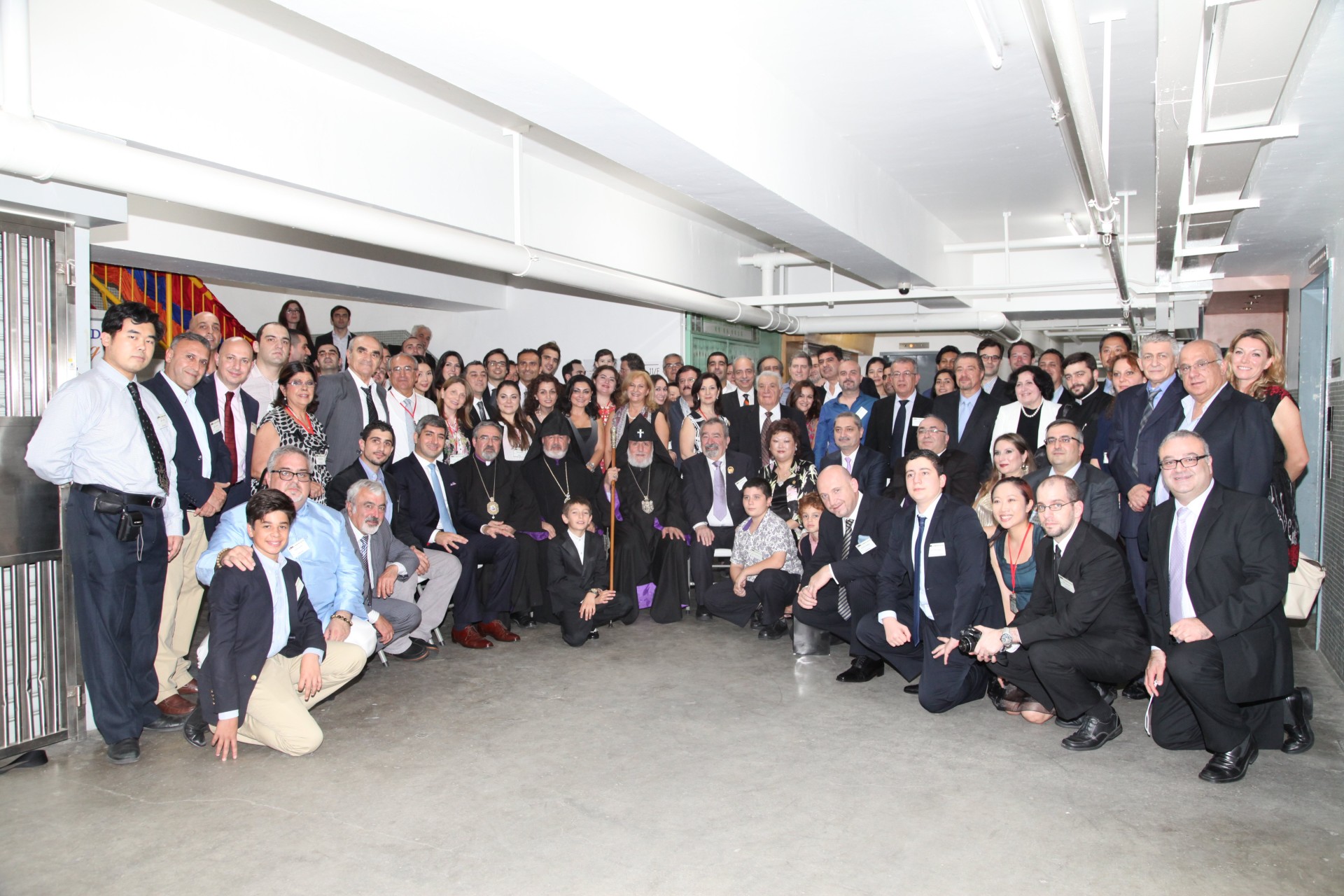
HONG KONG—On Sat., Nov. 9, the Armenian community of China, known as “ChinaHay,” along with more than 100 guests, including many from overseas, gathered in Hong Kong to attend the official opening ceremony of the newly established Jack & Julie Maxian Hong Kong Armenian Center.
Group Picture 1024x682 Armenians of China Celebrate Opening of ‘Maxian Hong Kong Armenian Center’
A group photo from the celebration
Honorary guests included His Holiness Karekin II, Supreme Patriarch and Catholicos of All Armenians; His Grace Bishop Haigazoun Najarian, Primate of the Diocese of Australia and New Zealand; His Eminence Archbishop Aram Ateshian, Patriarchal Vicar of Constantinople; His Excellency the Armenian Ambassador to China, Armen Sargsyan; and the Honorary Consul of Armenia to Thailand, Arto Artinian.
The two-day celebration began with a ribbon-cutting ceremony followed by the blessing given by Catholicos Karekin II at the beautiful center altar built especially for religious events. “Armenian couples will marry here, and Armenian kids will be baptized in this house,” Jack Maxian said in his welcoming speech. “We will arrange Armenian meetings in this center, festivities devoted to Armenian culture, and foreigners will be surprised that the Armenian people are able to build an Armenian house outside of their own land.”
That evening, Catholicos Karekin II granted the St. Nerses Shnorhali Medal of Honor to Mr. and Mrs. Maxian for their devotion to the nation. “We are happy to see that Armenian national identity is so well preserved in a remote country like China, despite the small size of the community,” he said. His Holiness also visited the grave of Sir Paul Catchik Chater, likely the most famous Armenian in Asia, who moved to Hong Kong in 1864 from Calcutta India and became one of the most successful businessmen in the history of Hong Kong with streets, parks, and buildings across Hong Kong still bearing his name.
Speaking on behalf of the Armenian community of China, Henri Arslanian highlighted the symbolic importance of this event and presented Mr. and Mrs. Maxian with a real piece from Mt. Ararat in appreciation of their years of devotion to the community and to celebrate their efforts in bringing the idea of creating an Armenian center to life.
Jack Maxian, in his inauguration speech, said, “I am convinced that, very soon, with your personal and collective commitment, the capacity of the center will multiply and the Armenian community of China will become exemplary in its patriotic and Armenian-oriented activity.” Jack and Julie Maxian generously donated a large collection of paintings to adorn the walls of the center, all of which were made especially for this occasion. The guests also enjoyed a wonderful Armenian dinner prepared by Julie Maxian for the occasion.
On the second day of the great celebration, Bishop Haigazoun Najarian held the Holy Mass, the first ever celebrated in the center. The guests also enjoyed brunch, after which they attended a lecture by Prof. Sebouh Aslanian, the Chair of Armenian Studies at UCLA, who traveled to Hong Kong for the occasion and described the role of Julfan Armenian merchants in the early modern world of the Indian Ocean, and up to Manila and China.
Later, the guests learned that Armenian-language, history, and culture classes would be offered at the center via the Armenian Virtual College (AVC). Yervant Zorian, the founder of the AVC, described how the educational institute has been helping similar communities worldwide and the enthusiasm of the AVC team in working with the Armenian community of China in the coming years.
The Jack & Julie Hong Kong Armenian Center will now host Armenians from China and all over the world. It will hold events with guest speakers, hold exhibitions, invite Armenian artists to perform, but, most importantly, it will be a gathering venue for Armenians and their friends.
Armenians have been traveling to and living in China for centuries. In 1910, the Armenian Relief Society (ARS) created the Armenian Club of Shanghai as a station for refugees in Shanghai. The club evolved over the years into a social club where the community gathered and where Armenian weddings, baptisms, and events took place. In 1923, the 400-strong community of Harbin in northern China built their first church. Most of the Armenians in China left the country around 1949 following the communist takeover. The Armenian Club of Shanghai was converted to private ownership by the Communists in 1949, and the Armenian Church was destroyed as part of Mao’s Cultural Revolution in the late 1960’s. The Armenian community of China has been growing considerably over the last few years. It currently consists of approximately 500 Armenians living in the country, mainly in the cities of Hong Kong, Shenzhen, Guangzhou, Shanghai, Nanjing, and Beijing.

Wednesday, November 13, 2013

Examining ‘the Denialist Habitus in Post-Genocidal Turkey’

An Interview with Talin Suciyan
The forced eradication of the Armenians from their homeland in 1915 has generated a unique scholarship that closely examines the genocidal policies from 1915 to 1923. One aspect, however, has remained blurred: the post-genocidal period and the repercussions of the genocide on the remaining Armenian population in Turkey. In this interview with the Armenian Weekly, Talin Suciyan shows the consistency of state policies and internalization of these policies on the level of everyday life by the larger parts of the society. According to Suciyan, the normalization of denial both by the state and the society created a denialist habitus. She also presents tangible examples of how the Armenians had to become part of the denial as there was no other way of existence for them in the public sphere.
talin 300x224 Examining ‘the Denialist Habitus in Post Genocidal Turkey’
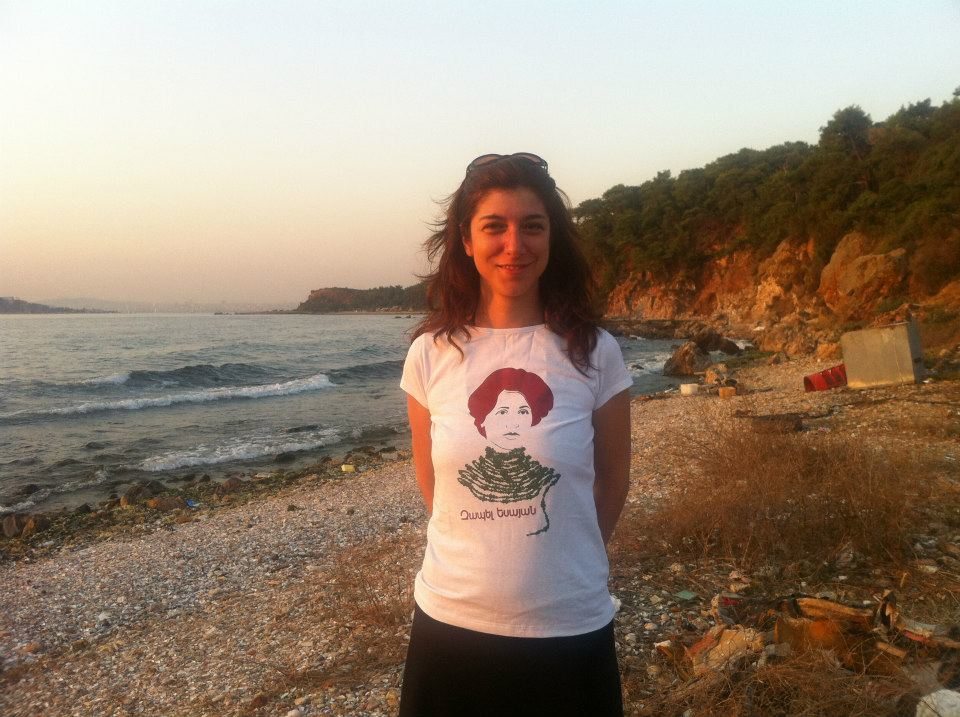
Talin Suciyan (Photo by Lara Aharonian)

Suciyan was born in Istanbul, Turkey. She attended the Armenian elementary school in her town and the Sahakyan Nunyan Armenian High School in Samatya. She graduated from Istanbul University’s radio, TV, and cinema department and continued her studies in Germany, South Africa, and India, receiving her master’s degree in social sciences. For 10 years, she worked in the field of journalism, producing and co-directing documentaries. From 2007-08, she reported from Armenia for Agos Weekly. In October 2008, she began to work at Ludwig Maximilian University’s (LMU) Institute of Near and Middle Eastern Studies as a teaching fellow, and as a doctoral student at the university’s Chair of Turkish studies. Currently, Suciyan teaches the history of late Ottoman Turkey, Republican Turkey, and Western Armenian. Since 2010, she has organized lecture series at LMU aimed at bridging the gap between Armenian and Ottoman studies. She successfully defended her Ph.D. dissertation in June 2013.

Varak Ketsemanian: In the introduction of your dissertation, you discuss the concept of denialist habitus. What were the mechanisms of denial in the post-genocide Republic of Turkey?
Talin Suciyan: Perhaps it would be good to start with an explanation of what I mean by “post-genocide habitus of denial.” This concept encompasses all of the officially organized policies, such as the 20 Classes, Wealth Tax, Citizen Speak Turkish Campaigns, prohibitions of professions for non-Muslims, etc., and the social support provided to these policies. These have mostly been against non-Muslims or others who for some reason became the target of state. Denialist habitus constitutes our daily life with its various forms. For instance, the Talat Pasha Elementary School, Ergenekon Avenue, and all the streets named after CUP leaders are very ordinary part of our lives. These examples become striking when you imagine having a school named after Hitler in Germany. Normalized hatred in the public sphere, in the media and press against the Kurds, Armenians, Alewites, or other non-Muslim groups are all part of this habitus. Juridical system is also not exempt from it. The cases of “denigrating Turkishness” and the atmosphere created through these cases in the society—involving the confiscation of properties of non-Muslims, kidnapping Armenians girls, systematic attacks on Armenians remaining in Asia Minor and northern Mesopotamia, changing the names of the villages where non-Muslims used to live, destroying their cultural heritage in the provinces, or using their churches or monasteries as stables—are all part of the post-genocide denialist habitus in Turkey.
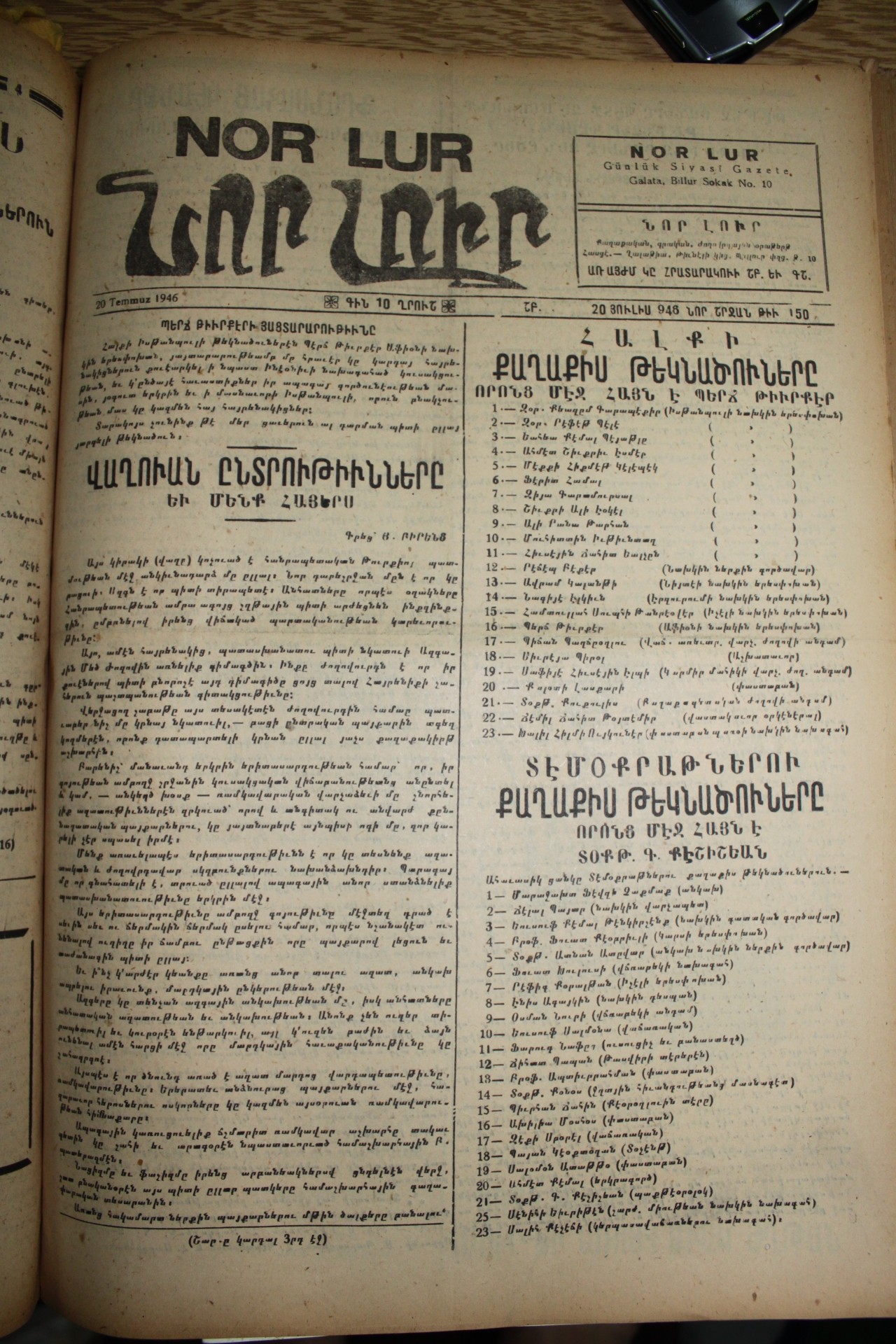
Nor Lur 20.7.1945 200x300 Examining ‘the Denialist Habitus in Post Genocidal Turkey’
The front page of the 20 July 1946 issue of Nor Lur.
With all of these practices, not only is the annihilation of these people denied, but also their very existence and history. As a result, the feeling of justice in the society could not be established. In this atmosphere, racism on a daily basis becomes ordinary. This racism, both in the provinces and in Istanbul, can easily be traced in the oral histories I’ve conducted. Through their personal histories, we see how they experienced it while playing on the streets, attending funerals, weddings, Sunday masses, or gatherings in their houses—in other words, their very existence in the provinces easily turned into a reason to be attacked. Of course, this was not only against Armenians. For instance, Jews in Tokat also had to deal with racist attacks on a daily basis. In Agop Aslanyan’s book, Adım Agop Memleketim Tokat, he refers to the racist attacks against Jews on the street, where they were equated with lice. [1]
The victims had no one, no institution to count on, they were absolutely alone in the struggle for their very existence and the denial of that existence. Their complaints were not heard. The assailants consequently knew that by attacking non-Muslims, verbally and physically, there would no punitive consequences. Official state policies during the first decades of the republican era in Turkey and also later enabled and supported the establishment and normalization of this habitus.
In other words, the republican state institutionalized this habitus of denial with its official policies both on the national and local levels, and supported its internalization on the societal level. Therefore, societal peace, a feeling of justice and freedom, cannot be established unless Turkey recognizes what happened between 1915 and 1923.

V.K.: On p. 4, you write, “Armenian Sources themselves become part of the Denial.” How?
T.S.: Yes, in this habitus of denial, the Armenian press was required to write certain things in certain ways. For instance, according to the memoirs of Ara Koçunyan, the editor-in-chief of the “Aztarar” daily, Manuk Aslanyan was called by the governor Muhittin Üstündağ to his office because he failed to cover the news of the annexation of Sanjak (Hatay). Although Aslanyan published an editorial two days after this conversation, his newspaper was nevertheless closed. There are various other examples of prohibiting or closing Armenian newspapers without any reason. “Nor Or” and “Hay Gin” are just two other examples from the republican era. These newspapers were apparently not good enough in internalizing the denialist habitus.. For instance, the “Marmara” newspaper, in its reporting on the destruction of an Armenian church in Sivas in the 1940’s, put the responsibility of locum tenens on Kevork Arch. Aslanyan, although the church was dynamited by Turkish officials.
Another example could be given in the context of relations with the diaspora: Armenian intellectuals and the press in Istanbul were expected to distance themselves from diaspora communities. So, they too had to use hostile language when describing other Armenian communities in the diaspora, denying the fact that those people in other parts of the world were their relatives. This continues to be an issue even today. However, I should point out that diaspora hatred is one of the oldest and deepest components of Kemalism, which can be traced in the republican archives in Turkey. The state prepared detailed reports on the Armenian newspapers and their editors-in-chief in the 1930’s and 1940’s–and, most probably, in later periods as well. In these reports, one of the most important criteria was the relation to other communities in the diaspora. In other words, for an Armenian newspaper to be regarded as “state friendly,” the first question was whether it was reporting news from other communities or not, and whether it had a network with other communities. It was in this atmosphere that the post-genocide habitus of denial was partly internalized by some Armenian community members, public opinion makers. The book-burning ceremony undertaken by Armenian community leaders of The 40 Days of Musa Dagh can be read in this context, too. [2] It is also important to emphasize that by being part of this habitus, the editors of the newspapers were hoping to have some more bargaining power with the state on other communal issues, such as the confiscation of properties or laws regulating the communal life. We can trace this very clearly in the editorials. However, this hope never turned into a reality.
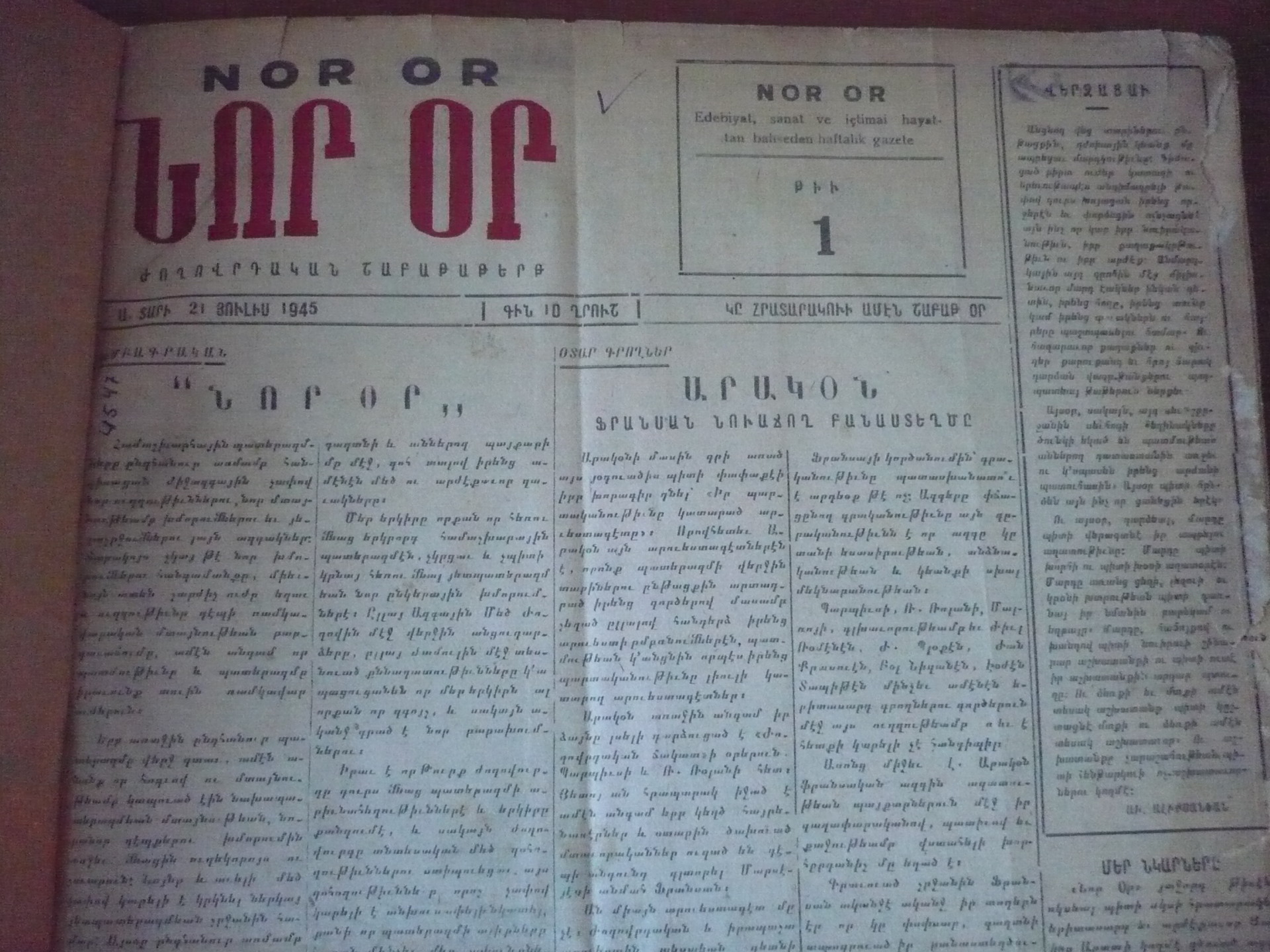
Nor Or sayi 1. 21.7.1945 300x225 Examining ‘the Denialist Habitus in Post Genocidal Turkey’
The front page of the 21 July 1945 issue of Nor Or.
It is important to underline, that I am not blaming anyone for what they did, or what they could not do, I only point out the sword of Democles that has been hanging over their heads.

V.K.: What role did the Armenian newspapers play in the re-construction of the community’s image in post-genocide Istanbul?
T.S.: Armenian newspapers had some very difficult tasks to accomplish. In the absence of Armenian history classes and an atmosphere of absolute prohibition of all books related to Armenian history, the newspapers were trying to provide historical knowledge by publishing biographies, and series on Armenians in the Ottoman Empire, the history of Armenian Church, etc.
Secondly, they had to react to anti-Armenian campaigns in the absence of representative bodies. Turkish editors, many of whom were parliamentarians at the same time, referred to Armenian editors and journalist as the representatives of their community, although there was no notion of representation. This very political task often put their existence in danger. Armenian newspapers were translating almost all news items related to Armenians from Turkish newspapers, and they were following the Armenian press in other countries. Thus, reading Armenian newspapers meant both following the agenda of Turkey and partly the agenda of Armenians in other parts of the world. Furthermore, Armenian newspapers were following the court cases opened against the pious foundations that mostly ended up with confiscated properties, such as in the case of Sanasaryan Han, Yusufyan Han, the cemetery of Pangalti, and many others. Cases of “denigrating Turkishness,” which have been filed almost exclusively against non-Muslims, were also followed closely. One can also find information about Armenian life in the provinces in the papers. Important primary sources, such as official documents, decisions of the Patriarchate or Catholicosates were all published in the newspapers. I should add that there were tens of newspapers and journals in the first decades of the republic, and that they all had different priorities. Therefore, Armenian newspapers and yearbooks are very good sources of republican history, like the memoirs of the patriarchs and public intellectuals, minutes and reports of the General (Armenian) National Assembly, the letters of the Catholicoses, among others.

V.K.: What were the repercussions of this denialist habitus? What was its social, political, cultural, and economic impact on the writing of the history of the community?
T.S.: We cannot talk about a historiography on Armenians during the republican years. Non-Muslims only appear in historical research when it concerns attacks, such as the pogroms of Sept. 6-7 1955, the Wealth Tax, 20 Classes, and others. Of course, the literature in these fields helps us a lot, but these are peak moments. One should look at the practices of daily life to understand how these tax policies, pogroms, or organized attacks affected them. How did the circumstances enable these attacks or policies against which there was no opposition? The denialist habitus as a concept helps us understand everyday life, which kept the society ready for provocations and reproductions of racism. I should perhaps add that republican elite, from 1923 onwards, was trying to “solve the problem” of the non-Muslims remaining in the country. In the memoirs of Patriarch Zaven Der Yeghiayan, we can see the process of negotiations with Refet Pasha [Bele] on this issue. This was also discussed during the deliberations prior to the signing of the Lausanne Treaty. In the minutes of secret parliament hearings we read how the presence of non-Muslims has been problematized. [3] Consequently, through the absolute prohibition of opening Armenian schools, the kidnapping Armenian girls throughout the republican period, the raiding of homes, the dynamiting or confiscation of cultural monuments, republican governments wanted to push the remaining Armenians out of Asia Minor and northern Mesopotamia, while at the same time, imagining Istanbul as a panopticon, a strict zone of control where all non-Muslims should be concentrated. A similar policy was implemented on the island of Imroz, where Greeks were allowed to remain after 1923. First, in the 1960s, an open-air prison was established there: criminals were brought to the island with their families. Consequently, the crime rate increased considerably. Then, Muslim settlers from the Black Sea region were brought to the island. Constant demographic engineering attempts were made in order to push the remaining Greeks out of the island. The consequences of these policies were disastrous. Both in Imroz and in the provinces republican governments pursued the same aim: Creating a society without non-Muslims, breaking the link between the people and the geography they lived in, and in the long run, eradicating the memory of their existence.
Photo 17 300x225 Examining ‘the Denialist Habitus in Post Genocidal Turkey’
Suciyan working in the archives of the Sourp Prgich Armenian Hospital in Istanbul.

V.K.: How did the first post-genocide generation of intellectuals reflect on the image of the Armenian community of Istanbul in the 1930’s and 1940’s?
T.S.: It is difficult to talk about one image. However, there was one very important characteristic about the “Nor Or” generation: They were the first generation of intellectuals who were born right after 1915 and were mostly active in leftist politics in Turkey. Why did they feel the need to publish an Armenian language newspaper? I think this is an important question to ask. It is quite clear that they had no other place to bring up the issues that were related to the community. They were urging for a more democratic community administration, with more participation and, on the other hand, they were very expressive about the anti-Armenian state policies and anti-Armenian campaigns reproduced by the public opinion-makers. Avedis Aliksanyan, Aram Pehlivanyan, Zaven Biberyan, Vartan and Jak Ihmalyan brothers, and others were pointing out the changing conjuncture after World War II and the need for equality for non-Muslims, in particular for Armenians in Turkey. “Nor Or” was one of the most outspoken and courageous newspapers in the republican history of Turkey. For instance, Zaven Biberyan advocated the right to immigrate to Soviet Armenia for Armenians in Turkey, which was quite dangerous; or he drew parallels between Jews and Armenians while responding to the anti-Armenian campaigns in the Turkish press. Most likely, these were the reasons behind the prohibition of “Nor Or” in December 1946, by Martial Law. Although there were other newspapers that were banned for a certain period, “Nor Or” was the only Armenian newspaper that was prohibited for good. The editors were imprisoned, and later left the country. Zaven Biberyan returned in the mid-1950’s, but all the others lost their contact with the society they were born and raised in.

V.K.: In your dissertation, you write that “Another international crisis parallel to the issue of Patriarchal election crisis was the territorial claim of  the Armenian political organizations at the San Francisco Conference. This claim was pushed further by the USSR government.” How did Turkey deal with the territorial claims presented by the Armenian political organizations?
T.S.: This was one of the most challenging issues for the Armenian community in Turkey. Turkey had sent a group of editors to San Francisco, and they remained there for quite long, around three months. Their task was to lobby for Turkey. The territorial claims presented by the Armenian organizations in the San Francisco Conference had a shocking impact on the Turkish delegation, especially when this claim was coupled with the call for immigration to Soviet Armenia by Stalin. With the call for immigration to Soviet Armenia, it was quite easy to blame all Armenians for being communists, especially the ones in Turkey, since they were queued in front of the USSR Embassy in Istanbul to register for immigration. At the end, Armenians from Turkey only waved to the ships passing through the Bosporus, and none of them were able to go to Soviet Armenia in 1946. The reason is not yet clear to me, there was always a question mark in the minds of Soviet officials regarding the Armenians in Turkey. After World War II, hatred against communism in Turkey was heightened to a great extent as a result of the territorial claims and immigration call for Armenians.
P1080753 300x225 Examining ‘the Denialist Habitus in Post Genocidal Turkey’
Suciyan with Varujan Köseyan.
The anti-Armenian campaign in Turkey was launched by the editors who reported from San Francisco. The newspapers “Yeni Sabah,” [4] “Gece Postası,” [5] “Vatan,” [6] “Cumhuriyet,” [7] “Akşam,” [8] “Tasvir,” [9] the abovementioned daily from Adana, “Keloğlan,” [10] “Son Telgraf,” [11] and “Tanin” all used quite a bit of racist language against Armenians. Asım Us, for instance, in his editorial for “Vakıt” asked Armenian intellectuals “to be conscientious and fulfill their duties.” [12] However, this was not typical to that period only. Throughout the year, after the San Francisco numerous conference articles were published along the same lines. In September 1945, Peyami Safa called the Armenians of Turkey to duty with an article entitled, “Armenians of Turkey, where are you?” published in “Tasvir” in September 1945. [13] The editors of the Armenian newspapers tried to respond to all these attacks. Aram Pehlivanyan, who penned a Turkish editorial published in “Nor Or,” in order to be heard by Turkish public opinion makers, thus explained the situation: “We are witnessing attacks of some of the Turkish newspapers against Armenians. The Armenian press is trying to respond to these attacks as much as it can. However, we have to admit that Armenian newspapers can have only a little impact on Turkish public opinion. Therefore, this self-defense is as ridiculous as fighting with a pin as opposed to a sword.” [14]

V.K.: How did the Patriarchal Election Crisis of 1944-1950 discuss the changing power relations on the post-World War II international scene?
T.S.: With the sudden death of Patriarch Mesrob Naroyan in 1944, Kevork Arch. Arslanyan was appointed as locum tenens. First, this was the period when a conflict turned into a court case between Arch. Arslanyan and the Armenian Hospital Sourp Prgich over the inheritance of Patriarch Naroyan. Second, the Turkish government was hindering the gatherings of the General (Armenian) National Assembly (GNA) and this was paralyzing the whole community administration, for the patriarchal elections could only take place with the GNA meeting. This had already been a problem starting in the 1930’s, when the whole community administration, (i.e., Nizamname of Armenian millet) had started to be undermined systematically. Kemalist secularism of the new Turkish state had targeted the administrations of non-Muslim communities, since they had the right to administer their communities based on Nizamnames, and the republican state had nothing to offer instead of these communal rights. In the last analysis, this policy was enabling the state to create de facto regulations according to its own will and interest. Coming back to the topic of patriarchal elections, not being able to organize the elections resulted in a split in the community: those who were for and those who were against Arch. Arslanyan. Almost every week, attacks and quarrels between the two groups took place in various churches.
Thirdly, the Catholicosate of Etchmiadzin, which was becoming active in the diaspora with Stalin’s immigration call, was also involved in this crisis, as well as the Catholicosate of Cilicia in Antelias, Lebanon, and other communities in the diaspora. This was the first communal crisis that turned into an international one during the republican years, leaving the Armenian community in Turkey in a very fragile position, since there were no mechanisms of representation and no real mechanisms of solving the problem. In other words, this crisis was a result of the eradication of the community’s legal basis, which had continued after 1915 and taken a systematic character with the republican policies. If the Ottoman state until 1915 had some kind of responsibility towards its non-Muslim millets, citizens or subjects, there was a complete evaporation of this responsibility during the republican period. Communities were told to no longer be communities, but equal citizens of the republic, like any other citizen of Turkey, which in reality did not apply and, more importantly, meant that Armenians no longer had the rights stemming from Nizamname. Thus, the legal basis of the communities, gained during the 19th century, was first problematized by the republican governments and then systematically eradicated, leaving the communities alone with the problems created as a result of this eradication.
Armenian newspapers, public opinion-makers, and the reports prepared by the GNA, eventually gathered by December 1950, are very rich sources to understand this very problematic period. The following comment was made in the report prepared by the investigative committee:
“This is not a history of a period, since it does not include all the incidents with their reasons and results. This is not a biographical account of someone. This is only 1 page of the overall crisis that our community has been going through for the last 30 years.” [15]
Last but not least, it is important to emphasize that this is not only the history of the Armenian community, but the history of Turkey during the first decades of the republican period. Single-party years and also decades that followed should be re-read in light of these sources, which would eventually radically change the historiography.

V.K.: Why did you dedicate your dissertation to the memory of Varujan Köseyan?
T.S.: Most of the Armenian newspapers that I referenced in my dissertation (“Nor Lur,” “Aysor,” “Tebi Luys,” “Marmara,” “Ngar,” “Panper,” and others) were located in the archives of the Sourp Prgich Armenian Hospital in Istanbul. This archive was put together by the late Varujan Köseyan (1920-2011), who rescued hundreds of volumes of Armenian newspapers from recycling. I spent quite a bit of time with him during the last two years of his life conducting interviews, and I was honored to enjoy his friendship. The room that I was working in, was like a storage room. Thanks to the efforts of the hospital administration, especially of Arsen Yarman and Zakarya Mildanoğlu, the archive room has been recently renovated and is now waiting for its researchers. Unfortunately, Köseyan could not see it. Yet, without his efforts, this research could not have been done by using such a wide range of sources, nor could the archive have been established. We owe our history to Köseyan.

Sunday, November 10, 2013

2003 Nobel Prize for MRI Denied to Raymond Vahan Damadian

By George B. Kauffman
According to the late Ulf Lagerkvist, a member of the Swedish Academy of Sciences who participated in judging nominations for the Chemistry Prize, “It is in the nature of the Nobel Prize that there will always be a number of candidates who obviously deserve to be rewarded but never get the accolade.” Usually, a losing candidate merely accepts the injustice. But in the case of the 2003 Nobel Prize in Physiology or Medicine of $1.3 million, awarded 10 years ago to University of Illinois Chemist Paul C. Lauterbur (1929-2007) and University of Nottingham (UK) Physicist Sir Peter Mansfield (b. 1933) “for their discoveries concerning magnetic resonance imaging,” the undoubtedly deserving candidate, Raymond Vahan Damadian, M.D. (b. 1936), an American of Armenian descent, did not take this injustice lying down.
MRI FIG. 6 reagan damadian 1024x792 2003 Nobel Prize for MRI Denied to Raymond Vahan Damadian
President Ronald Reagan presents the National Medal of Technology to Damadian, 1988.
A group called “The Friends of Raymond Damadian” protested the denial with full-page advertisements, “The Shameful Wrong That Must Be Righted” in the New York Times, Washington Post, the Los Angeles Times, and Stockholm’s Dagens Nyheter. His exclusion scandalized the scientific community, in general, and the Armenian community, in particular. Damadian correctly claimed that he had invented the MRI and that Lauterbur and Mansfield had merely refined the technology. On Sept. 2, 1971, Lauterbur had acknowledged that he had been inspired by Damadian’s earlier work.
Because Damadian was not included in the award, even though the Nobel statutes permit the award to be made to as many as three living individuals, his omission was clearly deliberate. The possible purported reasons for his rejection have included the fact that he was a physician not an academic scientist; his intensive lobbying for the prize; his supposedly abrasive personality; and his active support of creationism. None of these constitute valid grounds for the denial.
The careful wording of the prize citation reflects the fact that the Nobel laureates did not come up with the idea of applying nuclear magnetic resonance (NMR) (the term was later changed to avoid the public’s fear of the word “nuclear,” even though nuclear energy is not involved in the procedure) to medical imaging. Today magnetic resonance imaging (MRI) is universally used to image every part of the body and is particularly useful in diagnosing cancer, strokes, brain tumors, multiple sclerosis, torn ligaments, and tendonitis, to name just a few conditions. An MRI scan is the best way to see inside the human body without cutting it open.
MRI FIG. 2picture  2003 Nobel Prize for MRI Denied to Raymond Vahan Damadian
‘Apparatus and Method for Detecting Cancer in Tissue,’ U.S. Patent No. 3789832, Feb. 5, 1974.
The original idea of applying NMR to medical imaging (MRI) was first proposed by Damadian, a physician, scientist, and an assistant professor of medicine and biophysics at the Downstate Medical Center State University of New York in Brooklyn. Growing up in Forest Hills, N.Y., he attended the Julliard School and became a proficient violinist. When he was still a boy, he lost his grandmother to a slow death by cancer. He vowed to find a way to detect this dreaded disease in its early, still treatable stages.
MRI scanners make use of the fact that body tissue contains lots of water (H2O), and hence protons (1H nuclei), which will be aligned in a large magnetic field. Each water molecule contains two protons. When a person is inside the scanner’s powerful magnetic field, the average magnetic moment of many protons becomes aligned with the direction of the field. A radio frequency current is briefly turned on, producing a varying electromagnetic field. This electromagnetic field has just the right frequency, known as the resonance frequency, to be absorbed and flip the spin of the protons in the magnetic field. After the electromagnetic field is turned off, the spins of the protons return to thermodynamic equilibrium and the bulk magnetization becomes realigned with the static magnetic field. During this relaxation, a radio frequency signal (electromagnetic radiation in the RF range) is generated, which can be measured with receiver coils.
Information about the origin of the signal in three-dimensional space can be obtained by applying additional magnetic fields during the scan. These additional magnetic fields can be used to generate detectable signals only from specific locations in the body (spatial excitation) and/or to make magnetization at different spatial locations precess at different frequencies, which enables http://en.wikipedia.org/wiki/K-space_(MRI) encoding of spatial information. The 3D images obtained in MRI can be rotated along arbitrary orientations and manipulated by the doctor to be better able to detect tiny changes of structures within the body. These fields, generated by passing electric currents through gradient coils, make the magnetic field strength vary depending on the position within the magnet. Protons in different tissues return to their equilibrium state at different relaxation rates.
MRI FIGURE 7 Damadian medal 2003 Nobel Prize for MRI Denied to Raymond Vahan Damadian
Damadian’s National Medal of Technology, 1988.
Using a primitive NMR machine, Damadian found that there was a lag in T1 and T2 relaxation times between the electrons of normal and malignant tissues, allowing him to distinguish between normal and cancerous tissue in rats implanted with tumors. In 1971, he published the seminal article for NMR use in organ imaging in the journal Science (“Tumor Detection by Nuclear Magnetic Resonance,” March 19, 1971, vol. 171, pp. 1151-1153). Nevertheless, many individuals in the scientific and NMR community considered his ideas far-fetched, and he had few supporters at this time.
However, Damadian received a grant from the National Institutes of Health (NIH) in 1971 to continue his work. He proposed to use whole body scanning by NMR for medical diagnosis in a patent application, “Apparatus and Method for Detecting Cancer in Tissue,” filed on March 17, 1972 (U.S. Patent No. 3789832, issued Feb. 5, 1974). By February 1976, he was able to scan the interior of a live mouse using his FONAR (field focused nuclear magnetic resonance) method.
In 1977, using his machine christened “Indomitable,” now preserved in the Smithsonian Institution in Washington, D.C., Damadian tried to scan himself, but the test failed because of his excessive weight. On July 3, 1977, he obtained the first human NMR image—a cross-section of his slender postgraduate assistant Larry Minkoff’s chest, which revealed heart, lungs, vertebræ, and musculature. Minkoff had to be moved over 60 positions with 20-30 signals taken from each position. Congratulatory telegrams poured in from all over the world, including one from Mansfield.
In early 1978, Damadian established the FONAR Corporation in Melville, N.Y., to produce MRI scanners. Later that year he completed his design of the first practical permanent magnet for an MRI scanner, christened “Jonah.” By 1980 his QED 80, the first commercial MRI scanner, was completed.
The MRI imaging industry expanded rapidly with more than a dozen different manufacturers. On Oct. 6, 1997, the Rehnquist U.S. Supreme Court awarded him $128,705,766 from the General Electric Company for infringement of his patent.
Damadian is universally recognized as the originator of the MRI (by President Ronald Reagan, among others) and has received numerous prestigious awards such as the National Medal of Technology in 1988, the same year he was inducted into the National Inventors Hall of Fame. He was named Knights of Vartan 2003 “Man of the Year,” and on March 18, 2004, he received the Bower Award from the Franklin Institute of Philadelphia for his development of the MRI.

George B. Kauffman is Professor Emeritus of Chemistry at California State University, Fresno, Calif.