Thursday, February 20, 2014

Economic Blockades and International Law: The Case of Armenia

An adequate Armenian policy towards Turkey has spurred much debate, especially since the signing of the 2009 Armenia-Turkey protocols in Zurich. The opening of the border was considered one of the cornerstones of the protocols; thus, it is important to understand why the de-facto border was closed in the first place, and what alternatives to the protocols the Republic of Armenia has in mind.
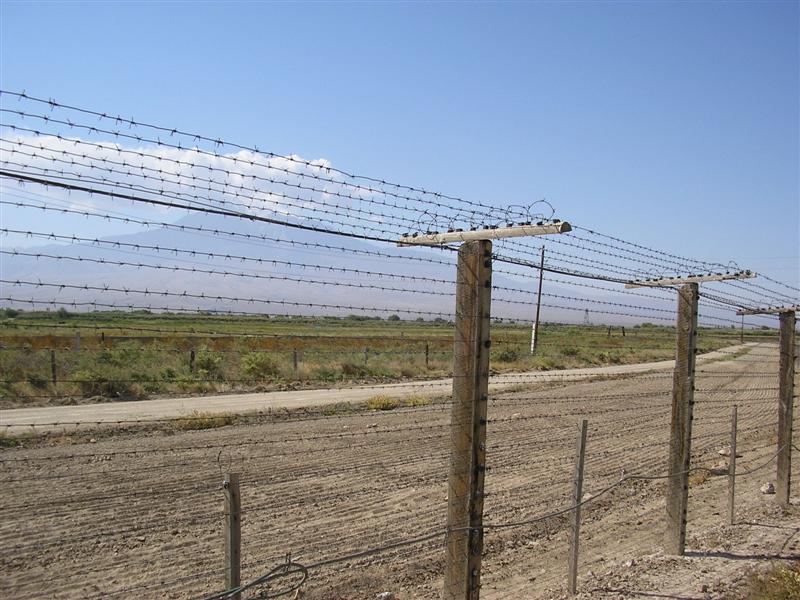
armenia border 2 Economic Blockades and International Law: The Case of Armenia
The Armenia-Turkey border
This article presents the legal and historical background of the unilateral economic blockades imposed on Armenia by Turkey and Azerbaijan, and proposes certain measures that Yerevan may take to protect its national interests. This article will not, however, cover the topic of the de-jure borders of Armenia with its neighbors.
Interestingly, Turkey was one of the first states to recognize the independence of the Republic of Armenia (the legal heir of the Armenian Democratic Republic of 1918) on Dec. 24, 1991, following the collapse of the Soviet Union. In 1993, due to the ongoing war between the Artsakh Republic and the Republic of Azerbaijan, Turkey unilaterally closed its land and air borders with Armenia, although the airspace was later re-opened in 1995. Despite the closed border, some indirect trade still takes place between the two states, mostly through Georgia. However, transit entails additional costs and, obviously, an under-realization of the trade potential. The closed borders additionally block Armenia’s guaranteed access to the sea, which would enable more efficient trade opportunities. This has certainly translated negatively on Armenia’s ability to take part in international economic cooperation and to better integrate with multilateral trading blocs. The primary imported goods from Turkey to Armenia are food products, textile, chemical industries, and household goods. Armenia, on its part, exports raw and processed leather, jewelry, and various metal products to Turkey. To this day, Turkey and Azerbaijan have refused to establish diplomatic relations with Armenia. Additionally, Azerbaijan closed its border with Armenia and Artsakh during the Soviet era.
An economic blockade is a type of unilateral coercive measure. It is widely acknowledged that the term “unilateral coercive measure” is difficult to define. Nevertheless, these measures often refer to economic steps taken by one state to compel a change in the policy of another. The most widely used forms of economic pressure are trade sanctions in the form of embargoes and/or boycotts, and the interruption of financial and investment flows between sender and target countries. While embargoes are often understood as being trade sanctions aimed at preventing exports to a target country, boycotts are measures seeking to refuse imports from a target country. Frequently, however, the combination of import and export restrictions is referred to as a trade embargo.
Turkey and Azerbaijan have effectively been exercising an illegal unilateral economic blockade against Armenia, which has hurt the latter economically. The UN Security Council, the sole body to legally authorize sanctions against states, has not done so against Armenia.
On Dec. 1, 2011 the Second Committee of the UN General Assembly approved the text of “Unilateral economic measures as a means of political and economic coercion against developing countries” by a recorded vote of 118 in favor, 2 against (Israel, United States), and 49 abstentions. The General Assembly called on the international community to condemn and reject the imposition of such measures, while requesting that the Secretary General continue to monitor their imposition and to study their impact on countries and on development.
Earlier in October 2002, the General Assembly had adopted a resolution on unilateral coercive economic measures that called on states to not recognize or apply such measures imposed by any state across territorial boundaries, as they are contrary to recognized principles of international law. Armenia said that by voting in favor of the resolution, it condemned the continuing practice of imposing such measures, particularly in the South Caucasus region. Such measures contravene international law and the principles of the UN Charter, and their practice is detrimental to developing countries, as well as those with economies in transition.
Armenia is not yet recognized by the UN as a victim state of unilateral coercive measures. Its first objective should be to make sure that the economic blockades by Turkey and Azerbaijan are categorized as a unilateral coercive measure. Armenia has previously stated at the UN that the negative consequences of sanctions have been felt beyond the countries directly affected, as they have also had adverse implications for the free flow of international trade and the effectiveness of international economic cooperation. Additionally, Armenia said that it does not agree with the imposition of unilateral economic measures as instruments of political and economic coercion against developing countries.
The Declaration on Principles of International Law concerning Friendly Relations and Co-operation among States in accordance with the Charter of the United Nations was adopted by the General Assembly on Oct. 24, 1970. The maintenance of international peace and security and the development of friendly relations and co-operation between nations are among the fundamental purposes of the UN. According to the Charter, the people represented by the UN are determined to practice tolerance and live together in peace as good neighbors.
Turkey and Azerbaijan are in clear violation of the Principle of Good Neighborliness, as well as all of the General Assembly resolutions condemning unilateral coercive measures. Armenia, as a subject of international law, has to take actions to protect its rights and ensure that Turkey and Azerbaijan adhere to the accepted international norms and principles. Even though the General Assembly resolutions are not obligatory, they do create the guidelines and parameters for moving forward. Armenia must use this card to deal with the dual blockade as well as Azerbaijan’s accusations that Armenia is in violation of Security Council resolutions.
Treaty law provides countries and individuals the right to life, the right to an adequate standard of living (including food, clothing, housing and medical care), the right to freedom from hunger, and the right to health. By blockading Armenia, Turkey and Azerbaijan have violated these rights. The Committee on Economic, Social, and Cultural Rights concluded that human rights must be taken fully into account when designing an appropriate sanctions regime; that effective monitoring should be undertaken throughout the period that sanctions are in force; and that the external entity imposing the sanctions has an obligation to take steps, individually and through international assistance and cooperation, in order to respond to any disproportionate suffering experienced by vulnerable groups within the targeted country. None of the requirements of this Committee have been followed by either Azerbaijan or Turkey.
Turkey and Azerbaijan are also in violation of customary international law and general principles. Within the United Nations more broadly, Member States have expressed their view that unilateral coercive measures of an economic character may constitute unlawful interferences. The 1965 Declaration on the Inadmissibility of Intervention in the Domestic Affairs of States and the Protection of Their Independence and Sovereignty, the 1970 Declaration on Friendly Relations, and the 1981 Declaration on the Inadmissibility of Intervention and Interference in the Internal Affairs of States—with a particular emphasis on economic measures, among others—establish the basis for the customary law.
In order to be regarded as intervention, the measures must be aimed at influencing the sovereign will of another state in undue fashion. Thus, where unilateral coercive measures intend to induce compliance with international legal obligations, such as non-use of force or human rights, they are less likely to infringe on the principle than when they are directed against the legitimate sovereign political decision-making of a state. The Turkish-Azerbaijani blockade in this case is clearly an intervention.
According to Chapter VII of the Charter of the United Nations, the Security Council may impose forcible or non-forcible measures in situations that constitute at least a threat to international peace and security. This has not been done with regards to Armenia.
Some states view unilateral coercive measures as infringing on the right to self-determination, basing their claim on Articles 1, Paragraph 2, and 55 of the Charter of the United Nations. Finally, these states note that unilateral coercive measures can also have the impact of the deprivation of one’s means of subsistence, and can constitute an obstacle to the realization of the right to development. Armenia can and should also use these factors in its argumentation.
Armenia needs to be more aggressive in the international arena in presenting its predicament. The border is not simply closed, but has been closed in violation of the accepted international norms and international documents. Once the brief but aggressive phase of awareness-building bears some positive results, and once the government of Armenia finds the right time, it needs to take the next step of introducing various resolutions within all possible international organizations (especially the OSCE) and pressure Turkey to abide by international rules and norms. It would be helpful to study the economic blockade resolutions regarding Cuba that pass in the General Assembly every year. Some other strategies may prove to be useful for Armenia as well.
At the same time, it is important to keep the Artsakh issue on the margins. At the beginning, the pursuit should only be geared towards the Turkish blockade, and not the Azerbaijani one. There is a high risk of also discussing the Artsakh conflict in the UN, should Armenia involve Azerbaijan in its demands. It would be less risky to first pressure Turkey and then, based on the experience, decide on the course of action regarding Azerbaijan’s blockade.
It is clear that Armenia, as a member of the international community, has certain rights and privileges provided by international law, and should thus use all possible instruments in its toolbox to ensure that its national interests are served well. International law by itself is unlikely to produce any tangible results for Armenia, but it should be incorporated into the Republic of Armenia’s wider strategy and foreign policy.

American Jewish University to Host ‘Armenia, Auschwitz and Beyond’

Recognizing the 100th anniversary of the Armenian Genocide, and in conjunction with the 44th Annual Scholars’ Conference on the Holocaust and the Churches, a special program, titled “Armenia, Auschwitz and Beyond,” will be presented Monday evening, March 9, on the Familian Campus of the American Jewish University, 15600 Mulholland Drive, in Bel Air, Calif.
Founded by Franklin H. Littell and Hubert G. Locke in 1970, the Annual Scholars’ Conference on the Holocaust and the Churches is an interdisciplinary, international, interfaith, intergenerational conference. It provides a forum for scholars to report the latest findings in Holocaust research, ensuring the valuable lessons of the Holocaust remain relevant for today’s world. This year’s program features Prof. Richard Hovannisian, Stephen Smith, and Prof. Michael Berenbaum.
Hovannisian is Professor of Modern Armenian History, a past holder of the Armenian Educational Foundation Chair at UCLA, and currently Chancellor’s Fellow at Chapman University in Orange County. The recent recipient of the UCLA Alumni Association’s “Most Inspiring Teacher” award, he is internationally acclaimed for his advancement of Armenian studies. His extensive scholarly publications have placed the Armenian Genocide into broader Near Eastern, Europeans and Russian contexts.
Smith is the executive director of the USC Shoah Foundation–The Institute for Visual History and Education, as well as the UNESCO Chair on Genocide Education. A theologian by training, he continues to be involved in memorial projects around the world and lectures widely on issues relating to the history and collective response to the Holocaust, genocide, and crimes against humanity. He recently presented the keynote speech at the United Nations on Holocaust Remembrance Day.
Berenbaum, a world authority on the History of the Holocaust, is Professor of Jewish Studies at the American Jewish University and executive director of the Sigi Zering Institute, a think tank exploring the ethical and religious implications of the Holocaust. He was involved with the creation of the United States Holocaust Memorial Museum in Washington, D.C., and as project director played a major role in its permanent exhibit; he has subsequently consulted on and designed museums on three continents. He is also an award-winning producer and historical consultant for numerous acclaimed films on the Holocaust.
The conference is hosted by different educational institutions around the country. This year, the American Jewish University is the host institution, with President Robert Wexler serving as the honorary chairman. Berenbaum is the 2014 Conference chairman.
The Annual Scholars’ Conference is supported in part by individual donors, along with grants from the Conference on Jewish Material Claims Against Germany and Verbe et Lumière.
The program will be held at the Gindi Auditorium in the Main Building (Ziegler Administration Building), and begins at 7:30 p.m. It is free and open to the public, but reservations are required by calling (310) 440-1279. For more information, contact Marcia Sachs Littell, Vice President of the Annual Scholars Conference, by e-mailing scholarsconf@aol.com or calling (610) 667-5437; or visit http://ascconf.org.

Tuesday, February 18, 2014

Armenia, Turkey Clash over Genocide at UN Security Council (Video)

Foreshadowing next year’s Centennial commemorative events, the Armenian Genocide issue was discussed for the first time at the UN Security Council on January 29.
Armenia’s Ambassador Garen Nazarian, addressing the main topic of the Security Council session, ‘War, its Lessons, and the Search for a Permanent Peace,’ began his remarks with a subtle hint to Turkey on UN’s peacemaking role: “to forge a deeper reconciliation among peoples, based on a shared narrative and memory of a troubled past. Often this process entails more than simply adopting declarations and resolutions, visiting and laying down flowers at victims’ memorials or signing agreements or protocols and shaking hands. To be lasting, reconciliation may require the settling of the past, recognition and acceptance of responsibility for committed crimes.”
Regarding lessons learned from the Armenian Genocide, Amb. Nazarian specifically mentioned that the “reconciliation process could be delayed for decades or even generations. This was the first modern genocide perpetrated under the cover of the First World War.” Armenia’s representative went on to insist that “ending impunity for heinous mass atrocity crimes is vital for restoring justice and normalcy.”
0 Armenia, Turkey Clash over Genocide at UN Security Council (Video)
Amb. Nazarian also outlined the steps necessary for proper reconciliation between nations: “successfully reconciled societies and nations usually undergo an extensive process of restoring justice, including reparations to victims and their heirs in order to re-establish their national dignity and identity. It is also imperative to speak with one voice against the distortion of history, the denial of historical crimes, and negationism.”
In his response, Turkey’s UN representative Halit Cevik, not surprisingly, focused on the future rather than his country’s bloody past. Without realizing that he was condemning his own country, the Turkish delegate insisted that “those responsible for the most serious crimes, crimes against humanity, genocide, and war crimes, must be held accountable.” Amb. Cevik then went on to repeat his government’s worn-out denials, claiming that “allegations of genocide regarding the 1915 events have never been legally or historically substantiated. In this same vein, there is neither political nor legal consensus as to the nature of those events…. We believe that deriving animosity from history by trying to imprint on others an incriminating and one-sided view of the past, and calling for selective compassion, is not the proper way of respecting the memory of many Turks, Armenians, and others who lost their lives during the First World War. It is therefore important to face history in its entirety, and through impartial scientific examination of historical records and archives, so that the right lessons may be drawn from history and the common fair memory can be reached.”
Amb. Nazarian, in his right of reply, expressed deep regret to hear the Turkish representative’s “distorted explanations about the undeniable fact of the Armenian Genocide which took the lives of 1.5 million Armenian children, women and men living in the Ottoman Empire during the regime of Young Turks…. It began on April 24, 1915, and went on until 1923 — the systematic and planned slaughter of the entire nation.”
Describing in detail the deportations and massacres culminating in genocide, Amb. Nazarian asserted that “this crime has been recognized by a number of [UN] member states and international organizations, including the United Nations and its subsidiary body — the Sub-Commission on Prevention of Discrimination and Protection of Minorities.
In a second reply to Amb. Nazarian, Turkey’s representative became more subtle in his denialism: “We did not say that nothing happened in 1915. These events do not fit in the description of genocide which was defined in the [UN] Convention of 1948. Now, an Armenian delegation is raising that the 1915 events are genocide in the absence of any resolution or any decision of the International Court. So how do you expect us…,” before he could finish his statement, his cell phone rang, interrupting him in mid-sentence.
It is very likely that more such confrontations will take place with Turkey leading up to the Centennial of the Armenian Genocide. Turkish officials do not seem to realize that the more they deny and counter the Armenian activities, the more they help publicize the Genocide and the just demands of the Armenian people. Meanwhile, thanks to the Turkish delegation’s two responses to Amb. Nazarian statements, the Armenian Genocide was extensively discussed at the UN Security Council for the first time ever!

Scholars Call for Reexamination of ECHR Judgment on Genocide Denial Case

Highlight ‘Historical and Conceptual Inaccuracies’ in Court Decision
BOSTON, Mass. (A.W.)–Concerned genocide scholars issued an open letter highlighting  ”historical and conceptual inaccuracies” in the European Court’s decision on Dogu Perinçek v. Switzerland, and called on the government of Switzerland to request a reexamination of the Court’s judgment.
Below is the full text of the letter, released on Feb. 14.
***
An Open Letter to:
Madame la Conseillère fédérale
Simonetta Sommaruga
Cheffe du Département fédéral de justice et police (DFJP)
Palais fédéral ouest
CH-3003 Berne
After having read the European Court’s decision on Dogu Perinçek v. Switzerland (ECHR. 370, 230, 17 December, 2013) we, as concerned genocide scholars, believe it imperative to respond to historical and conceptual inaccuracies that are articulated in the decision, and we believe those inaccuracies have serious ethical and social significance.
We do not take issue with the notion of freedom of expression, something that scholars agree is most often an essential part of open, democratic society. We are, however, concerned about elements of the Court’s reasoning that are at odds with the facts about the historical record on the Armenian genocide of 1915 and at odds with an ethical understanding of denialism.
The decision asserts that: 1) “genocide as a precisely defined legal concept was not easy to prove”; 2) “the Court doubted that there could be a general consensus as to the events such as those at issue, given that the historical research was by definition open to discussion and a matter of debate, without necessarily giving rise to a final conclusion or to the assertion of objective and absolute truths”; the court uses the phrase “heated debate” in referring to the current political context surrounding the Armenian genocide.
First, it is the overwhelming conclusion of scholars who study genocide (hundreds of independent scholars, who have no affiliations with governments, and whose work spans many countries and nationalities and the course of decades) that the Ottoman mass killings of Armenians conforms to all the aspects of Article 2 of the U.N. CPPC definition of genocide.
In 1997, the International Association of Genocide Scholars (IAGS), the major body of scholars who study genocide, passed a resolution unanimously recognizing the Ottoman massacres of Armenians as genocide. The International Center for Transitional Justice (ICTJ) prepared an analysis for the Turkish Armenian Reconciliation Commission (TARC) in 2003, stating that “the Events [of 1915] include all of the elements of the crime of genocide as defined in the Convention (UNCPPCG).
In 2000, 100 leading Holocaust scholars signed a petition in The New York Times affirming the events of 1915 were genocide and urging worldwide recognition. An Open Letter from the IAGS to Turkish Prime Minister Erdogan, in June, 2005, enjoined the Turkish government to own up to “the unambiguous historical record on the Armenian genocide.” The only three histories of genocide in the 20th century that genocide-studies theorists (such as William Schabas) agree on are the cases of the Armenians in Turkey, in 1915; the Jews in Europe, in 1940–45; and the Tutsis in Rwanda, in 1994. The destruction of the Armenians was central to Raphael Lemkin’s creation of the concept of genocide as a crime in international law, and it was Lemkin who coined and first used the term Armenian Genocide in 1944.
The idea put forth by the Court that crimes of genocide may only apply to the events in Rwanda and at Srebrenica because they were tried at the ICC is incomplete. Crimes of genocide have been assessed as historical events by scholars for decades now, and both the crimes committed against the Armenians by the Ottoman Turks in 1915 and those committed against the Jews of Europe by the Nazis in the 1940s were deemed genocide by Lemkin. As legal scholars have noted, crimes of genocide can be tried retroactively, and William Schabas has pointed out that in the Eichmann trial in Jerusalem, in 1961, the word genocide was used retroactively to designate crimes committed against the Jews.
Further, under Article 10, “the Court clearly distinguished the present case from those concerning the negation of the crimes of the Holocaust. . . . because the acts that they had called into question had been found by an international court to be clearly established.” We would note that the perpetrators of the Holocaust were prosecuted at the Nuremberg Trials (1945–46), not for the crime of genocide, but for “crimes against humanity,” even though Raphael Lemkin had previously created the term “genocide.” The Armenian case, contrary to the Court’s assertion, does have a clear legal basis for its authenticity. First, “crimes against humanity” was the very phrase coined by France, the United Kingdom, and Russia in their 1915 joint declaration in response to the massacres of the Armenians by the Ottoman Turkish government. After WWI, the Ottoman government convened military tribunals (1919–20) to try 200 high-level members of the military and government for premeditated mass murder of the Armenian population. The ICTJ decision of 2006 also affirms such a legal basis.
The Court also decided, on the basis of Article 17 (prohibition of abuse of rights), that “The rejection of the legal characterization as ‘genocide’ of the 1915 events was not such as to incite hatred against the Armenian people.” Yet the ECtHR states (para 19) that “the negation of the Holocaust is today the principal motor of anti-Semitism.” We would note similarly that the denialism of the Armenian genocide in Turkey resulted in the assassination of Armenian Turkish journalist Hrant Dink, and has resulted in violence to others in Turkey.
In referring to the Armenian genocide as “an international lie,” Mr. Perençik reveals a level of extremism that belies all sense of judgment. We believe that the Court makes a misstep when it privileges Turkey’s denialism (a country with one of the worst records on intellectual freedom and human rights over the past decades) as a “heated debate.” As the IAGS has written in an Open Letter on denialism and the Armenian genocide (October, 2006), “scholars who deny the facts of genocide in the face of the overwhelming scholarly evidence are not engaging in historical debate, but have another agenda. In the case of the Armenian Genocide, the agenda is to absolve Turkey of responsibility for the planned extermination of the Armenians—an agenda consistent with every Turkish ruling party since the time of the Genocide in 1915. Scholars who dispute that what happened to the Armenians in the Ottoman Empire in 1915 constitutes genocide blatantly ignore the overwhelming historical and scholarly evidence.”
As noted genocide scholar Deborah Lipstadt has written: “Denial of genocide whether that of the Turks against the Armenians, or the Nazis against the Jews is not an act of historical reinterpretation . . . . The deniers aim at convincing innocent third parties that there is another side of the story . . . when there is no other side.” We believe that the Court’s decision and reasoning contributes to denialism and this has a corrosive impact on efforts for truth and reconciliation, and ethics.
We believe it important that the government of Switzerland request a reexamination of the Court’s judgment in this case.
Sincerely,
Taner Akçam, Kaloosdian/Mugar Professor, Center for Holocaust and Genocide Studies, Clark University
Margaret Lavinia Anderson; Professor of the Graduate School (Current); Professor of History emerita; University of California – Berkley
Joyce Apsel, Master Teacher of Humanities, New York University; Past President, International Association of Genocide Scholars
Yair Auron, head, Department of Sociology, Political Science and Communication, The Open University of Israel
Peter Balakian, Donald M. and Constance H. Rebar Professor of the Humanities, Colgate University
Annette Becker, Professor of History, University of Paris, Ouest Nanterre La Defense; senior member, Institut Universitaire de France
Matthias Bjornlund, archival historian; Danish Institute for Study Abroad (DIS), Copenhagen
Donald Bloxham, Professor of Modern History, University of Edinburgh
Hamit Bozarslan, Director, EHESS, Paris
Cathy Caruth, Frank H. T. Rhodes Professor of Humane Letters, Cornell University
Frank Chalk, Professor of History; Director, Montreal Institute for Genocide and Human Rights Studies
Israel Charny, Past President International Association of Genocide Scholars; Director, Institute on the Holocaust and Genocide, Jerusalem
Deborah Dwork, Rose Professor of History; Director of the Strassler Center for Holocaust and Genocide Studies, Clark University
Helen Fein, Independent Scholar; former executive director of Institute for the Study of Genocide (New York)
Marcelo Flores, Professor of Comparative History; director, The European Master in Human Rights and Genocide Studies, University of Siena
Donna-Lee Frieze, Prins Senior Fellow, Center For Jewish History, New York City; Visiting Fellow, Alfred Deakin Research Institute, Deakin University, Melbourne.
Wolfgang Gust, Independent Scholar, Director armenocide.com.de Hamburg
Herbert Hirsch, Professor of Political Science, Virginia Commonwealth University; co-editor, Genocide Studies International
Marianne Hirsch, William Peterfield Trent Professor of English and Comparative Literature at Professor in the Institute for Research on Women, Gender, and Sexuality; Columbia University
Tessa Hofmann, Prof. h.c. Dr. phil, Frie Universitat Berlin, Institute for East European Studies
Richard Hovanissian, Professor Emeritus, Armenian and Near Eastern History at the University of California, Los Angeles; Distinguished Visiting Scholar at Chapman University and the University of California, Irvine
Raymond Kevorkian, Historian, University of Paris-VIII-Saint Denis
Hans-Lukas Kieser, Professor of Modern History, University of Zurich
Mark Levene, Reader in Comparative History, University of Southampton, UK
Robert Jay Lifton, MD; Distinguished Professor Emeritus, The City University of New York
Deborah Lipstadt, Dorot Professor of Modern Jewish History and Holocaust Studies, Emory University
Wendy Lower, John K. Roth Professor of History, Claremont McKenna College
Robert Melson, Professor Emeritus, Purdue University; Past President, International Association of Genocide Scholars
Donald E. Miller, Professor of Religion; Director, Center for Religion and Civic Culture, University of Southern California
A. Dirk Moses, Professor of Global and Colonial History, European University Institute, Florence and Senior Editor, Journal of Genocide Research.
James R. Russell, Mashtots Professor of Armenian Studies, Harvard University
Roger W. Smith, Professor Emeritus of Government, College of William and Mary; Past President, International Association of Genocide Scholars
Leo Spitzer, K.T. Vernon Professor of History Emeritus, Dartmouth College
Gregory Stanton, Research Professor in Genocide Studies and Prevention, George Mason University; Past President, International Association of Genocide Scholars
Yves Ternon, Historian of modern genocide, independent scholar, France
Henry C. Theriault, Professor of Philosophy, Worcester State University; Co-Editor-in-Chief, Genocide Studies and Prevention
Eric D. Weitz, Dean of Humanities and Arts and Professor of History, The City College of New York/Graduate Center

Thursday, February 13, 2014

‘Facing History,’ Knights Host Genocide Commemoration Essay Contest

High school and college students are invited to participate in an essay contest to actively support the the Armenian Genocide commemoration that will be held on Sun., April 27 in Times Square (46th St./Broadway), from 2-4 p.m. Co-sponsors of the contest include the Knights & Daughters of Vartan, an international Armenian fraternal organization with headquarters in the U.S., and Facing History and Ourselves, an international educational and professional development organization.
One winner and two runner-ups will be selected by a distinguished panel of judges. The first place winner will receive $300; second place runner-up will receive $200; and third place runner-up will receive $100. The winners will be recognized at the Times Square commemoration on April 27 and, depending on time constraints, may read their essays.
The question to answer in this year’s essay is: “On the threshold of the 100th anniversary, how should the world recognize the Armenian Genocide?”
The essay should be 800 words maximum, double-spaced, 12-point Arial type, and must include the student’s full name and age, teacher’s full name and subject area, name of high school or college, year in school, hometown and state, phone number, and email address at the top of each page of the essay. The deadline to submit essays is Mon., March 31, 2014, to Taleen Babayan via e-mail at april24nyc@gmail.com.
The three winners will be contacted directly and announced to the mainstream and Armenian media during the week of April 8.
About the Times Square commemoration
Founded in 1985 by the late Sam Azadian, a former Brooklyn, N.Y. resident who lost four siblings during the genocide, the Armenian Genocide Commemoration at Times Square has honored the 1.5 million Armenian lives lost during the 1915 Genocide of the Armenians by the Young Turk government of the Ottoman Empire. This annual event draws thousands of Armenian and non-Armenian participants to commemorate the solemn occasion. The event features speeches and tributes delivered by prominent political figures and civic leaders, officials of the Knights and Daughters of Vartan, representatives of major Armenian-American organizations, distinguished scholars and educators, as well as high-ranking Armenian and non-Armenian clergy.

Armenian Genocide Recognition: Necessary but Not Sufficient

With the approaching Centennial of the Armenian Genocide in 2015, Turkish leaders are coming under increasing pressure from the international community to face their country’s sordid past and acknowledge the genocide. Significantly, public statements regarding the Armenian Genocide were made in the last few days by the heads of three European states: France, Germany, and the Czech Republic.
During his visit last month to Turkey, French President Francois Hollande, without using the word “genocide,” called on Turkish leaders to confront their history: “Memory work is always painful…but must be done. What we need is to carry out reconciliation through research and recognition of what has happened… By recognizing the historical events you will be elevated not only in your own eyes, but also in the eyes of the world.”
Hollande also held a private meeting with Rakel Dink, the widow of martyred Turkish-Armenian journalist Hrant Dink.
Similar wise counsel was offered last week by German Chancellor Angela Merkel to visiting Turkish Prime Minister Recep Erdogan: “Turkey must come to terms with its history.” Ironically, Erdogan was the one who brought up this issue by complaining that Germany was planning to allocate funds for the commemoration of the Armenian Genocide Centennial.
The president of the Czech Republic, Milos Zeman, went even further than the French and German leaders by actually using the term “Armenian Genocide” during President Serge Sarkisian’s visit to Prague two weeks ago: “Next year marks the 100th anniversary of the Armenian Genocide. In 1915, 1.5 million Armenians were killed.”
While international pressure on the Turkish government is expected to become progressively more intense with the approach of the Centennial, Armenians should be wary not to be misled by such well-meaning, but at times, self-serving statements. If such pressures prompt a Turkish leader to admit to the Ottoman government’s intent in committing massacres or even genocide, it would be insufficient to satisfy the just demands of the Armenian people. In fact, the raising of expectations for Turkish recognition could be counter-productive, because if and when Turkey does acknowledge it, everyone including Armenians may wrongly assume that our long-anticipated objective has been realized!
Several decades ago, when the world was still unaware of the basic facts of the Armenian Genocide, its recognition by the international community and the Turkish government was imperative. However, at this stage, when over two dozen countries, many international organizations, and the International Association of Genocide Scholars have acknowledged the Armenian Genocide, mere recognition is no longer the ultimate goal.
Rather than recognition, Armenians and all people of goodwill now seek justice for the genocide committed by Ottoman-Turkish leaders. Just as Germany paid compensation to Holocaust survivors, the government of Turkey, as successor to the Ottoman Empire, has to pay billions of dollars in restitution, and return the stolen Armenian properties and occupied lands.
To strive for restitutive justice, Armenians should use all possible means—political pressure, economic boycotts, public protests, and lawsuits—to convince Turkey’s leaders that they would be better off negotiating with representatives of the Armenian government and Armenian Diaspora, seeking a just resolution for this long-lasting injustice. As there are considerable disparities between the political, economic, and military capabilities of the two sides, Armenians may not be able to obtain all their demands overnight, but should insist that Turkish officials offer them as much restitution as possible in a phased manner towards eventual full justice.
The just settlement of the Armenian Genocide issue would have many benefits for Turkey, which would be hailed by the international community as a progressive and civilized country. Its leaders may even be considered for the Nobel Peace Prize. Recognition followed by restitution would also facilitate Turkey’s entry into the European Union. Otherwise, the continued refusal to come to terms with the Armenian Genocide would prolong the Turkish people’s embarrassing predicament of being constantly reminded of the crimes committed by their forefathers and continuously humiliated before the entire world as genocide denialists.
Should Turkish leaders have the courage to resolve their Armenian conundrum, the Armenian people would finally begin obtaining long-awaited compensation for their losses, enjoy an economically and geopolitically more viable and secure homeland, with the expectation that a repentant neighbor will be more inclined toward peaceful coexistence.

Monday, February 10, 2014

YET ANOTHER ARMENIAN GENOCIDE DENIAL BY Institute of Turkish Studies (ITS)

ITS Treasurer Edward Erickson: ‘It’s probably not genocide.’ 
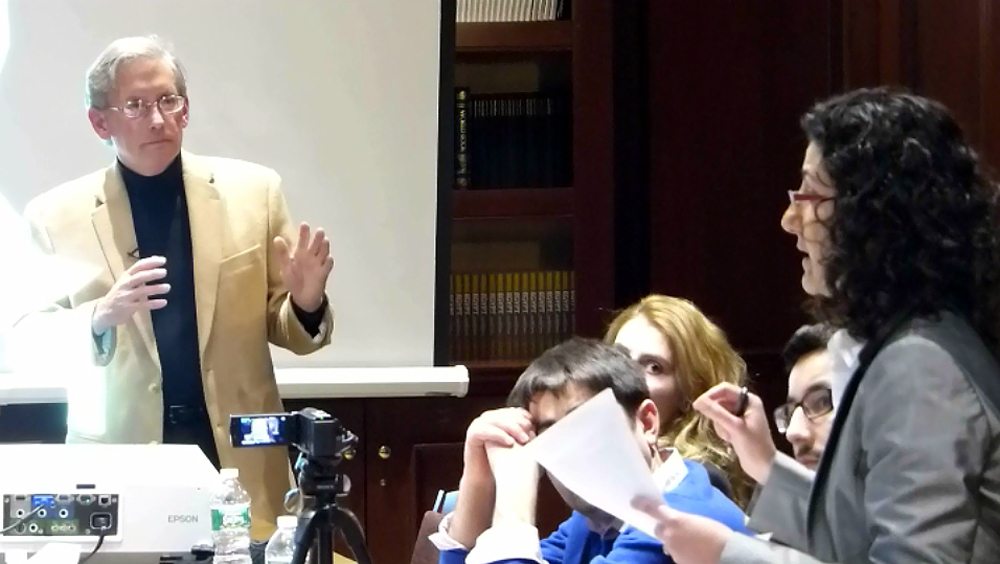
WASHINGTON—Institute of Turkish Studies (ITS) Treasurer Edward Erickson responded angrily on Feb. 5 to Armenian National Committee of America (ANCA) questions about his position on the Armenian Genocide and his organization’s ties to the Turkish government, threatening to have ANCA Government Affairs Director Kate Nahapetian removed from his lecture at Georgetown University.
kate erickson 300x169 ANCA Challenges Genocide Denial at ‘Institute of Turkish Studies’ Event
ANCA Government Affairs Director Kate Nahapetian challenges ITS Treasurer Dr. Edward Erickson on ITS ties to the Turkish government at his Feb. 5 lecture at Georgetown University.
“Can we get her out of here?” was Dr. Erickson’s response to Nahapetian’s inquiry about whether he believed the murder of 1.5 million Armenians constituted genocide. “This is not Turkey,” retorted Nahapetian, noting that those holding positions not shared by the lecturer cannot simply be silenced in the U.S.
The ITS had arranged for Erickson to lecture at the Georgetown University Center for Contemporary Arab Studies Boardroom on his latest book. Referencing Erickson’s opening assertion that history has an agenda, that “resources drive policy” and “resources determine policy,” ANCA Executive Director Aram Hamparian asked Erickson to clarify the Institute of Turkish Studies’ ties to the Turkish government and its policy of genocide denial. Dr. Erickson acknowledged that the ITS was founded by a grant by the Turkish government, but claimed that “the ITS has no strings attached, is not a puppet or an organ of the Turkish government. It operates as a separate entity. It makes its own decisions and its agenda has nothing to do with anything Armenian or the denial of the genocide.”
Nahapetian challenged that assertion, reminding Erickson and attendees that former ITS Chairman Donald Quataert felt compelled to relinquish his position with the organization following a meeting with then-Turkish Ambassador to the U.S. Nabi Sensoy, precipitated by an article Quataert had written acknowledging the genocide.
In a 2008 “Inside Higher Ed” article, Quataert told reporter Scott Jaschik that the ambassador “made it clear that if I did not separate myself as chairman of the board, that funding for the institute would be withdrawn by the Turkish government and the institute would be destroyed.” Jaschik’s complete article on the topic, titled “Is Turkey Muzzling U.S. Scholars?”, is available here.
ITS’s ties with the Turkish government were explored extensively in the spring 1995 “Holocaust and Genocide Studies” Journal article titled, “Professional Ethics and the Denial of Armenian Genocide,” by Dr. Roger W. Smith, Dr. Eric Markusen, and Dr. Robert Jay Lifton, the full text of which is available here.
Voice of America reporter Arsen Kharatyan and other attendees, including Lee Jundanian and Dikran Dourian, asked other questions and expressed their concerns about Erickson’s flawed scholarship and his ties to Turkey’s international campaign of genocide denial. In what was perhaps the most puzzling moment of the talk, when questioned a second time on his position regarding the Armenian Genocide, this time by Kharatyan, Erickson replied, “There are days I wake up and I think, ‘It’s probably genocide.’ There are days I wake up and I think ‘probably not.’”
0 ANCA Challenges Genocide Denial at ‘Institute of Turkish Studies’ Event
Following the lecture, Hamparian commented, “We saw today yet another angry attempt by an Ankara-funded organization, this time the Institute of Turkish Studies, to enforce—right here in America—Turkey’s shameful gag-rule on the Armenian Genocide.”