A friend once sent me a Christmas card with a handwritten greeting:
"May your genocide be recognized this holiday season." It still makes me
laugh out loud, because it captures something about the absurd and
profound impasse between Turkey and the Armenian people.
One hundred years ago
this month, the Ottoman Empire began carrying out a systematic plan to
exterminate its minority Armenian population. Between 1 million and 1.5
million people were killed or died of starvation. Yet the Turkish
government won't admit this historical fact. It spends a fortune
annually to stop scholarly and cultural events about the genocide, even
going so far as to pay former Sen. Richard Gephardt's Gephardt Group
more than $1 million each year to lobby against congressional
resolutions on the genocide. Turkey has threatened several times, most
recently in 2007, to close Turkish missile bases to U.S. airplanes if
Congress passes a simple non-binding statement acknowledging the events
of 1915 as genocide. And its tactics work; the resolution, which had the
votes to pass, was killed at the State Department's behest.
The
United States isn't the only target of this censorship effort. At their
government's prompting, Turkish diasporan organizations in 2009 mounted
a campaign to stop the Toronto school board from including the Armenian
genocide in a human rights curriculum. In 2010, Ankara succeeded in
pressuring the Rwandan government to scrap a presentation on the
Armenian genocide at a panel on genocide at the United Nations. In 2012,
the Turkish government was successful in demanding that the British
government order the Tate Gallery to remove the word "genocide" from the
wall text of an Arshile Gorky exhibit.
Substitute "Jews" for
"Armenians" and "German government" for "Turkish government" and you can
imagine the ensuing moral outrage. The Armenian community has been
waiting a century for the international community to stand up to Turkey.
It shouldn't have to wait any longer.
The word "recognition"
hovers over the history of the Armenian genocide like a hawk. It's a
defining word that embodies an ethical basis for accountability after a
human rights crime. The issue of recognition is not an abstraction, or a
rhetorical game. The "R-word" is about responsibility, social justice
and repair in the aftermath of one of the most extensive human rights
crimes of the modern era: the crime that was instrumental in Raphael
Lemkin's coining the very word and concept of genocide.
When
Lemkin was asked in February 1949, just after the U.N. Genocide
Convention was ratified, why he became interested in genocide, he
answered, "Because it happened so many times. It happened to the
Armenians. And after — the Armenians got a very rough deal at the
Versailles conference because the criminals who were found guilty
weren't punished." Lemkin was not only noting the importance of the
event but also pointing out that it's ethically harmful to commit such a
crime with impunity.
Denial of genocide is the final stage of
genocide because it strives to kill the memory of the event; denial
seeks to demonize the victims and rehabilitate the perpetrators; denial
creates what the psychiatrist Robert Jay Lifton has called "a morally
counterfeit universe for the survivors and their legacy."
In
December, after North Korea organized a hacking operation against Sony
Pictures to stop the release of "The Interview," President Obama spoke
out against the use of threats by foreign powers to inhibit free speech
in the United States.
"We cannot have a society where some
dictator someplace can start imposing censorship here in the United
States," he said, "because if somebody is able to intimidate folks out
of releasing a satirical movie, imagine what they'll do when they see a
documentary that they don't like, or news reports that they don't like —
or even worse, imagine if producers or distributors or others start
engaging in self-censorship because they don't want to offend the
sensibilities of somebody whose sensibilities probably need to be
offended."
Obama
has gone further than any other president in confronting Turkish
leaders by asking them to deal with the events of 1915 honestly, as he
did in 2009 when he visited Turkey. But he should heed his own wisdom
and stop self-censoring.
The president understands clearly that
what happened to the Armenians is genocide. In 2008, before his
election, he stated, "My firmly held conviction [is] that the Armenian
genocide is not an allegation, a personal opinion or a point of view,
but rather a widely documented fact supported by an overwhelming body of
historical evidence." The president should follow the example of Pope
Francis who, in acknowledging the historical significance of the
Armenian genocide on Sunday, refused to be intimidated by Turkish
government bullying and cajoling.
The
Turkish government, for its part, should stop interfering with cultural
events and intellectual freedom in democratic societies. And it should
listen to many of its own ethically committed citizens who work hard for
truth in Turkey. The Turkish scholar and journalist Cengiz Aktar spoke
for many of his citizens when he wrote, "The Armenian genocide is the
Great Catastrophe of Anatolia, and the mother of all taboos in this
land. Its curse will continue to haunt us as long as we fail to talk
about, recognize, understand and reckon with it."
Removing the curse won't require magic. All that's necessary is moral leadership.
Peter
Balakian is the Donald M. and Constance H. Rebar Professor of the
Humanities at Colgate University and the author of many books, including
"The Burning Tigris: The Armenian Genocide and America's Response."
Friday, April 17, 2015

Turkey ‘Not on Same Page’ with International Community--THEY SUPPORT ISIS QUIETLY
Turkey ‘Not on Same Page’ with International Community

Armenia's Foreign Minister Edward Nalbandian at a press conference in Yerevan. Jan. 26, 2015. (Photo: Photolure)
YEREVAN (Arka)—Armenia’s minister of foreign affairs Edward Nalbandian said Tuesday that Turkey and the international community are increasingly in disagreement, while commenting on Pope Francis’ reaffirmation of the Armenian Genocide on Sunday. On Sunday the head of the Roman Catholic Church served a landmark Holy Mass in the Armenian Catholic rite in St. Peter’s Basilica. In his speech, Pope Francis reaffirmed the Vatican’s recognition of the Armenian Genocide. The Pope’s statement provoked anger in Turkey, whose government recalled its ambassador to the Vatican.
“If Turkey disagrees with this statement and with many countries having recognized the Armenian genocide, and does not agree with the opinion of the international organizations, than it is the problem of Turkey, but not of the global community,” Nalbandian said. “This indicates that Turkey and the international community do not speak the same language.”
“This confirms Ankara’s continuing policy of denial at a state level and, hence, assumes responsibility for the crime committed by the Ottoman Empire leadership,” the Armenian foreign minister said.
Guided by universal human values, the Pope said that concealing or denying the genocide would mean leaving the wound bleeding without bandaging it, Nalbandian said.
“Denial is opening the doors not to reconciliation, but to new crimes against humanity,” Nalbandian said.
Turkish Hackers Hit Vatican Website
Turkish Hackers Hit Vatican Website

A screenshot of vatican.va
Turkish hackers hit the Vatican’s website on Monday in an apparent retaliation for the pope’s remarks on Sunday, when he referred to the events of 1915 as “the first Genocide of the 20th century,” reported the Hill. Vatican.va was knocked offline by a denial-of-service attack on Monday night, according to reports, but restored by Tuesday morning. A Turkish hacker on Twitter took credit for the hit, demanding that the pope retract his comments, added the Hill.
The pope’s comments have angered Turkey prompting Ankara to recall its Vatican envoy and calling Francis’s remarks “slanderous.”
Erdogan Warns Pope to not Repeat ‘Mistake’
Erdogan Warns Pope to not Repeat ‘Mistake’

Turkish President Recep Tayyip Erdogan warned the pope
ANKARA–Turkish President Recep Tayyip Erdogan on Tuesday blasted Pope Francis for his reaffirmation of the Armenian Genocide and warned the pontiff to not make the same “mistake” again, reported the Turkish media. Speaking to the Turkish Exporters Assembly at the presidential palace, Erdogan said: “I condemn the Pope and hope that he will not make the same mistake again, and want to urge him [not to do so],” reported Today’s Zaman.
Pope Francis described the slaughter of 1.5 million Armenians under the Ottoman Empire as “the first genocide of the 20th century” during a mass on Sunday, in which the Armenian Catholic rite was celebrated in St. Peter’s Basilica. The pope added that “concealing or denying evil is like allowing a wound to keep bleeding without bandaging it.”
“Whenever politicians, religious functionaries assume the duties of historians, then delirium comes out, not fact. Hereby, I want to repeat our call to establish a joint commission of historians and stress we are ready to open our archives,” added Erdogan.
The Turkish leader claimed that during a recent visit to Turkey, the pope had allegedly vowed that “to not let historic events be taken out of context and be used for propaganda against Turkey,” said Erdogan, adding that the pope had come off as “a different politician.
“His remarks display the appearance of a mentality different to that of a religious functionary,” Erdogan said. “I won’t let historical events be brought out of their own course and turned into a campaign against our country and nation.”
Erdogan also made reference to the no infamous “condolence” statement he made on April 23, 2014, in which he offered condolences to the grandchildren of Armenians who died during World War I and reiterated his call for historian to study the Armenian Genocide.
Official Claims Pope and Argentines are “Brainwashed”
Turkey’s minister of European Affiars, Volkan Bozkir, in remarks broadcast on national TV on Monday said the Argentineans as a whole, and not just the pope, had been “brainwashed by rich and powerful Armenians,” reported the New York TImes.
“In Argentina,” Bozkir asserted, “the Armenian diaspora controls the media and business.” The minister provided no evidence for his assertion and was not asked for any, added the New York Times.
“I would like to note that the pope is from Argentina, a country that hosted Nazi war criminals who perpetrated unspeakable crimes against humanity,” Bozkir said, while speaking at rally in Istanbul, reported Today’s Zaman.
Public Discussion: The Armenian Genocide
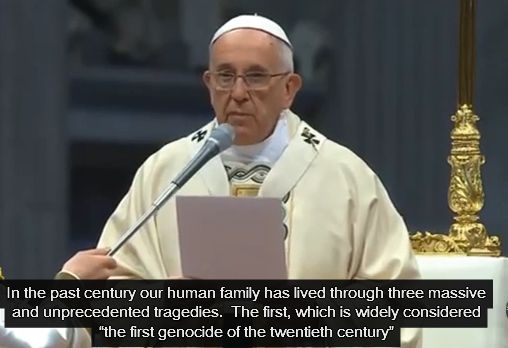
After a century, the killings are still a political fault line, with many Armenians arguing they have been unfairly underplayed by historians and disputed by Turkey.
Tonight on the Loudonville Campus of Siena College, the educational and healing processes continue.
Rafi Topalian is the chairman for the Capital District Armenian Genocide Committee. "We're looking forward to a nice discussion because we will have many students from high school and college, and we invite the public at large to be part of the discussion, and to contribute, comment, or to learn, because not many people know about the Armenian genocide that preceded the Jewish Holocaust."
Some people wonder "Who are the Armenians?"
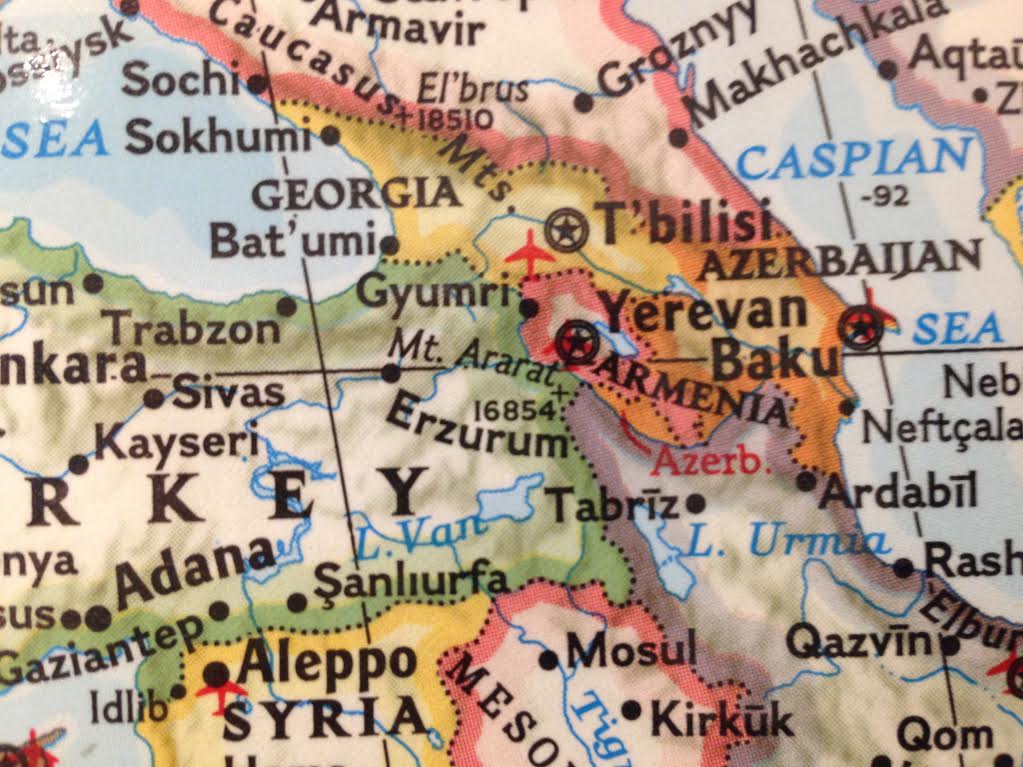
A million and a half Armenians call the U.S. home, with more than 5,000 in the Albany area. Topalian has initiated a dialog with the local Turkish community, but concedes it will may take even more time to heal old wounds.
- (Free) Thursday, April 16, 2015 - 7:00PM - Siena College - ARC.
- Local and Siena officials and families of survivors will be among attendees.
- A reception featuring Armenian desserts will follow at 8:00PM.
Watertown High Students Respond to Turkish Consul Letter to Globe
WATERTOWN, Mass. (A.W.)—On March 26, students in Watertown High
School’s Armenian-language class drafted a “Letter to the Editor” to the
Boston Globe in response to another letter published by the paper on
March 20. Authored by Omur Budak, the consul general of Turkey in
Boston, the letter, titled “Myopic View of Complex Episode Hurts
Turkish-Armenian Relations,” was written in response to best-selling
novelist Chris Bohjalian’s op-ed in the paper, titled “Why Does Turkey
Continue to Deny Armenian Genocide?” published on March 9.
In his letter, Budak harshly criticized Bohjalian, arguing that his view of history was “myopic” and “problematic.”
“Chris Bohjalian disregards a deep history of 800 years of coexistence, cultural tolerance, friendship, and mutual respect between the two nations, and turns a blind eye to the very complex nature of this issue,” wrote Budak.
“The radicals among the Armenian diaspora are intolerant toward any different opinion. Their narrative, based on demonizing and disrespecting memories of millions of Turks, categorically labels any fair attempt to accurately understand this period as denial. Yet, contrary to Bohjalian’s opinion, there is neither political, legal, nor academic consensus on the description of the events of 1915,” wrote Budak, in a passage referenced by the students.
“To call the Armenian Genocide of 1915 a ‘complicated episode’ during World War I and to claim that those who acknowledge the genocide are ‘radicals’ is shameful,” wrote the students, adding that the Turkish government “seeks to create artificial controversy and confusion regarding an established historical event.”
The students ended their letter with the following: “To invite world leaders to the Gallipoli commemoration on April 24—Armenian Genocide Memorial Day—is truly, in Chris Bohjalian’s words, ‘appalling’ and exceedingly ‘offensive.’”
The Globe has not published the students’ letter, which is reprinted in full below.
Students’ letter
March 26, 2015
Dear Editor,
We are writing in response to Turkish Consul S. Omur Budak’s letter of March 20 (“Myopic View of Complex Episode Hurts Turkish-Armenian Relations”). To call the Armenian Genocide of 1915 a “complicated episode” during World War I and to claim that those who acknowledge the genocide are “radicals” is shameful. The Turkish government uses tactics similar to Holocaust deniers, and it seeks to create artificial controversy and confusion regarding an established historical event.
The Armenian Genocide, like the Holocaust, is a thoroughly documented fact. The International Association of Genocide Scholars, the leading group of experts on Holocaust and Genocide studies, unanimously declared in 1997 that “The mass murder of Armenians in Turkey in 1915 is a case of genocide which conforms to the statutes of the United Nations Convention on the Prevention and Punishment of Genocide.” They also condemned the Turkish government’s continued denial of the Armenian Genocide.
In addition, 126 leading scholars of the Holocaust, including Elie Wiesel, placed a statement in the New York Times in June 2000 affirming the “incontestable fact of the Armenian Genocide.”
Contrary to Mr. Budak’s claims, the historical record and proof of the Armenian Genocide is unambiguous and documented by overwhelming evidence.
To invite world leaders to the Gallipoli commemoration on April 24—Armenian Genocide Memorial Day—is truly, in Chris Bohjalian’s words, “appalling” and exceedingly “offensive.”
Armenian Language Class Students
Watertown High School
50 Columbia Street
Watertown MA 02472
Budak letter
Budak’s letter, “Myopic View of Complex Episode Hurts Turkish-Armenian Relations,” as published by the Boston Globe, follows.
RE “TURKEY’S denial” (Op-ed, March 9): The opinion offered regarding this complicated episode of World War I, in which millions of Ottoman citizens of all religions and ethnicities vastly suffered, only discourages current relations between Turks and Armenians.
Chris Bohjalian disregards a deep history of 800 years of coexistence, cultural tolerance, friendship, and mutual respect between the two nations, and turns a blind eye to the very complex nature of this issue.
The radicals among the Armenian diaspora are intolerant toward any different opinion. Their narrative, based on demonizing and disrespecting memories of millions of Turks, categorically labels any fair attempt to accurately understand this period as denial. Yet, contrary to Bohjalian’s opinion, there is neither political, legal, nor academic consensus on the description of the events of 1915.
Turkey fully understands and respectfully recognizes the sufferings of Armenians. As publicly stated by President Recep Erdogan on April 23, 2014, we hope that our peoples, who share similar customs and manners, will be able to remember together their losses in a decent way. The spirit of the age necessitates looking for ways to build a common future beneficial to all, rather than living in the disputable memories of the past.
Bohjalian’s views on the Battle of Gallipoli commemorations are problematic as well. April 25 is traditionally observed as Anzac Day, a day of war remembrance for Australians and New Zealanders, and the day prior has been established as an international day of remembrance for more than a decade in Turkey for the joint ceremonies held jointly by what were once enemy states. This joint commemoration epitomizes not only the great sufferings and losses of all nations, but also constitutes a vivid example of the spirit of the Alliance of Civilizations initiative undertaken by Turkey and Spain.
Our desire to share in the pain, to heal the wounds, and to re-establish friendship between Turks and Armenians remains sincere.
Omur Budak
Consul general of Turkey in Boston
In his letter, Budak harshly criticized Bohjalian, arguing that his view of history was “myopic” and “problematic.”
“Chris Bohjalian disregards a deep history of 800 years of coexistence, cultural tolerance, friendship, and mutual respect between the two nations, and turns a blind eye to the very complex nature of this issue,” wrote Budak.
“The radicals among the Armenian diaspora are intolerant toward any different opinion. Their narrative, based on demonizing and disrespecting memories of millions of Turks, categorically labels any fair attempt to accurately understand this period as denial. Yet, contrary to Bohjalian’s opinion, there is neither political, legal, nor academic consensus on the description of the events of 1915,” wrote Budak, in a passage referenced by the students.
“To call the Armenian Genocide of 1915 a ‘complicated episode’ during World War I and to claim that those who acknowledge the genocide are ‘radicals’ is shameful,” wrote the students, adding that the Turkish government “seeks to create artificial controversy and confusion regarding an established historical event.”
The students ended their letter with the following: “To invite world leaders to the Gallipoli commemoration on April 24—Armenian Genocide Memorial Day—is truly, in Chris Bohjalian’s words, ‘appalling’ and exceedingly ‘offensive.’”
The Globe has not published the students’ letter, which is reprinted in full below.
Students’ letter
March 26, 2015
Dear Editor,
We are writing in response to Turkish Consul S. Omur Budak’s letter of March 20 (“Myopic View of Complex Episode Hurts Turkish-Armenian Relations”). To call the Armenian Genocide of 1915 a “complicated episode” during World War I and to claim that those who acknowledge the genocide are “radicals” is shameful. The Turkish government uses tactics similar to Holocaust deniers, and it seeks to create artificial controversy and confusion regarding an established historical event.
The Armenian Genocide, like the Holocaust, is a thoroughly documented fact. The International Association of Genocide Scholars, the leading group of experts on Holocaust and Genocide studies, unanimously declared in 1997 that “The mass murder of Armenians in Turkey in 1915 is a case of genocide which conforms to the statutes of the United Nations Convention on the Prevention and Punishment of Genocide.” They also condemned the Turkish government’s continued denial of the Armenian Genocide.
In addition, 126 leading scholars of the Holocaust, including Elie Wiesel, placed a statement in the New York Times in June 2000 affirming the “incontestable fact of the Armenian Genocide.”
Contrary to Mr. Budak’s claims, the historical record and proof of the Armenian Genocide is unambiguous and documented by overwhelming evidence.
To invite world leaders to the Gallipoli commemoration on April 24—Armenian Genocide Memorial Day—is truly, in Chris Bohjalian’s words, “appalling” and exceedingly “offensive.”
Armenian Language Class Students
Watertown High School
50 Columbia Street
Watertown MA 02472
Budak letter
Budak’s letter, “Myopic View of Complex Episode Hurts Turkish-Armenian Relations,” as published by the Boston Globe, follows.
RE “TURKEY’S denial” (Op-ed, March 9): The opinion offered regarding this complicated episode of World War I, in which millions of Ottoman citizens of all religions and ethnicities vastly suffered, only discourages current relations between Turks and Armenians.
Chris Bohjalian disregards a deep history of 800 years of coexistence, cultural tolerance, friendship, and mutual respect between the two nations, and turns a blind eye to the very complex nature of this issue.
The radicals among the Armenian diaspora are intolerant toward any different opinion. Their narrative, based on demonizing and disrespecting memories of millions of Turks, categorically labels any fair attempt to accurately understand this period as denial. Yet, contrary to Bohjalian’s opinion, there is neither political, legal, nor academic consensus on the description of the events of 1915.
Turkey fully understands and respectfully recognizes the sufferings of Armenians. As publicly stated by President Recep Erdogan on April 23, 2014, we hope that our peoples, who share similar customs and manners, will be able to remember together their losses in a decent way. The spirit of the age necessitates looking for ways to build a common future beneficial to all, rather than living in the disputable memories of the past.
Bohjalian’s views on the Battle of Gallipoli commemorations are problematic as well. April 25 is traditionally observed as Anzac Day, a day of war remembrance for Australians and New Zealanders, and the day prior has been established as an international day of remembrance for more than a decade in Turkey for the joint ceremonies held jointly by what were once enemy states. This joint commemoration epitomizes not only the great sufferings and losses of all nations, but also constitutes a vivid example of the spirit of the Alliance of Civilizations initiative undertaken by Turkey and Spain.
Our desire to share in the pain, to heal the wounds, and to re-establish friendship between Turks and Armenians remains sincere.
Omur Budak
Consul general of Turkey in Boston
European Parliament Genocide Vote Shines Spotlight on Obama
WASHINGTON—The Armenian National Committee of America (ANCA) welcomed
the European Parliament’s adoption of an Armenian Genocide Centennial
Resolution, emphasizing how this official action shines a bright
spotlight on President Barack Obama’s much-anticipated April 24
statement regarding this crime.
“The European Parliament’s strong stand for a truthful and just resolution of the Armenian Genocide underscores the stark nature of the choice before President Obama,” stated ANCA Executive Director Aram Hamparian. “This April 24, President Obama can take his moral cues from Pope Francis or Recep Erdogan. He can stand up for truth, along with the European Parliament, our top NATO allies, 43 U.S. states, a growing pro-justice Turkish civil society movement, and the moral conscience of the world community. Or he can opt—on the solemn Centennial of this crime—to continue enforcing a foreign government’s gag-rule on honest American discourse on the Armenian Genocide.”
“As Americans, we should never outsource our nation’s human rights policy or allow any foreign country—friend or foe—to compromise our nation’s stand against genocide,” added Hamparian.
Prior to his election to the oval office, Obama was clear and unequivocal in promising to properly characterize Ottoman Turkey’s murder of over 1.5 million Armenian men, women, and children between 1915 and 1923 as genocide. In a Jan. 19, 2008 statement he wrote: “The facts are undeniable. An official policy that calls on diplomats to distort the historical facts is an untenable policy. As a senator, I strongly support passage of the Armenian Genocide Resolution (H.Res.106 and S.Res.106), and as president I will recognize the Armenian Genocide.”
Click here for the full text of that statement.
http://anca.org/change/docs/obama_pledge_011908.pdf
President Obama has yet to honor his pledge. He is expected to make a statement on the topic on April 24, the international day of commemoration of the Centennial of the Armenian Genocide.
Click here for a complete record of Senator Obama’s statements on the Armenian Genocide prior to his election to the White House.
http://anca.org/change/docs/Obama_Armenian_Genocide.pdf
Thousands across the U.S. have taken action through the ANCA’s #MarchtoJustice advocacy tool—http://www.marchtojustice.org/take-action—to call on Obama to properly characterize the Armenian Genocide in his annual April 24 address.
The U.S. first recognized the Armenian Genocide in 1951 through a filing that was included in the International Court of Justice (ICJ) Report titled, “Reservations to the Convention on the Prevention and Punishment of the Crime of Genocide.” The specific reference to the Armenian Genocide appears on page 25 of the ICJ Report: “The Genocide Convention resulted from the inhuman and barbarous practices which prevailed in certain countries prior to and during World War II, when entire religious, racial, and national minority groups were threatened with and subjected to deliberate extermination. The practice of genocide has occurred throughout human history. The Roman persecution of the Christians, the Turkish massacres of Armenians, the extermination of millions of Jews and Poles by the Nazis are outstanding examples of the crime of genocide.”
President Ronald Reagan reaffirmed the Armenian Genocide in 1981. The U.S. House of Representatives adopted legislation on the Armenian Genocide in 1975, 1984, and 1996.
The European Parliament first recognized the Armenian Genocide in 1987 and has subsequently reaffirmed its pledge in 2000, 2002, and 2005.
Today’s resolution on the Armenian Genocide Centennial was supported by all political groups in the European Parliament. It stated, in part, “whereas an increasing number of Member States and national parliaments recognize the Armenian Genocide perpetrated in the Ottoman Empire; whereas one of the main motivations of the European unification movement is the will to prevent the recurrence of wars and crimes against humanity in Europe…whereas the importance of keeping the memories of the past is paramount, since there can be no reconciliation without the truth and remembrance; Pays tribute, on the eve of the Centenary, to the memory of the one-and-a-half million innocent Armenian victims who perished in the Ottoman Empire; joins the commemoration of the centenary of the Armenian Genocide in a spirit of European solidarity and justice; calls on the Commission and Council to join the commemoration.”
The resolution goes on to note that “the European Parliament calls on Turkey to come to terms with its past by recognizing the Armenian genocide and thus pave way for a genuine reconciliation.”
This latest European Parliament action comes just days after Pope Francis clearly and unequivocally reaffirmed the Armenian Genocide, stating, “In the past century our human family has lived through three massive and unprecedented tragedies. The first, which is widely considered ‘the first genocide of the 20th century,’ struck your own Armenian people, the first Christian nation, as well as Catholic and Orthodox Syrians, Assyrians, Chaldeans, and Greeks. Bishops and priests, religious, women and men, the elderly, and even defenseless children and the infirm were murdered.”
“The European Parliament’s strong stand for a truthful and just resolution of the Armenian Genocide underscores the stark nature of the choice before President Obama,” stated ANCA Executive Director Aram Hamparian. “This April 24, President Obama can take his moral cues from Pope Francis or Recep Erdogan. He can stand up for truth, along with the European Parliament, our top NATO allies, 43 U.S. states, a growing pro-justice Turkish civil society movement, and the moral conscience of the world community. Or he can opt—on the solemn Centennial of this crime—to continue enforcing a foreign government’s gag-rule on honest American discourse on the Armenian Genocide.”
“As Americans, we should never outsource our nation’s human rights policy or allow any foreign country—friend or foe—to compromise our nation’s stand against genocide,” added Hamparian.
Prior to his election to the oval office, Obama was clear and unequivocal in promising to properly characterize Ottoman Turkey’s murder of over 1.5 million Armenian men, women, and children between 1915 and 1923 as genocide. In a Jan. 19, 2008 statement he wrote: “The facts are undeniable. An official policy that calls on diplomats to distort the historical facts is an untenable policy. As a senator, I strongly support passage of the Armenian Genocide Resolution (H.Res.106 and S.Res.106), and as president I will recognize the Armenian Genocide.”
Click here for the full text of that statement.
http://anca.org/change/docs/obama_pledge_011908.pdf
President Obama has yet to honor his pledge. He is expected to make a statement on the topic on April 24, the international day of commemoration of the Centennial of the Armenian Genocide.
Click here for a complete record of Senator Obama’s statements on the Armenian Genocide prior to his election to the White House.
http://anca.org/change/docs/Obama_Armenian_Genocide.pdf
Thousands across the U.S. have taken action through the ANCA’s #MarchtoJustice advocacy tool—http://www.marchtojustice.org/take-action—to call on Obama to properly characterize the Armenian Genocide in his annual April 24 address.
The U.S. first recognized the Armenian Genocide in 1951 through a filing that was included in the International Court of Justice (ICJ) Report titled, “Reservations to the Convention on the Prevention and Punishment of the Crime of Genocide.” The specific reference to the Armenian Genocide appears on page 25 of the ICJ Report: “The Genocide Convention resulted from the inhuman and barbarous practices which prevailed in certain countries prior to and during World War II, when entire religious, racial, and national minority groups were threatened with and subjected to deliberate extermination. The practice of genocide has occurred throughout human history. The Roman persecution of the Christians, the Turkish massacres of Armenians, the extermination of millions of Jews and Poles by the Nazis are outstanding examples of the crime of genocide.”
President Ronald Reagan reaffirmed the Armenian Genocide in 1981. The U.S. House of Representatives adopted legislation on the Armenian Genocide in 1975, 1984, and 1996.
The European Parliament first recognized the Armenian Genocide in 1987 and has subsequently reaffirmed its pledge in 2000, 2002, and 2005.
Today’s resolution on the Armenian Genocide Centennial was supported by all political groups in the European Parliament. It stated, in part, “whereas an increasing number of Member States and national parliaments recognize the Armenian Genocide perpetrated in the Ottoman Empire; whereas one of the main motivations of the European unification movement is the will to prevent the recurrence of wars and crimes against humanity in Europe…whereas the importance of keeping the memories of the past is paramount, since there can be no reconciliation without the truth and remembrance; Pays tribute, on the eve of the Centenary, to the memory of the one-and-a-half million innocent Armenian victims who perished in the Ottoman Empire; joins the commemoration of the centenary of the Armenian Genocide in a spirit of European solidarity and justice; calls on the Commission and Council to join the commemoration.”
The resolution goes on to note that “the European Parliament calls on Turkey to come to terms with its past by recognizing the Armenian genocide and thus pave way for a genuine reconciliation.”
This latest European Parliament action comes just days after Pope Francis clearly and unequivocally reaffirmed the Armenian Genocide, stating, “In the past century our human family has lived through three massive and unprecedented tragedies. The first, which is widely considered ‘the first genocide of the 20th century,’ struck your own Armenian people, the first Christian nation, as well as Catholic and Orthodox Syrians, Assyrians, Chaldeans, and Greeks. Bishops and priests, religious, women and men, the elderly, and even defenseless children and the infirm were murdered.”
Subscribe to:
Posts (Atom)